How to Automate Irrigation on a Large Farm: Systems, Costs and Practical Guide
Managing irrigation manually becomes increasingly difficult as a farm grows. A farmer may have several fields, different soil types, multiple irrigation blocks, changing crop water requirements and long distances between the pump station and production areas. Someone may need to decide when to start a pump, which valve to open, how long each zone should run and whether enough water actually reached the crop.
The problem is not simply the amount of labour involved. Irrigating every field for the same amount of time can result in overwatering some areas while other areas become too dry. Soil texture, crop growth stage, root depth, weather, field elevation and irrigation-system performance can all affect how much water a crop actually needs.
Irrigation automation addresses this problem by connecting the water-delivery system to controllers, sensors and software that can monitor conditions and operate irrigation equipment according to defined rules. Depending on the system, automation can range from a programmable controller that opens valves at scheduled times to a more advanced system that combines soil moisture sensors, weather information, flow meters, pressure sensors and remote monitoring.
For a large farm, the objective should not be to automate everything simply because the technology is available. The objective is to build an irrigation system that applies the right amount of water to the right production zone at an appropriate time, while giving farm managers enough information to detect problems and make informed decisions.
What Does Irrigation Automation Mean on a Large Farm?
Irrigation automation means using control equipment and software to reduce or remove the need for manual operation of pumps, valves and irrigation zones.
A basic automated system may use a timer or controller to operate irrigation according to a fixed schedule. A more advanced system can receive information from soil moisture sensors or weather data and use that information to adjust irrigation decisions.
The most useful distinction is between automatic operation and automatic decision-making.
A timer can automatically turn a pump on at 6:00 a.m. and off at 8:00 a.m. That is automation, but the system does not necessarily know whether the soil is already wet from rainfall.
A sensor-based system can monitor soil moisture and send information to a controller. The controller can then compare the measured condition with an irrigation threshold and initiate or stop irrigation according to the programmed rules.
Large farms can also combine soil information with evapotranspiration data, rainfall measurements, flow monitoring and field management zones. This creates a more comprehensive irrigation management system rather than simply replacing a manual switch with an electronic one.
Research and extension guidance support the use of soil moisture monitoring and water-balance approaches as tools for irrigation scheduling, while recent irrigation systems increasingly combine sensors, controllers and remote monitoring.
Why Large Farms Need a Different Approach to Irrigation Automation
A small farm may be able to manage irrigation from one pump, one field and a handful of valves. A large commercial farm can have many independent irrigation blocks, different crops and significant differences in soil and elevation.
This makes uniform irrigation particularly problematic.
For example, consider a hypothetical 300-hectare farm producing maize, vegetables and soybeans. The maize fields may have deeper roots and different water requirements from the vegetable fields. Within the maize area, one section may have heavier soil while another section has sandy soil. A low-lying section may retain water longer than an elevated area.
If every block receives exactly the same irrigation duration, the system is treating different production environments as though they were identical.
Large-farm automation can address this by dividing the farm into manageable irrigation zones and using information from representative areas to guide irrigation decisions.
The goal is not necessarily to install a sensor in every hectare. A better approach is usually to identify meaningful management zones and place sensors where their readings can represent those zones reliably.
Soil moisture sensor guidance recommends considering differences in soil type, root-zone depth and field conditions when deciding where and at what depths sensors should be installed. Fields with contrasting soils may need to be monitored separately.
How an Automated Farm Irrigation System Works
A large automated irrigation system normally has several connected layers. Water must first be available, the hydraulic system must be capable of delivering it, sensors must provide useful information, and a controller must be able to operate the equipment.
A simplified system looks like this:
| System component | Main function | Importance on a large farm |
|---|---|---|
| Water source | Provides irrigation water | Determines available supply |
| Pump | Moves water through the system | Must match required flow and pressure |
| Mainline and laterals | Transport water | Determine distribution capacity |
| Valves | Control individual zones | Allow different blocks to be irrigated separately |
| Soil moisture sensors | Measure soil water conditions | Support irrigation scheduling |
| Flow meters | Measure delivered water | Help identify leaks and under-delivery |
| Pressure sensors | Monitor system pressure | Help detect hydraulic problems |
| Controller | Makes or executes irrigation decisions | Connects sensors with irrigation equipment |
| Weather station or weather data | Provides rainfall and atmospheric information | Supports water-balance decisions |
| Communication network | Transfers field data | Enables remote monitoring and control |
| Software or dashboard | Displays information and controls equipment | Gives managers a central view of the farm |
| Power supply | Runs pumps and electronics | Critical for reliable automation |
This architecture is not identical for every farm. A centre pivot operation will have different hardware from a drip-irrigated orchard, while a vegetable farm using multiple blocks may require a different valve and pump arrangement.
The principle is the same: measure, decide, control and verify.
Start With the Irrigation System, Not the Sensors
One of the common mistakes in smart irrigation projects is buying sensors before examining the underlying irrigation system.
A soil sensor cannot compensate for a badly designed irrigation network.
If the pump cannot provide adequate pressure, the pipes are undersized, filters are blocked or emitters are badly distributed, automation may simply make the existing problem operate automatically.
Before installing smart controls, assess the hydraulic performance of the farm.
This includes checking the water source, pump capacity, pressure, pipe sizes, filtration, irrigation distribution, drainage and the number of zones that can operate simultaneously.
For large-acreage farms, centre pivots and linear-move systems can be practical because they are designed to cover large regular fields, while drip and microirrigation can provide more controlled water delivery in orchards, vegetables and other crops where localized application is appropriate.
Automation should therefore be treated as a control layer built on top of a properly designed irrigation system.
Use Soil Moisture Sensors to Know What Is Happening in the Root Zone
The most important question in automated irrigation is not simply whether the pump is running. It is whether the crop root zone contains enough available water.
Soil moisture sensors help answer this question.
Different sensors measure soil water in different ways. Some estimate volumetric water content, while others measure soil water tension or matric potential. The readings are useful only when the farmer understands what they represent in the particular soil and root zone.
Sensor placement is also critical.
A sensor installed too close to an emitter may indicate unusually wet soil. A sensor installed in a compacted area, wheel track or unusual soil patch may not represent the wider field. A sensor placed at an unsuitable depth may provide information about water that is below or above the main root zone.
For larger fields, sensors should be positioned according to soil types, crop rooting depth, irrigation layout and management zones rather than simply distributed at equal distances.
University of Minnesota Extension recommends placing sensors at multiple depths and locations and considering separate monitoring where soil types differ.
Combine Soil Moisture With Crop Water Demand
Soil moisture sensors are valuable, but they should not be treated as the only source of irrigation information.
Crop water demand changes with weather, crop growth stage, canopy development and atmospheric conditions.
This is where evapotranspiration, commonly called ET, becomes important.
Evapotranspiration represents water leaving the soil and plants through evaporation and plant transpiration. An irrigation management system can combine ET estimates with rainfall, irrigation amounts and soil moisture information to estimate how quickly water is being depleted from the root zone.
A water-balance approach accounts for water entering and leaving the soil. Rainfall and irrigation add water, while crop evapotranspiration, runoff and deep drainage can remove water.
For a large farm, combining these sources can be more useful than relying on a single sensor reading.
A practical system might therefore use:
- Soil moisture sensors for field-level conditions
- A weather station for rainfall and atmospheric measurements
- Crop information for growth-stage requirements
- Irrigation records for water already applied
- Flow meters to confirm actual water delivery
- Pressure sensors to detect hydraulic problems
- Farm maps to define irrigation zones
The result is a decision system based on several sources of information rather than a simple timer.
Decide How Much Automation the Farm Actually Needs
Not every large farm needs a fully autonomous irrigation system.
There are several levels of automation.
| Automation level | How it works | Suitable situation |
|---|---|---|
| Scheduled automation | Controller operates pumps and valves according to a timetable | Farms with predictable irrigation requirements |
| Sensor-assisted automation | Soil moisture or weather data helps determine irrigation timing | Farms wanting better scheduling |
| Remote automation | Managers monitor and control equipment from a phone or computer | Large farms with distant fields |
| Zone-based automation | Different blocks receive different schedules | Farms with multiple crops or soil types |
| Variable-rate irrigation | Application rate changes according to management zones | Fields with significant spatial variability |
| Integrated automation | Sensors, weather, flow, pressure, pumps, valves and software work together | Large commercial operations with sufficient infrastructure |
A sophisticated system is not automatically a better investment.
If a farm has uniform soil, simple irrigation requirements and reliable operators, improving scheduling and installing reliable automatic valves may provide more practical value than investing in complex variable-rate technology.
Extension guidance on variable-rate irrigation similarly emphasizes that its value is greatest where field variability is persistent and well defined. Uniform fields may receive less benefit from complex variable-rate systems.
Automating Pumps and Irrigation Valves
Once the irrigation zones have been defined, the next step is controlling water movement.
Electric or hydraulic valves can open and close individual irrigation zones. Pump controllers can start and stop pumps according to system requirements.
For example, a farm may have eight irrigation zones. Instead of requiring a worker to travel to each valve, the controller can activate the appropriate zone according to the irrigation schedule.
Pressure monitoring adds another layer of control.
If a valve is supposed to open but the pressure does not respond as expected, the system can flag the problem. Likewise, abnormal pressure or flow can indicate a leak, blocked line, failed valve or other hydraulic fault.
An IoT irrigation system demonstrated by Penn State combines soil moisture sensors, a controller, solenoid valves, pressure monitoring, a communication gateway and remote access. The system was designed so irrigation could be controlled automatically or remotely according to sensor readings.
For a commercial farm, this type of fault monitoring can be just as important as automatic scheduling.
Use Flow Meters to Confirm That Irrigation Actually Happened
A controller can say that an irrigation zone was activated. That does not necessarily mean the crop received the intended amount of water.
A pump could fail.
A valve could remain closed.
A pipeline could leak.
Pressure could fall.
Filters could become blocked.
Emitters could become clogged.
A flow meter provides an independent measurement of how much water is actually moving through the system.
This creates an important principle in farm automation: do not only automate commands; verify results.
A large farm manager should ideally be able to see not only that Zone 4 was commanded to irrigate, but also whether water actually flowed through Zone 4 at the expected rate and pressure.
Where IoT Fits Into Large-Farm Irrigation
The Internet of Things, or IoT, refers to connected devices that collect and exchange data.
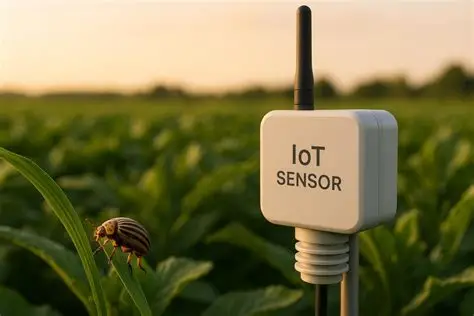
In irrigation, an IoT system can connect soil moisture sensors, weather stations, controllers, pressure sensors, flow meters and valves.
The communication method depends on the farm.
Possible technologies include cellular networks, Wi-Fi, LoRaWAN and other radio-based communication systems.
Large farms should not automatically choose a communication technology because it is popular. The farm’s terrain, distance between fields, cellular coverage, power availability and required data frequency should determine the choice.
A field controller may use a low-power wireless network to communicate with nearby sensors and valves, while a gateway sends information to a central platform.
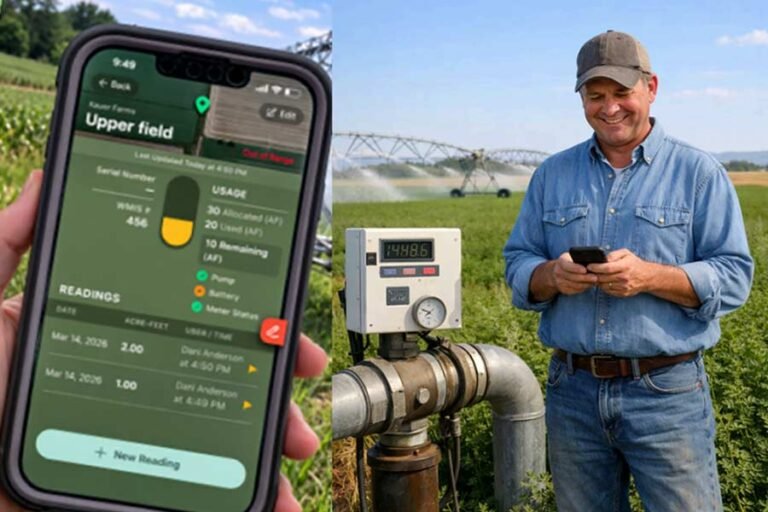
This means a farmer may be able to monitor irrigation activity from an office without physically visiting every field.
However, remote connectivity should not become a single point of failure. A well-designed system should have appropriate local control or fallback procedures so that irrigation does not completely stop simply because internet connectivity is temporarily unavailable.
Can Solar Power Run an Automated Irrigation System?
The answer depends on what is being powered.
Small field sensors and control boxes can operate on low-power systems, including battery and solar charging arrangements. Large irrigation pumps are a different matter because they require substantially more power.
A farm therefore needs to separate the energy requirements of the control system from those of the water-pumping system.
Solar power may be suitable for sensors, gateways and low-power controllers in locations where grid electricity is unavailable. Solar-powered pumping can also be used in suitable agricultural systems, but its design must account for water demand, pumping head, storage, solar resource, system size and operating schedule.
FAO identifies solar-powered irrigation as an option for energy-constrained agricultural areas, while also noting that irrigation modernization needs to be considered alongside water-management requirements.
Variable Rate Irrigation for Large Farms
Variable Rate Irrigation, or VRI, takes automation further by allowing different parts of a field to receive different irrigation rates.
This can be useful where the farm has persistent differences in soil texture, elevation, drainage or crop performance.
For example, a sandy area may require different irrigation management from a heavier soil area because the two soils hold and transmit water differently.
A VRI system can use management-zone maps to change application rates as the irrigation machine moves through the field.
However, a zone map alone does not tell the farmer how much water should be applied. Irrigation depth still needs to be based on crop demand, soil water-holding capacity, current moisture conditions and system capability.
This is why soil sensors, field observations and irrigation scheduling methods remain important even in highly automated systems.
What Does It Cost to Automate Irrigation on a Large Farm?
There is no single price for large-farm irrigation automation because the cost depends heavily on what is already installed.
Automating an existing drip system with several valves is very different from building a new centre-pivot irrigation network with remote monitoring, variable-rate control and extensive field sensors.
The main cost categories usually include the following:
| Cost area | What may be included |
|---|---|
| Irrigation infrastructure | Pumps, pipes, filtration, storage, emitters or sprinklers |
| Automation controller | Central controller, zone controllers and control panels |
| Valves | Automatic electric or hydraulic valves |
| Soil sensors | Moisture probes and associated installation |
| Weather monitoring | Weather station or external weather data |
| Flow monitoring | Flow meters and water-use monitoring |
| Pressure monitoring | Pressure sensors and gauges |
| Communication | Cellular, LoRaWAN, radio or other communication equipment |
| Power | Solar, batteries, electrical supply or backup power |
| Software | Monitoring, scheduling and farm-management platforms |
| Installation | Electrical, hydraulic, networking and sensor installation |
| Training | Staff training and system commissioning |
| Maintenance | Sensor replacement, valves, pumps, filters and other components |
| Technical support | Software, connectivity and equipment support |
There are published examples showing that individual soil moisture sensors can range from relatively inexpensive tensiometric devices to several hundred US dollars for more advanced sensor types, while data loggers can add substantially to the equipment cost. These figures are location and product dependent and should not be treated as a current installed-system price for Nigeria or another specific market.
For a large commercial farm, the correct financial calculation is therefore not simply “How much does a sensor cost?”
The more useful question is:
What will it cost to measure, control and maintain irrigation across the farm reliably?
Installation, communication, power, valves, controllers, pumps and technical support can become more significant than the sensors themselves.
How Much Can an Automated Irrigation System Save?
It is tempting to attach a guaranteed water-saving percentage to smart irrigation, but that would be misleading.
The outcome depends on what the farm is doing before automation.
A farm that already has excellent irrigation scheduling and a well-maintained system may have less room for improvement than a farm that irrigates according to a fixed timetable regardless of rainfall and soil conditions.
Research in different agricultural environments has demonstrated potential water-use improvements from sensor-based irrigation, including work in Sub-Saharan Africa using wireless soil moisture sensors for wheat irrigation. However, results from one crop, soil, irrigation method and climate should not be transferred directly to every farm.
The economic value can come from several areas:
- Avoiding unnecessary irrigation
- Reducing excessive pumping
- Reducing labour required for routine valve operation
- Detecting leaks sooner
- Reducing irrigation-related nutrient losses
- Improving consistency between irrigation zones
- Making better use of limited water supplies
- Reducing unnecessary field visits
- Improving records of irrigation events
The financial result should be calculated from the farm’s actual water, energy, labour and maintenance costs.
How to Automate Irrigation on a Large Farm Step by Step
Assess the existing irrigation system
Begin with the water source, pump, pipes, valves, irrigation method, pressure and flow.
Measure what the system is actually capable of delivering before purchasing automation equipment.
Divide the farm into irrigation zones
Group fields according to crop, soil, irrigation method, topography and water requirements.
A large farm should not necessarily be treated as one irrigation unit.
Understand the root zone
Determine where most active roots are located and how deep water needs to be monitored.
Sensor depth should relate to the crop and soil rather than being selected simply because it is convenient.
Establish irrigation thresholds
Determine how much soil water depletion the crop can tolerate before irrigation is required.
The threshold can vary according to crop, growth stage, soil and irrigation capacity. Extension guidance commonly uses management allowable depletion as part of irrigation scheduling rather than treating one universal moisture reading as suitable for every crop.
Install representative sensors
Install sensors in locations that represent the important management zones.
Avoid placing every sensor in the easiest location simply because it is near a road or control box.
Automate valves and pumps
Connect the irrigation zones to automatic valves and pump controls that can respond to the scheduling system.
Add flow and pressure monitoring
Use these measurements to confirm that irrigation is operating correctly.
Connect the system remotely
Where connectivity is reliable and useful, connect the controller to a dashboard or mobile system so managers can monitor the farm remotely.
Test before full deployment
Automate one or a few representative blocks first.
Check sensor readings, valve response, pressure, flow, communication reliability and irrigation timing.
Compare automated performance with previous management
Measure water use, energy use, labour time, irrigation uniformity, crop performance and system failures.
Only expand the system when the evidence shows that it is solving a real farm problem.
A Practical Example of Large-Farm Automation
Consider a hypothetical 200-hectare vegetable and maize farm divided into several irrigation blocks.
The farm currently has automatic pumps but workers manually open and close field valves. Irrigation is based largely on a fixed timetable.
The farm manager first maps the irrigation network and discovers that several blocks have different soil textures. Sensors are installed in representative areas, with different monitoring depths according to root-zone conditions.
The farm then connects automatic valves to zone controllers. Flow meters are installed on major irrigation lines, while pressure sensors monitor selected points.
The system does not immediately become completely autonomous.
During the first season, the farm manager compares sensor readings with field observations, weather conditions and crop performance. Irrigation thresholds are adjusted as more information becomes available.
The manager can then see when soil moisture is approaching the chosen trigger point, activate irrigation remotely where appropriate and receive an alert if a zone reports abnormal flow or pressure.
The important improvement in this example is not the smartphone application. It is the connection between field conditions, irrigation decisions and physical water delivery.
What Are the Benefits of Automated Irrigation?
The main advantage of automation is greater control over a complex irrigation operation.
For a large farm, this can reduce the amount of routine manual work required to operate valves and monitor distant fields.
Sensor-based scheduling can also make irrigation decisions more responsive to actual soil conditions than a fixed timetable.
Remote monitoring can help managers identify problems without physically travelling to every field.
Automation can also create better irrigation records. A farm can record when zones operated, how long they ran, how much water moved through the system and whether pressure remained within the expected range.
Better records are particularly valuable when irrigation decisions need to be reviewed against crop performance, energy costs or water availability.
There can also be environmental benefits where automation improves irrigation management. More precise scheduling can reduce unnecessary water application and the risk of excessive deep drainage or nutrient movement below the root zone. Extension guidance identifies water and energy conservation and reduced nutrient leaching as potential benefits of improved irrigation management.
These are potential benefits, not automatic outcomes.
What Are the Limitations of Irrigation Automation?
Automation does not eliminate the need for agricultural knowledge.
A sensor can report a moisture condition, but it does not automatically understand whether a crop is suffering from disease, poor root development, salinity, nutrient deficiency or another problem.
Likewise, an automated valve can open correctly while the crop still receives inadequate water because an emitter line is blocked or the irrigation system is poorly designed.
Other limitations include equipment failure, sensor drift, communication problems, power interruptions, software problems, damaged field equipment and the need for regular maintenance.
Large farms also face a scaling problem. More irrigation zones mean more valves, sensors, controllers and potential points of failure.
The system therefore needs a maintenance strategy.
Sensors should be checked against field conditions. Valves should be inspected. Filters should be cleaned. Pressure and flow should be monitored. Communication equipment should be tested. Backup procedures should be established.
Automation without maintenance can create a false sense of control.
Does Automated Irrigation Require Internet?
Not necessarily.
A farm can automate pumps and valves using local controllers without relying on continuous internet access.
However, internet or cellular connectivity becomes useful when the farm wants remote monitoring, cloud-based data storage, mobile alerts or remote control.
Some systems use local radio communication between field devices and a gateway, while the gateway uses cellular or another internet connection to communicate with the central platform.
For farms in areas with weak connectivity, the system should be designed so that basic irrigation control can continue locally when the internet is unavailable.
Connectivity should therefore be treated as part of system design, not an assumption.
Can Artificial Intelligence Control Farm Irrigation?
Artificial intelligence can be incorporated into irrigation decision systems, but it is not required for irrigation automation.
A conventional automated system can use defined soil moisture thresholds, crop information, weather data and irrigation schedules without machine learning.
More advanced systems may use algorithms to analyse historical and real-time data and improve irrigation recommendations.
Research into smart irrigation increasingly includes predictive algorithms and machine-learning approaches, but these systems still depend on good sensor data, appropriate agronomic assumptions and local validation.
For most commercial farms, it is more important to have reliable sensors, good hydraulic performance and sound irrigation scheduling than to add AI simply for the sake of using AI.
Is Automated Irrigation Suitable for Every Large Farm?
No.
Farm size alone does not justify automation.
A large farm with a poorly designed irrigation system, unreliable power and no technical support may struggle with a complex automation project.
Another large farm with a well-designed irrigation network, multiple production blocks, high labour requirements and significant water-management challenges may have a stronger case.
The technology is more likely to be useful when the farm has:
| Farm condition | Why it matters |
|---|---|
| Multiple irrigation zones | Automation reduces repeated manual operation |
| Long distances between fields | Remote monitoring reduces unnecessary travel |
| Different soil types | Sensors can support zone-specific management |
| High irrigation frequency | Automation reduces routine labour |
| Valuable crops | Consistent water management can be important |
| Limited water supply | Better scheduling becomes more valuable |
| Reliable technical support | Problems can be diagnosed and repaired faster |
| Existing irrigation infrastructure | Automation can sometimes be added without replacing the whole system |
A farm may not need sophisticated automation if irrigation is simple, uniform and already well managed.
Common Mistakes to Avoid
Automating a poorly designed irrigation system
Automation cannot correct fundamental hydraulic problems.
Installing too few or badly placed sensors
A sensor is only useful when its location represents the soil and crop conditions that the manager is trying to understand.
Using one moisture threshold for every crop
Different crops, soils and growth stages can have different water requirements.
Ignoring rainfall
A fixed automated schedule can continue irrigating after substantial rainfall unless the system accounts for rainfall or current soil moisture.
Ignoring flow and pressure
Knowing that a valve opened does not prove that the crop received the intended amount of water.
Depending completely on internet connectivity
A loss of connectivity should not necessarily bring the entire irrigation operation to a halt.
Buying technology without local support
A low-cost controller can become expensive if replacement parts, programming assistance or technical support are unavailable.
Expecting automation to replace irrigation management
Farm staff still need to interpret crop conditions, review system performance and respond to abnormal conditions.
What Should a Farmer Ask an Irrigation Automation Provider?
Before purchasing or installing an automated system, ask the provider to explain the complete system rather than showing only the sensor or mobile application.
Important questions include:
- What irrigation equipment can the system control?
- Can it operate the existing pumps and valves?
- How many irrigation zones can it manage?
- What types of soil moisture sensors are supported?
- How should sensors be installed and calibrated?
- Does the system require internet access?
- What happens when communication fails?
- What happens during a power outage?
- Can the system operate manually if automation fails?
- Can it monitor flow and pressure?
- Can it detect leaks or abnormal irrigation?
- What software or subscription fees apply?
- Where is farm data stored?
- Who owns the data?
- How often do sensors require maintenance or replacement?
- Are spare parts available locally?
- Who will install and commission the system?
- What training will farm staff receive?
- Can the system be expanded to additional fields?
- Can it integrate with the farm’s existing irrigation equipment?
- What happens if the controller fails during a critical irrigation period?
These questions can reveal the difference between a practical farm system and a technology package that looks impressive but is difficult to operate in real field conditions.
How to Start Automating a Large Farm Without Overspending
A phased approach is usually more practical than attempting to automate every field at once.
Start by identifying the irrigation problems that cost the farm the most.
If the major problem is labour, automatic valves and remote pump control may provide the first improvement.
If the main problem is irrigation timing, soil moisture sensors and better scheduling may be more important.
If water losses are the concern, flow monitoring, pressure monitoring and leak detection may deserve priority.
If the farm has substantial differences in soil and elevation, management-zone mapping and variable-rate irrigation may eventually become useful.
This approach keeps the investment connected to a measurable farm problem.
A pilot project can then be installed on representative fields. The farm can compare water use, energy use, labour requirements, irrigation performance and crop response before expanding the system.
Final Considerations
Automating irrigation on a large farm is not simply a matter of installing sensors and downloading a mobile application.
A reliable system begins with the farm’s water source and hydraulic infrastructure. From there, automation can connect pumps, valves, soil moisture sensors, weather information, flow meters, pressure sensors and control software.
The most useful systems turn field information into practical irrigation decisions while maintaining the ability for farm managers to intervene when conditions change.
For large commercial farms, the real value of automation is better control over a complex water-management operation. But that value depends on good irrigation design, correct sensor placement, reliable equipment, appropriate scheduling rules, maintenance and competent farm management.
The right question is therefore not whether a farm should buy smart irrigation technology.
The better question is: Which irrigation problem is costing the farm water, labour, energy or production performance, and can automation solve that specific problem at a reasonable total cost?
That is the starting point for a practical irrigation automation strategy.
Frequently Asked Questions
What is the easiest way to automate irrigation on a large farm?
The simplest starting point is usually automatic control of pumps and irrigation valves using a programmable controller. The system can later be connected to soil moisture sensors, weather information, flow meters and remote monitoring as the farm’s needs justify additional complexity.
Can soil moisture sensors automatically turn irrigation on and off?
Yes, sensor-based irrigation systems can be configured to use soil moisture readings as part of automatic control. However, the correct trigger depends on crop, soil, root depth, growth stage and irrigation-system capacity. A single moisture value should not be treated as universally suitable for every farm.
Does automated irrigation save water?
It can, particularly when it replaces poorly timed or excessive irrigation with scheduling based on soil moisture, crop water demand and weather conditions. The amount saved varies considerably according to the original irrigation practice, crop, soil, climate and system performance.
Does a large farm need IoT for irrigation automation?
No. Basic automation can operate locally without an internet connection. IoT becomes particularly useful when managers need remote monitoring, alerts, cloud-based records or remote control of distant irrigation zones.
How many soil moisture sensors does a large farm need?
There is no universal number. Sensor quantity depends on field size, soil variability, crop type, irrigation method, root depth and management zones. Representative locations are more important than simply installing a large number of sensors.
Can automated irrigation work with centre pivot systems?
Yes. Centre pivots can be equipped with automation and, where appropriate, variable-rate irrigation technology. Soil, elevation, crop and water-demand information can be used to support zone-based irrigation decisions.
Is automated irrigation expensive?
The cost varies widely. A system that adds automatic valves and a controller to an existing irrigation network can be very different from a new large-scale installation involving pumps, extensive sensors, communication infrastructure, flow monitoring and variable-rate control. Installation, maintenance and technical support should be included in the total cost.
Should a farmer automate the entire farm at once?
Not necessarily. A phased approach can reduce risk. Starting with a representative irrigation block allows the farm to test the sensors, controls, communication system and scheduling strategy before expanding to additional fields.