How Farmers Can Use Weather Apps to Make Better Farming Decisions
Weather is one of the most important factors influencing farming decisions.
A farmer may have good seed, fertilizer, machinery, irrigation equipment and labour, but weather conditions can still affect whether a field can be planted, whether fertilizer should be applied, whether spraying will be effective, how much irrigation is required and whether harvested crops can be safely dried.
This is why weather information has become an important part of modern farm management.
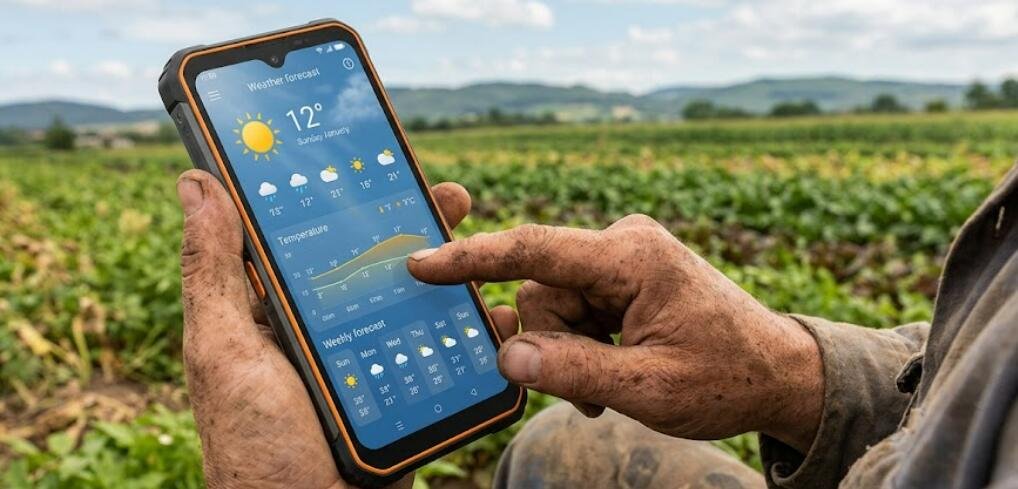
Farmers no longer have to depend entirely on observing the sky or relying on general weather reports. Weather apps can provide forecasts for rainfall, temperature, wind, humidity and other conditions directly on a smartphone.
However, having a weather app is not the same as knowing how to use weather information for farming.
The real value comes from connecting the forecast to a specific farm decision.
Instead of simply asking, “Will it rain today?”, a farmer can ask:
Should I plant tomorrow?
Should I spray today?
Do I need to irrigate this field?
Should I delay fertilizer application?
Can I harvest this crop safely?
Is there a risk of heavy rain or strong wind?
Weather apps can help farmers answer these questions, provided the forecast is relevant to the farm location and interpreted together with actual field conditions.
The World Meteorological Organization and FAO identify weather and climate information as useful for decisions involving sowing, harvesting, water management, fertilizer management and pest and disease control.
What Is a Weather App for Farming?
A weather app is a digital application that provides information about current and expected atmospheric conditions.
A general weather application may show:
- temperature
- rainfall probability
- rainfall amount
- humidity
- wind speed
- wind direction
- cloud cover
- thunderstorms
- weather warnings
- sunrise and sunset
- short-term forecasts
Agricultural weather services can go further by combining weather information with agricultural conditions.
Some systems may provide information related to:
- soil moisture
- crop water requirements
- growing degree days
- frost or heat risk
- drought
- rainfall accumulation
- disease risk
- irrigation requirements
- planting windows
- agricultural advisories
For farmers, the most useful system is not necessarily the one with the largest number of weather indicators.
It is the one that provides information relevant to the decisions being made on the farm.
Why Weather Information Matters to Farmers
Agriculture is highly exposed to weather variability.
Rainfall affects planting and crop establishment.
Temperature affects crop development.
Wind can interfere with spraying and cause physical damage to crops.
Humidity can influence disease conditions.
Rainfall can affect harvesting, drying and transportation.
Extreme weather can cause flooding, erosion, drought stress or other damage.
This means weather information can influence decisions throughout the production cycle.
FAO describes timely climate and weather information as important for decisions involving planting, input application, water management, pest and disease control and harvesting.
Weather Apps Can Help Farmers Decide When to Plant
Planting is one of the most important weather-sensitive decisions on a farm.
For rain-fed agriculture, farmers need enough soil moisture for seeds to germinate and establish successfully.
A farmer may therefore monitor:
- expected rainfall
- rainfall accumulation
- forecast duration
- temperature
- expected dry periods
- historical seasonal patterns
- local field conditions
The farmer should not treat a single rainfall forecast as an automatic signal to plant.
For example, a forecast for a small amount of rain followed by several days of dry conditions may produce a different planting decision from a forecast indicating sustained rainfall.
The actual decision also depends on the crop, soil type, planting method and existing soil moisture.
Weather information should therefore be treated as one input into the planting decision.
Using Seasonal Forecasts for Farm Planning
Short-term weather forecasts are useful for operational decisions.
Seasonal forecasts serve a different purpose.
They provide an outlook for broader weather patterns over a longer period.
Farmers can use seasonal information to consider:
- crop selection
- planting windows
- crop duration
- water planning
- drought preparedness
- drainage requirements
- seed variety selection
- input planning
- livestock management
In Nigeria, the Nigerian Meteorological Agency provides an annual Seasonal Climate Prediction containing information such as expected rainfall patterns, rainfall onset and cessation, temperature, dry spells and length of the growing season. NiMet also provides agricultural meteorological products intended to support farming decisions.
Seasonal forecasts should not be interpreted as precise day-by-day predictions.
Their value is in helping farmers prepare for possible seasonal conditions.
Weather Apps Can Help With Irrigation Decisions
Irrigation is another area where weather information can improve farm management.
If significant rainfall is expected, a farmer may decide to delay irrigation.
If hot and dry conditions are expected, the farmer may need to monitor soil moisture more closely.
A more advanced irrigation decision can combine:
Weather forecast + soil moisture + crop stage + irrigation system + soil type
For example, two fields may receive the same weather forecast but require different irrigation decisions because they have different soils or crops.
This is why farmers should avoid using rainfall probability alone to determine irrigation.
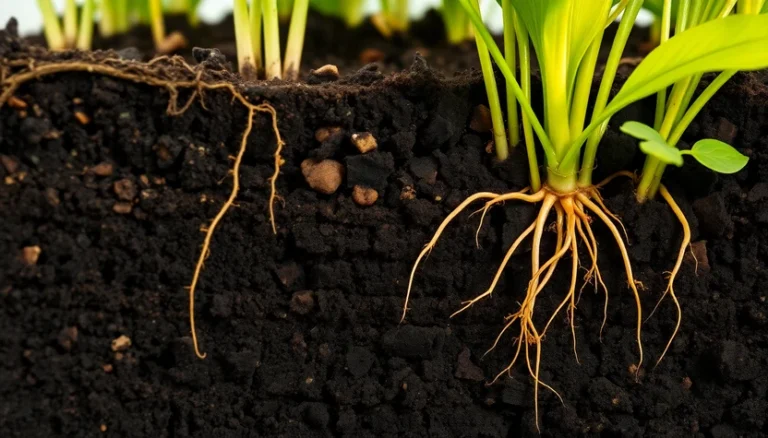
The amount of rainfall matters, but so does how much water actually reaches the root zone.
Using Weather Information Before Fertilizer Application
Weather can also influence fertilizer application.
Heavy rainfall shortly after certain fertilizer applications may increase the risk of nutrient movement or loss, depending on the fertilizer, soil, crop and application method.
Farmers can therefore check the forecast before scheduling fertilizer operations.
The goal is not simply to avoid every rainfall event.
Rainfall can be useful for moving nutrients into the soil.
The important consideration is whether the expected weather conditions are appropriate for the particular fertilizer and application method being used.
This is one reason agricultural weather advisory services can be more useful than a general weather forecast.
Weather Apps Can Help Farmers Plan Spraying
Spraying pesticides, herbicides, fungicides and foliar products can be affected by weather conditions.
Wind is particularly important because strong or unsuitable winds can increase spray drift.
Rain can also interfere with certain applications depending on the product and the time between application and rainfall.
Farmers can therefore check:
- wind speed
- wind direction
- rainfall probability
- expected rainfall timing
- temperature
- humidity
before spraying.
However, the product label and agronomic recommendations should remain the primary guide.
A weather app should support the decision, not replace pesticide instructions or professional advice.
Temperature Can Influence Farm Decisions
Temperature affects many agricultural processes.
Farmers may monitor temperature when making decisions about:
- crop establishment
- heat stress
- livestock management
- greenhouse ventilation
- irrigation
- seed storage
- harvested crop handling
- disease risk
Extremely high temperatures can increase crop water demand.
For livestock, hot conditions can increase heat stress risk and change water and ventilation requirements.
For protected agriculture, temperature information can help operators manage greenhouse conditions.
The important point is that temperature should be interpreted according to the crop, livestock species, growth stage and production system.
Humidity Can Help Farmers Monitor Disease Risk
Humidity is another useful weather indicator.
Certain fungal and plant disease conditions are associated with combinations of moisture, temperature, leaf wetness and other environmental factors.
A weather app can therefore provide useful background information for crop scouting.
However, humidity alone does not diagnose a disease.
A farmer should still inspect the crop for actual symptoms and consider:
- crop variety
- growth stage
- field history
- disease pressure
- rainfall
- temperature
- leaf wetness
- local agronomic advice
Some agricultural weather systems combine weather information with disease-risk models to provide more specific agricultural warnings.
Wind Information Is Important for Spraying and Farm Safety
Wind is often overlooked by farmers who focus mainly on rainfall.
Wind information can help with decisions involving:
- pesticide spraying
- fertilizer application
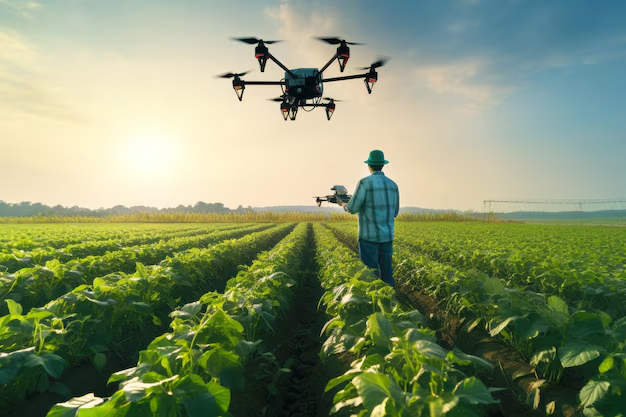
- drone operations
- irrigation
- greenhouse management
- harvesting
- machinery operation
- livestock protection
Strong winds can also increase the risk of crop lodging or damage to structures such as greenhouses and shade systems.
For spray operations, the farmer should always follow the product label and applicable regulations regarding weather conditions and application.
Weather Apps Can Help Farmers Prepare for Heavy Rain
Heavy rainfall can create several farm risks.
These can include:
- flooding
- soil erosion
- waterlogging
- nutrient movement
- road access problems
- crop damage
- harvesting delays
- machinery access problems
A farmer who monitors rainfall forecasts can prepare drainage channels, move equipment, postpone field operations or accelerate harvest activities where appropriate.
The decision depends on the crop and farm conditions.
A forecast should therefore trigger preparation rather than panic.
Using Weather Apps to Plan Harvesting
Harvesting at the wrong time can create quality and logistics problems.
Farmers may monitor weather conditions before harvesting to determine whether field conditions are likely to be suitable.
Weather information can help with:
- scheduling harvesting machinery
- arranging labour
- preparing transport
- planning drying
- protecting harvested produce
- reducing exposure to rain
- organising storage
For crops that require drying, a farmer may also need to consider several days of weather rather than only the weather on the planned harvest date.
A dry afternoon does not necessarily mean that conditions will remain suitable throughout the harvesting and drying process.
Weather Information Can Help With Post-Harvest Management
Weather decisions do not stop when the crop leaves the field.
Farmers handling grains, fruits, vegetables and other agricultural products may need to consider:
- rainfall
- humidity
- temperature
- ventilation
- drying conditions
- transportation conditions
For example, harvested grain may require appropriate drying before safe storage.
Weather information can help farmers plan natural or assisted drying, but moisture content should be measured using appropriate equipment rather than estimated solely from a weather app.
Weather Apps Can Help Reduce Unnecessary Farm Operations
Weather information can also help farmers avoid unnecessary work.
Suppose a farmer plans to irrigate a field in the morning but a substantial rainfall event is expected later in the day.
The farmer may decide to review the irrigation schedule instead of applying water immediately.
Similarly, if spraying is scheduled before a period of unsuitable weather, the operation may be rescheduled.
Reducing unnecessary operations can potentially save:
- fuel
- labour
- water
- machinery hours
- chemical inputs
The actual savings depend on the farm’s operations and how accurately weather information supports the decision.
Weather Apps Can Support Farm Labour Planning
Farm managers can use weather forecasts to plan labour-intensive activities.
Activities that may be affected include:
- planting
- weeding
- spraying
- fertilizer application
- harvesting
- sorting
- drying
- loading
- transportation
If heavy rain is expected, managers may need to adjust the work schedule.
For large commercial farms, integrating weather information into task scheduling can make this process more systematic.
For small farms, even a daily weather check can help with basic planning.
Weather Apps and Farm Management Software
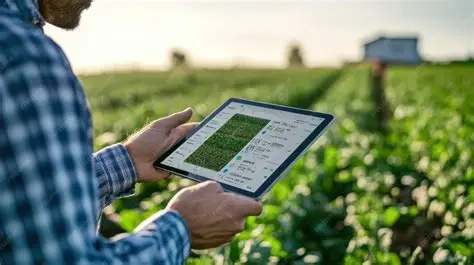
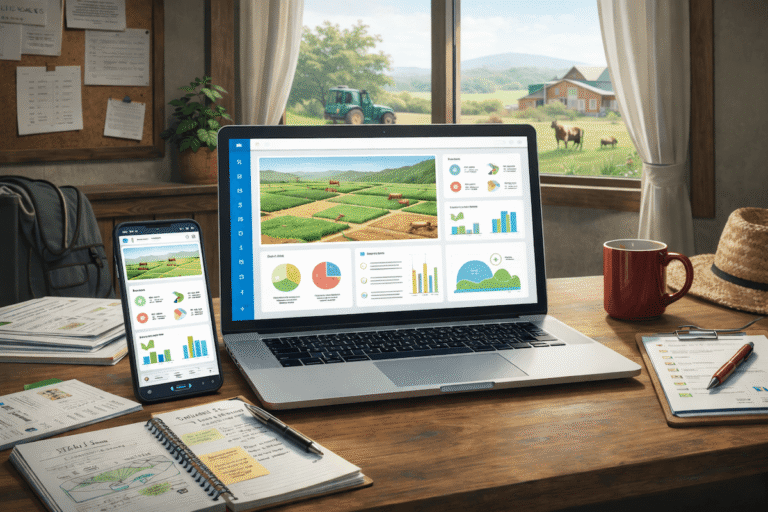
Weather information becomes more powerful when connected to farm management software.
A farm management platform can potentially combine:
Weather data
with:
Field records
Crop information
Farm activities
Irrigation
Input applications
Crop monitoring
This allows weather information to become part of the farm’s operational record.
For example, a farm manager could record that a fertilizer application was delayed because of forecast rainfall.
Later, the manager can compare the decision with actual weather and crop performance.
Over several seasons, this creates a more useful farm history.
Combining Weather Apps With Soil Sensors
Weather forecasts do not tell farmers exactly what is happening inside the soil.
This is why combining weather information with soil sensors can provide better information.
A soil moisture sensor may indicate that a field is already sufficiently wet.
The weather forecast may indicate another rainfall event is expected.
Together, the two pieces of information can provide a stronger basis for an irrigation decision than either one alone.
More advanced systems may combine:
- weather forecasts
- soil moisture sensors
- temperature sensors
- humidity sensors
- crop growth information
- satellite imagery
- irrigation systems
This is part of the broader development of precision agriculture and digital farm management.
Weather Apps Can Be Useful for Smallholder Farmers
Farm weather technology is not limited to large commercial farms.
Smallholder farmers can use basic weather applications to monitor:
- rainfall
- temperature
- thunderstorms
- wind
- short-term forecasts
- seasonal information
The technology does not have to be expensive.
A farmer with a smartphone can start with publicly available weather information.
The more important issue is whether the information is sufficiently local and useful for the farmer’s decision.
FAO has highlighted the importance of localized weather information for farm-level decisions, particularly for smallholder farmers.
Weather Apps Are Particularly Important for Rain-Fed Agriculture
Rain-fed farms are highly exposed to rainfall variability.
For these farms, farmers may need weather information to make decisions about:
- planting
- replanting
- fertilizer application
- weeding
- crop protection
- harvesting
- water conservation
Seasonal climate information can help with longer-term planning, while short-term forecasts can support daily operations.
The two types of information should not be confused.
A seasonal forecast may indicate the expected characteristics of a growing season.
A short-term forecast addresses conditions expected over the coming days.
Using Weather Apps in Nigerian Agriculture
Weather information is particularly relevant to Nigerian farmers because agricultural production occurs across very different ecological and climatic zones.
A farmer in northern Nigeria may face very different rainfall patterns from a farmer in the humid south.
Even within the same state, local conditions can vary.
This makes location-specific information important.
NiMet provides seasonal climate predictions, agricultural meteorological services and early-warning information for Nigerian users. Its agricultural products include information such as rainfall, temperature, soil moisture indicators and other weather-related information relevant to farming.
NiMet’s 2026 Seasonal Climate Prediction includes rainfall onset and cessation information, rainfall amounts, temperature, dry spells and growing-season information.
In April 2026, NiMet also announced a partnership with AIM for Scale focused on using AI-based weather forecasting and digital advisory systems to deliver more actionable weather information to farmers across Nigeria.
For Nigerian farmers, this means weather technology is increasingly moving beyond general forecasts toward agricultural decision support.
How Farmers Should Read Rainfall Probability
Rainfall probability is one of the most commonly misunderstood weather indicators.
If an app reports a 70 percent chance of rain, it should not automatically be interpreted as meaning that 70 percent of the farm will receive rain.
The exact meaning depends on the forecasting service and its methodology.
Farmers should therefore pay attention to other information, including:
- expected rainfall amount
- forecast timing
- duration
- location
- intensity
- storm warnings
For agricultural decisions, rainfall amount can often be more useful than probability alone.
For example, a high probability of very light rainfall may have a different agricultural significance from a moderate probability of a major rainfall event.
Don’t Rely on One Weather App
Different weather services can sometimes provide different forecasts.
This happens because forecasts are generated from different models, observations, data sources and processing methods.
Farmers should therefore avoid treating one application’s forecast as absolute certainty.
For important decisions, particularly those involving expensive inputs or major weather risks, farmers can compare:
- local meteorological agency information
- reputable weather services
- farm-level observations
- nearby weather stations
- agricultural advisories
- field conditions
In Nigeria, NiMet should be an important reference for official national weather and climate information.
Weather Forecasts Are Not Perfect
Weather forecasting has improved substantially, but forecasts still contain uncertainty.
Forecast accuracy generally depends on:
- forecast horizon
- location
- weather system
- available observations
- forecasting model
- local terrain
- atmospheric conditions
The further into the future a forecast looks, the more uncertainty generally needs to be considered.
This is why farmers should avoid making major decisions based on a single long-range forecast without monitoring for updates.
Weather Apps Should Be Combined With Field Observation
Digital information should complement practical farm observation.
A farmer should continue checking:
- soil moisture
- crop condition
- drainage
- pest and disease symptoms
- water levels
- field accessibility
- local rainfall
- wind conditions
The weather app may say there is no significant rainfall expected, while a local storm could still develop.
Similarly, a general regional forecast may not represent conditions at a particular field.
Field observation remains important.
Using Weather Apps for Different Farm Decisions
Different farm activities require different weather information.
| Farm decision | Weather information to monitor |
|---|---|
| Planting | Rainfall, soil moisture, temperature, growing-season outlook |
| Irrigation | Rainfall, temperature, evapotranspiration where available, soil moisture |
| Fertilizer | Rainfall timing and amount, soil condition |
| Spraying | Wind, rainfall, humidity, temperature |
| Harvesting | Rainfall, humidity, temperature and field conditions |
| Drying | Rainfall, humidity, temperature and expected dry periods |
| Livestock | Temperature, heat conditions, storms and rainfall |
| Greenhouse | Temperature, humidity, wind and solar conditions |
| Machinery work | Rainfall, field wetness and storm conditions |
| Farm safety | Severe weather warnings, wind, lightning and flooding |
The exact variables required depend on the crop and production system.
How Commercial Farms Can Use Weather Data More Systematically
Large farms can move beyond manually checking weather applications.
Weather data can potentially be incorporated into farm management workflows.
For example:
Weather forecast
โ
Field conditions
โ
Scheduled farm activity
โ
Weather suitability check
โ
Proceed, delay or reschedule
This can be applied to spraying, irrigation, fertilizer application, harvesting and other operations.
Farm managers can also keep records of weather conditions alongside farm activities.
Over time, this creates historical data that can be compared with:
- yields
- input use
- crop losses
- irrigation
- disease occurrence
- harvest timing
- production costs
This can help the farm understand how weather has affected its operations.
Using Weather Data With Artificial Intelligence
AI is increasingly being used in weather forecasting and agricultural decision-support systems.
The potential application is broader than simply displaying tomorrow’s temperature.
AI-based systems can process large amounts of information from:
- weather observations
- forecast models
- satellite imagery
- farm sensors
- soil data
- crop information
- historical farm records
The goal can be to turn raw weather information into more specific agricultural recommendations.
Nigeria’s meteorological agency announced in 2026 that it was working with AIM for Scale to strengthen AI-based weather forecasting and digital agricultural advisory services.
However, farmers should distinguish between an official weather forecast, an agricultural advisory generated from forecast data and an AI-generated recommendation.
These are not necessarily the same thing.
What to Look for in a Weather App for Farming
Farmers choosing a weather application should consider more than appearance.
Useful features may include:
| Feature | Why it matters |
|---|---|
| Local forecasts | More relevant to the farm location |
| Hourly forecasts | Useful for daily operations |
| Multi-day forecasts | Helps with planning |
| Rainfall amount | Helps assess expected water input |
| Rainfall probability | Indicates forecast likelihood |
| Wind speed | Important for spraying and safety |
| Wind direction | Useful for spray planning |
| Temperature | Supports crop and livestock decisions |
| Humidity | Useful for some disease and crop assessments |
| Severe-weather alerts | Supports risk management |
| Historical weather | Helps analyse past conditions |
| Agricultural advisories | Converts weather information into farm guidance |
| Offline or low-data access | Useful in areas with connectivity limitations |
| Local language support | Improves accessibility |
| Integration with farm software | Helps connect weather and farm operations |
Farmers should prioritise features that solve actual problems on their farms.
Common Mistakes When Using Weather Apps
One of the biggest mistakes is treating a forecast as certainty.
Another is using a forecast that is too general for the farm.
A regional forecast may not represent conditions at a specific field.
Farmers can also make the mistake of looking only at temperature while ignoring rainfall, wind and humidity.
Another problem is checking the weather only once per day.
Forecasts can change as new observations become available.
For important operations, farmers should check updated forecasts before carrying out the activity.
Farmers should also avoid allowing an app to replace agronomic judgement.
Weather is one part of farm decision-making, not the entire decision.
How to Build a Simple Weather-Based Farm Routine
Farmers do not need a sophisticated digital agriculture system to start using weather information effectively.
A simple routine can be:
Check the seasonal outlook
Before the production season, review available seasonal climate information.
Check the weekly forecast
Use it to plan major farm activities.
Check the daily forecast
Use it for time-sensitive operations.
Check severe-weather warnings
Pay particular attention to heavy rainfall, flooding, thunderstorms and strong winds.
Compare the forecast with field conditions
Check soil moisture, crop condition and accessibility.
Record important decisions
Note why an activity was delayed, advanced or cancelled.
Review the results
Compare the decision with what actually happened.
This creates a simple feedback loop that improves farm planning over time.
Why Farmers Should Record Weather Alongside Farm Activities
A farm that records weather conditions alongside production activities can learn from its own history.
For example, the farm could record:
Planting date: 15 June
Rainfall after planting: Recorded
Crop establishment: Good
Replanting: None
Over several seasons, these records may help the farmer understand how planting dates and rainfall patterns relate to crop establishment.
Similarly, a farm could record:
Spraying date
Wind conditions
Rainfall after application
Observed crop response
This creates valuable historical information for future farm planning.
Weather Apps and Precision Agriculture
Weather technology is an important component of precision agriculture.
Precision farming aims to manage agricultural resources according to differences within the farm rather than treating every hectare exactly the same.
Weather data can be combined with:
- GPS
- satellite imagery
- drones
- soil sensors
- yield monitors
- irrigation systems
- farm management software
For example, a commercial farm may identify one field with low soil moisture and another with adequate moisture.
Instead of irrigating both fields equally, the farm can use field-specific information to make a more targeted decision.
The technology becomes more useful as the farmer combines multiple data sources.
The Most Important Lesson About Weather Apps
A weather app should not be treated as a digital replacement for the farmer’s judgement.
Its purpose is to improve the information available before a decision is made.
The strongest approach is:
Forecast + field observation + crop knowledge + farm records + agronomic advice
This combination gives farmers more context than any single weather indicator.
Final Takeaway
Weather apps can help farmers make better decisions by providing timely information about rainfall, temperature, wind, humidity, storms and other weather conditions.
The information can support decisions about planting, irrigation, fertilizer application, spraying, harvesting, drying, livestock management and farm labour planning.
For Nigerian farmers, official meteorological services such as NiMet provide additional seasonal and agricultural weather information that can complement mobile weather applications. NiMet’s agricultural meteorology services specifically aim to support farmers with weather and climate information for planning and operational decisions.
But a weather forecast is not a guarantee of what will happen at a particular field.
Farmers should compare forecasts with actual field conditions, monitor updated information and follow crop-specific agronomic recommendations.
The greatest value of weather technology comes when weather information becomes part of a broader farm management system.
Instead of simply checking whether it will rain, farmers can use weather information to ask better management questions:
When should I plant?
When should I irrigate?
When should I spray?
When should I apply fertilizer?
When should I harvest?
How should I prepare for extreme weather?
That shift from simply observing weather to using weather information for farm decisions is where digital weather technology becomes a practical AgricTech tool.
Frequently Asked Questions
Can weather apps really help farmers make better decisions?
Yes. Weather information can support decisions involving planting, irrigation, spraying, fertilizer application, harvesting and other farm activities. Its usefulness depends on forecast quality, location accuracy and how well the information is combined with field conditions.
What weather information is most important for farmers?
Rainfall, rainfall amount, temperature, wind speed, wind direction and humidity are commonly useful. The most important variables depend on the crop, farm activity and production system.
Can farmers use weather apps to decide when to plant?
Weather forecasts can help farmers assess planting conditions, particularly rainfall expectations and temperature. Farmers should also consider soil moisture, crop requirements, local agronomic advice and seasonal climate information.
Can weather apps help with irrigation?
Yes. Farmers can use rainfall forecasts and temperature information to support irrigation planning. Where available, combining weather information with soil moisture measurements can provide a stronger basis for irrigation decisions.
Should farmers use weather apps before spraying pesticides?
Farmers should check relevant weather conditions before spraying. Wind, rainfall, temperature and humidity can affect application conditions. However, the pesticide label and applicable agricultural guidance should remain the primary reference.
How accurate are weather apps for farming?
Accuracy varies according to location, forecast period, weather conditions, data sources and forecasting models. Short-range forecasts are generally more relevant for immediate operations, while longer-range forecasts contain greater uncertainty.
Is a weather app enough for making farm decisions?
No. Weather information should be combined with field observation, crop knowledge, soil conditions, farm records and appropriate agronomic advice.
What weather service can Nigerian farmers use?
Nigerian farmers can consult the Nigerian Meteorological Agency, NiMet, which provides public weather services, seasonal climate predictions and agricultural meteorological information. Farmers can also use reputable weather applications as additional sources of short-term information.
Can weather information be connected to farm management software?
Yes. Some digital agriculture systems can combine weather information with field, crop, irrigation and operational records. This can help farm managers incorporate weather conditions into scheduling and production analysis.
Can smallholder farmers benefit from weather apps?
Yes. Smallholder farmers can use basic mobile weather information for planting, spraying, irrigation and harvesting decisions. Localised information and easy-to-understand advisories are particularly important for practical use.