How to Identify and Treat Maize Streak Virus
How to Identify and Treat Maize Streak Virus: A Farmer’s Guide to a Disease You Can’t Spray Away
I remember the first time I saw maize streak virus properly, though at the time I didn’t know that’s what I was looking at. A patch of young maize near the edge of my field had these narrow, broken stripes of pale yellow running along the leaves, parallel to the veins, almost like someone had taken a fine brush and flicked pale paint along the leaf in short strokes. I assumed it was some kind of nutrient problem and threw fertilizer at it for two weeks straight, watching it do absolutely nothing while the affected plants stayed stunted and the healthy ones around them kept growing normally. An extension officer finally walked my field with me and named it in about ten seconds, maize streak virus, and told me flatly that no fertilizer on earth was going to fix it. That was a humbling lesson, and it taught me that this particular disease needs to be understood completely differently from almost every other maize problem I deal with.
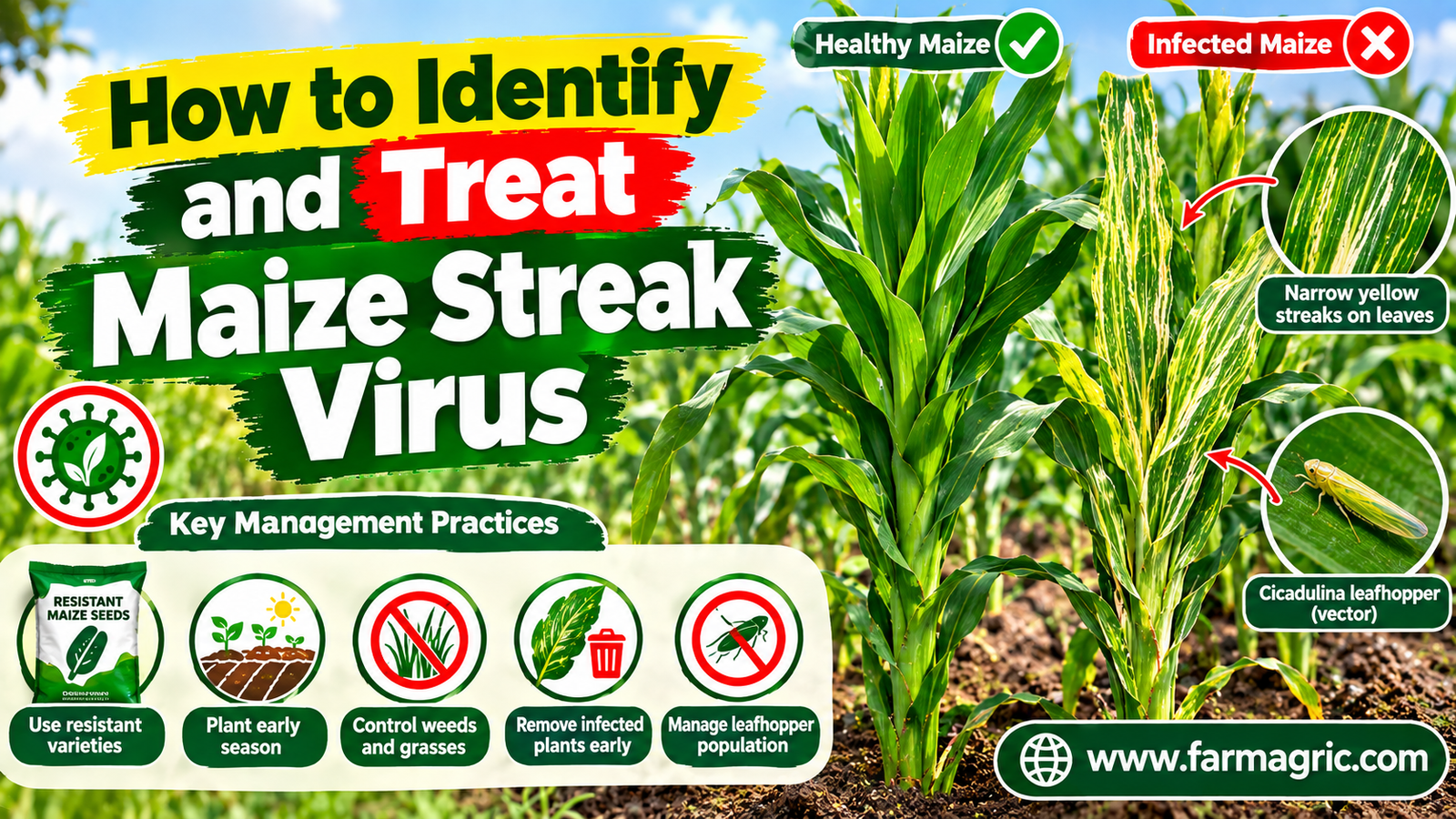
So let me answer you straight, because I know you’re looking at streaked leaves right now wondering what’s wrong and what you can spray to fix it. Maize streak virus is identified by narrow, broken, pale yellow to white streaks running parallel to the leaf veins, usually most visible on younger leaves, and there is no chemical cure or treatment once a plant is infected, the only real management is prevention through resistant varieties, early control of the leafhopper insects that spread it, and removing infected plants before the virus spreads further through the field. This is one of the few maize problems where the answer isn’t a fix you apply after the fact, it’s a set of decisions you make before infection happens, because once those streaks appear, that plant’s fate is largely already decided.
What Maize Streak Virus Actually Is
Maize streak virus is spread entirely by a small insect called the leafhopper, specifically a species that feeds on maize and several related grasses. The leafhopper doesn’t cause much direct damage feeding on the plant, the real damage comes from the virus it carries and transmits while feeding, moving from an infected plant or infected wild grass to a healthy maize plant. Once a plant is infected, the virus spreads systemically through it, and there is no way to remove it or cure it, the plant will carry the infection for its entire life. This is fundamentally different from a nutrient deficiency or even most fungal diseases, where correcting the underlying cause allows the plant to recover. With maize streak virus, prevention and early intervention before infection spreads are the only tools that actually work.
What Most Farmers Get Wrong
The first mistake, the one I made myself, is treating the symptoms as a nutrient deficiency and wasting time and fertilizer trying to fix something that fertilizer cannot touch. The narrow, broken streak pattern is genuinely distinctive once you know what to look for, but it’s easy to confuse with nutrient issues if you’ve never seen it before.
The second mistake is ignoring the leafhopper itself and focusing entirely on the visible plant symptoms. Since the virus is spread by this specific insect, controlling the insect population, especially early in the season, matters far more than anything you do to plants that are already showing streak symptoms.
The third mistake is planting susceptible varieties year after year in an area with a known history of the disease, simply because that’s the seed that’s always been available or affordable. Resistant and tolerant varieties exist specifically because breeders have worked on this problem for decades, and using them is by far the single most effective tool available.
The fourth mistake is leaving infected plants standing in the field, assuming there’s no harm in letting them finish out the season since they’re already infected anyway. Infected plants act as a continuing source of virus that leafhoppers can pick up and spread to still-healthy plants nearby, so removing them early actually protects the rest of the field.
The fifth mistake is ignoring the role of surrounding wild grasses and volunteer maize plants as a reservoir for both the leafhopper and the virus between seasons. A field that looks clean at planting can still face heavy pressure if the field margins are full of grasses harboring both the insect and the disease from the previous season.
Step-by-Step: How to Identify and Manage Maize Streak Virus
1. Learn to recognize the symptom pattern precisely. Look for narrow, broken streaks of pale yellow to almost white color running parallel to the leaf veins, usually starting on younger leaves near the base of the leaf blade and sometimes extending the full length of the leaf. Unlike nutrient deficiencies, the color change follows a streaky, broken pattern rather than a solid or gradient change, and it typically doesn’t follow the V-shaped pattern characteristic of nitrogen deficiency.
2. Check plant age and timing of symptom onset. Maize streak virus symptoms typically appear early, often within the first few weeks after emergence, since young plants infected soon after germination show the most severe stunting and streaking. Symptoms appearing very early in a plant’s life, combined with the streak pattern, strongly point toward this disease rather than a nutritional cause.
3. Assess how widespread the infection is across the field. Walk the field and note whether infected plants are scattered individually, clustered near field edges, or spread throughout uniformly. Infection concentrated near edges or near grassy borders often points to leafhoppers moving in from surrounding vegetation, which tells you something about where to focus control efforts.
4. Remove and destroy severely infected plants, especially early in the season. Pull out plants showing severe stunting and streaking as soon as you identify them, particularly if infection is caught early while only a small percentage of the field is affected. Removing these plants reduces the reservoir of virus available for leafhoppers to pick up and spread further.
5. Control the leafhopper population directly. Scout for leafhoppers, small, pale, wedge-shaped insects that jump readily when disturbed, particularly on young plants in the first few weeks after emergence. Where leafhopper numbers are high, an approved insecticide targeted at the insect itself, applied early in the season, can meaningfully reduce virus transmission even though it does nothing for plants already infected.
6. Manage field margins and surrounding grasses. Keep field edges and borders reasonably clear of dense wild grasses where possible, since these often serve as a reservoir for both the leafhopper and the virus between maize seasons. This doesn’t mean stripping all vegetation, since some border diversity helps with other pest management goals, but dense, unmanaged grass immediately bordering the field increases risk.
7. Choose resistant or tolerant varieties for future planting, especially in high-risk areas. If your area has a history of maize streak virus pressure, prioritize varieties bred with resistance or tolerance to this disease over standard varieties, even if the resistant seed costs somewhat more, since the yield protection it offers in a bad year far outweighs the price difference.
8. Adjust planting timing to avoid peak leafhopper activity where possible. Leafhopper populations often build up during certain periods tied to weather and the availability of alternative host grasses. Where local extension knowledge indicates a period of particularly high leafhopper activity, avoiding planting susceptible varieties right into that window reduces early infection risk.
9. Practice crop rotation and avoid continuous maize in high-pressure areas. Rotating with a non-host crop for at least one season can help reduce the local buildup of both the virus reservoir and the leafhopper population tied specifically to maize and related grasses.
Warning Signs to Watch For
Streaking that appears on the very youngest leaves first, especially within two to three weeks of emergence, is the earliest and most reliable warning sign, and catching it at this stage lets you remove infected plants before the disease has a chance to spread further. Severe stunting paired with streaking, where an infected plant is noticeably smaller than its healthy neighbors of the same age, indicates an early, severe infection that will significantly reduce or eliminate that plant’s yield potential. High numbers of small, jumping leafhoppers on young plants, even before any streaking is visible, is a warning that transmission risk is high and that insect control should happen immediately rather than waiting for symptoms to confirm the problem. And a pattern of infection concentrated near field edges bordering dense wild grass is a sign that the surrounding vegetation is acting as a disease reservoir that needs to be managed for future seasons.
What I’d Do Differently If Starting Again Today
If I were starting over, I’d learn to identify the streak pattern correctly from the very first season instead of wasting two weeks throwing fertilizer at a problem fertilizer could never fix. I’d prioritize resistant varieties from the start in my area, rather than only switching after losing a meaningful portion of a harvest to the disease, since I now know the yield protection is worth far more than the small extra cost of better seed. I’d scout specifically for leafhoppers in those first few weeks after emergence rather than only reacting once visible streaking appeared, since early insect control has a real chance of preventing infection that later action simply cannot undo. And I’d manage my field margins more deliberately from the beginning, understanding now how much those unmanaged grassy edges were quietly feeding both the insect and the virus between my seasons for years without my realizing it.
Frequently Asked Questions About Maize Streak Virus
Can maize streak virus be cured once a plant is infected?
No, there is no cure or treatment that removes the virus from an already infected plant, since it spreads systemically through the plant’s tissue permanently, which is why prevention and early removal of infected plants are the only effective management tools.
How is maize streak virus different from nitrogen deficiency in appearance?
Nitrogen deficiency typically shows a solid yellow color moving in a V shape from the leaf tip down the lower, older leaves, while maize streak virus shows narrow, broken streaks running parallel to the veins, usually appearing on younger leaves early in the plant’s life.
What insect spreads maize streak virus?
The disease is spread by a leafhopper species that feeds on maize and related wild grasses, picking up the virus from infected plants and transmitting it to healthy ones while feeding, making leafhopper control a key part of prevention.
Are there maize varieties resistant to streak virus?
Yes, plant breeders have developed varieties with meaningful resistance or tolerance to maize streak virus, and choosing these in areas with a known history of the disease is one of the most effective single steps a farmer can take to reduce yield loss.
Should I remove infected maize plants or leave them to finish the season?
Removing severely infected plants, especially early when only a small portion of the field is affected, is generally the better choice, since infected plants act as a continuing source of virus that leafhoppers can spread to still-healthy neighboring plants.
If there’s one thing I want you to remember from all this, it’s that maize streak virus is a disease you win against before it ever shows up, not after, so put your effort into resistant seed and early leafhopper control rather than searching for a spray that simply doesn’t exist for this one.