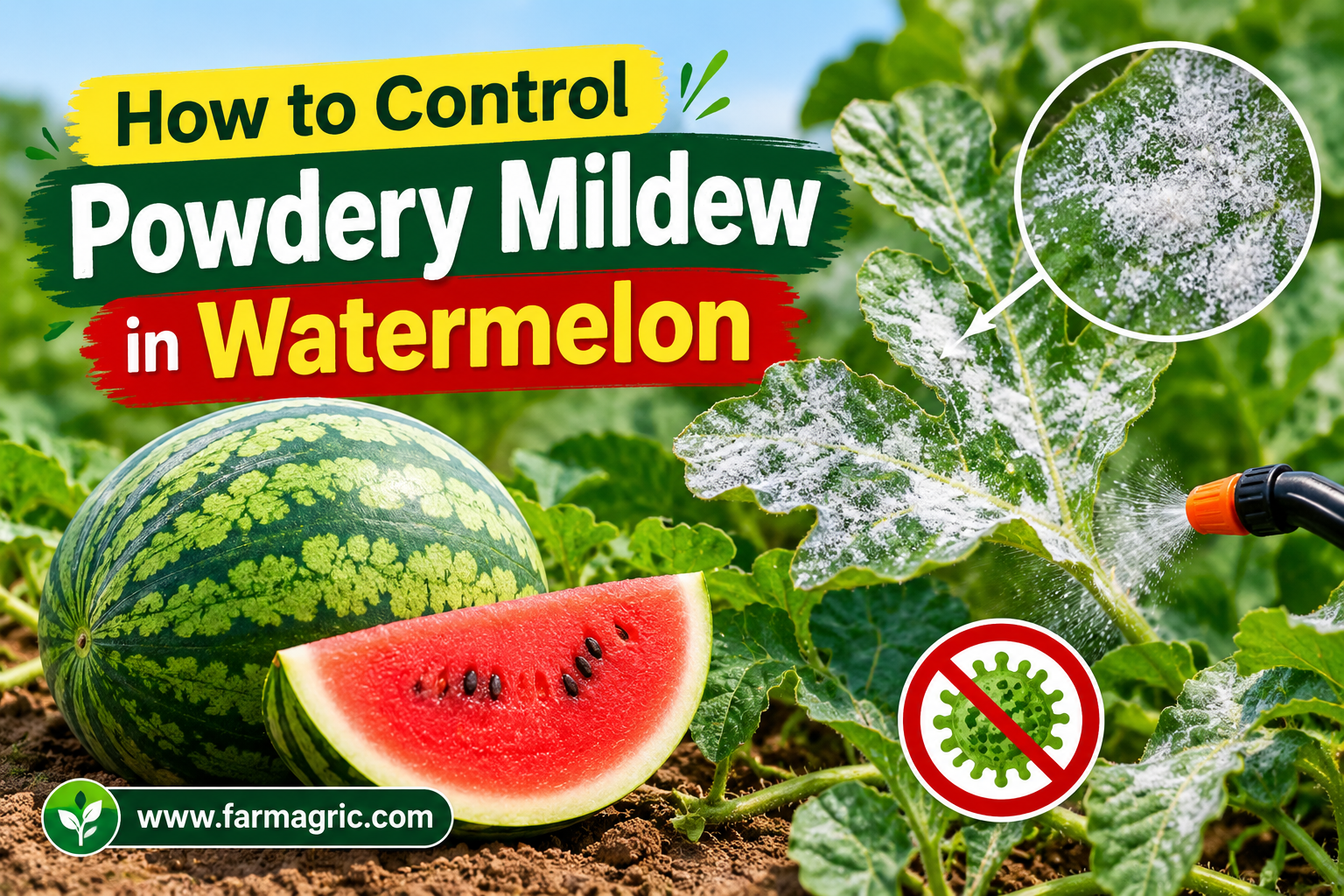
How to Control Powdery Mildew in Watermelon
How to Control Powdery Mildew in Watermelon: A Farmer’s Guide to Stopping the White Dust Before It Costs You the Crop
I remember walking my watermelon field one morning and noticing what looked like a light dusting of flour on a few of the older leaves near the center of the planting, faint enough that I nearly convinced myself it was just dust kicked up from a dry patch of soil nearby. Within two weeks that same faint dusting had spread across most of the canopy, leaves curling and yellowing beneath a thickening white coating, and the vines themselves had slowed down so much that the fruit still developing on them never reached the size or sweetness I expected from that planting. That season taught me that powdery mildew is deceptively easy to dismiss in its earliest stage precisely because it looks so harmless, almost cosmetic, right up until it has already weakened the whole plant’s ability to feed the fruit it is carrying.
So let me answer you straight, because I know you have spotted that same pale, powdery coating on your watermelon leaves and you are wondering whether it is serious enough to act on right now. You control powdery mildew in watermelon mainly by planting resistant varieties where available, maintaining good airflow through proper spacing and avoiding overly dense vine growth, applying a protective fungicide preventively once conditions favor the disease rather than waiting for heavy coverage to appear, removing and destroying severely infected leaves to reduce the spore load spreading through the planting, and avoiding excess nitrogen which produces the soft, lush growth this fungus favors most. Unlike many plant diseases that need standing water or prolonged leaf wetness to establish, powdery mildew is unusual in that it often thrives during warm, dry conditions with high humidity, which means a farmer waiting for rain to stop before worrying about disease pressure is often watching the exact weather pattern that lets this particular fungus take hold fastest.
Why Powdery Mildew Spreads So Easily Once It Establishes
Powdery mildew is caused by a fungus that, unlike most other fungal diseases, does not require free water on the leaf surface to germinate and infect, instead thriving in conditions of high humidity alongside moderate to warm temperatures, which allows it to spread readily even during stretches of otherwise dry weather that would slow down many other common crop diseases. The white, powdery coating farmers recognize is actually a dense layer of fungal spores sitting on the leaf surface, and because these spores are extremely lightweight and easily carried by wind, a small, seemingly minor patch of infection can spread across an entire planting within one to two weeks under favorable conditions, moving from leaf to leaf and plant to plant far more readily than diseases that depend on rain splash or direct contact to spread. The fungus feeds on the leaf surface rather than penetrating deeply into plant tissue immediately, which is part of why early infection looks so deceptively mild, but as coverage increases, it progressively reduces the leaf’s ability to photosynthesize effectively, directly starving the plant of the energy it needs to size and sweeten the fruit it is carrying.
What Most Farmers Get Wrong
The first mistake, the one behind my own underperforming harvest that season, is dismissing the earliest faint white patches as dust or a minor cosmetic issue rather than recognizing them immediately as the start of a disease that spreads considerably faster than its harmless initial appearance would suggest.
The second mistake is assuming that because the weather has been dry, disease pressure is low, not recognizing that powdery mildew specifically does not need the wet leaf conditions that many other fungal diseases depend on, and can in fact spread aggressively during exactly the warm, dry, humid stretches that make farmers feel they can relax their disease monitoring.
The third mistake is planting vines too densely, creating a crowded canopy with limited airflow that keeps humidity trapped around the leaves even during an otherwise unremarkable stretch of weather, providing favorable conditions for the fungus regardless of what the broader climate is doing.
The fourth mistake is applying heavy nitrogen fertilizer without considering how directly it affects disease susceptibility, since lush, soft, nitrogen-fed growth is consistently more vulnerable to powdery mildew infection than more moderately fed, somewhat tougher plant tissue.
The fifth mistake is waiting until infection has spread extensively across the planting before applying any fungicide, when preventive application timed ahead of or very early within a favorable disease period is considerably more effective than trying to knock back an infection that has already established itself across a large portion of the canopy.
Step-by-Step Plan to Control Powdery Mildew in Watermelon
Start by selecting a variety with known resistance or tolerance to powdery mildew wherever this is available for your region, since considerable breeding effort has gone into developing watermelon varieties that handle this particular disease noticeably better than standard susceptible types, and this single choice can reduce risk substantially before the season even begins.
Space vines and manage planting density to support good airflow through the canopy, avoiding excessively crowded plantings where leaves overlap heavily and trap humidity close to the leaf surface regardless of broader weather conditions, since this trapped, humid microclimate favors fungal establishment even during stretches when the surrounding air is otherwise relatively dry.
Scout the planting regularly, at least weekly, checking the undersides as well as the tops of leaves, particularly older leaves near the center of the plant where powdery mildew often establishes first, looking for small, faint white or grayish powdery patches before they have the chance to spread extensively across the canopy.
Apply a protective fungicide preventively once conditions favor the disease, generally warm days combined with high humidity, rather than waiting for visible infection to appear, since fungicides are considerably more effective at preventing new infection on healthy tissue than at controlling an infection that has already established itself across a significant portion of the plant.
Choose a fungicide appropriate for powdery mildew specifically, following label instructions precisely for rate and timing, and consider rotating between different fungicide modes of action across the season if multiple applications are needed, since repeated use of the same product can encourage resistant fungal populations to develop over time.
Remove and destroy severely infected leaves where infection is caught early and limited to a manageable number of leaves, taking this material completely out of the growing area rather than leaving it on the ground nearby, since infected leaves continue producing spores capable of infecting healthy tissue nearby for as long as they remain in the planting.
Moderate nitrogen application rather than feeding heavily, particularly once vines are well established and fruit has begun developing, since excess nitrogen produces the soft, lush growth that powdery mildew infects most readily, making a more balanced fertilizer approach genuinely useful as a disease management tool and not simply a nutritional consideration.
Water at the base of plants rather than through overhead sprinkling where practical, since while powdery mildew does not require free water to infect the way some other diseases do, maintaining generally drier leaf surfaces still supports overall plant health and avoids adding unnecessary additional humidity directly around the foliage.
Avoid working among plants during the most humid part of the day or when leaves are notably damp from dew, since moving through a planting under these conditions can physically spread spores from infected to healthy plants on hands, tools, and clothing more efficiently than the spores would otherwise spread through wind alone.
Monitor weather patterns through the season, increasing scouting frequency specifically during stretches of warm days and high humidity nights, since this combination is one of the more reliable predictors of rising powdery mildew risk regardless of whether rainfall has been heavy or light during that same period.
Rotate watermelon and related cucurbit plantings to different areas of your land across seasons where practical, since powdery mildew spores and other disease pressure specific to this crop family can persist in plant debris and nearby volunteer plants, and a season of a different, unrelated crop can help reduce this carryover pressure before watermelon is planted in that same location again.
Clear and destroy crop residue at the end of the season rather than leaving old vines to decompose in the field, since this residue can harbor fungal spores through to the following season, giving next year’s planting an unnecessary head start toward infection.
Warning Signs to Watch For
Small, faint white or light gray powdery patches appearing first on older leaves, often near the center or base of the plant, are the earliest sign of powdery mildew establishing, and catching this stage quickly, before the coating has thickened or spread to younger leaves, gives the best chance of limiting further spread through prompt action. Leaves that begin yellowing and curling beneath an increasingly thick white coating indicate the infection has progressed enough to be meaningfully reducing that leaf’s ability to photosynthesize, directly affecting the energy available to developing fruit. Rapid spread of the powdery coating across many leaves within just one to two weeks, particularly during a stretch of warm days and humid nights, signals that conditions have become highly favorable for the disease and that broader preventive action across the whole planting is warranted immediately rather than only treating the specific leaves already showing symptoms. A noticeable slowdown in vine growth and fruit development, even where the powdery coating itself does not look especially severe, can reflect the cumulative effect of reduced photosynthesis across a significant portion of the canopy. And fruit that stays smaller or less sweet than expected from a planting with confirmed powdery mildew pressure earlier in the season often reflects energy that the plant was unable to direct toward fruit development because so much of its leaf capacity was compromised during the critical growth period.
What I’d Do Differently If Starting Again Today
If I were starting over, I would treat the very first faint white patches as an immediate call to action rather than dismissing them as dust the way I did that disappointing season, since I now understand how quickly this particular disease moves once it has any kind of head start. I would prioritize resistant varieties wherever they were available for my region rather than planting whatever was most convenient or familiar, given how much that single decision can reduce risk before any other management choice even comes into play. I would manage vine density and spacing specifically with airflow in mind rather than letting vines sprawl into whatever pattern they naturally fell into, understanding now how much that trapped humidity around a crowded canopy was working against me regardless of the broader weather. And I would moderate my nitrogen application more deliberately once vines were established, recognizing now how directly that lush, heavily fed growth I used to associate with a healthy-looking planting was actually making my crop more vulnerable to exactly the disease that ended up costing me real yield that season.
Frequently Asked Questions About Powdery Mildew in Watermelon
Does powdery mildew need wet leaves or rain to spread in watermelon? No, unlike many fungal diseases, powdery mildew does not require free water on the leaf surface to establish and can spread readily during warm, dry conditions combined with high humidity, which is exactly why disease pressure can rise even during stretches of otherwise dry weather that might make a farmer feel less concerned about disease risk.
Can powdery mildew be cured once it has spread across a watermelon plant? There is no treatment that fully reverses existing infection on already affected leaf tissue, so management focuses on preventive fungicide application to protect healthy tissue, removing severely infected leaves to reduce ongoing spore production, and supporting overall plant vigor to help the plant continue producing despite some level of infection pressure.
Are there watermelon varieties resistant to powdery mildew? Yes, plant breeders have developed varieties with meaningful resistance or tolerance to powdery mildew, and choosing these where available for your region is one of the most effective single steps a grower can take to reduce risk substantially before the season even begins.
Does too much nitrogen fertilizer really make powdery mildew worse in watermelon? Yes, excess nitrogen produces soft, lush plant growth that this particular fungus infects more readily than more moderately fed, somewhat tougher tissue, making balanced fertilizer application a genuinely useful part of disease management rather than purely a nutritional consideration.
How quickly can powdery mildew spread through a watermelon planting? Under favorable warm, humid conditions, powdery mildew can spread from a small, isolated patch to cover a significant portion of a planting within one to two weeks, since its lightweight spores travel easily on wind, making early detection through regular scouting considerably more valuable than waiting to act until infection is already widespread.
If there is one thing I want you to remember from all this, it is that powdery mildew’s faint, dusty first appearance is not a minor cosmetic issue, it is an early warning you can still act on cheaply and effectively, so scout your older leaves closely, choose resistant seed where you can, and treat that first pale patch as seriously as you would treat it after it had already spread across half your field, because by the time it looks as obvious as flour dusted across your whole canopy, the fruit underneath has already been paying the price for weeks.