
How to Space Maize Plants for Maximum Yield
How to Space Maize Plants for Maximum Yield: A Farmer’s Guide to Getting Population Right
I used to plant maize the way my father did, three or four seeds dropped into each hole, close together, the thinking being that more seeds meant a better chance something would survive and you’d sort out the crowding later. I rarely actually got around to thinning properly, and for years I harvested cobs that were noticeably smaller than what my neighbor across the fence was pulling off his field, even though we planted the same seed on the same day most seasons. It took an embarrassingly long time for me to realize the problem wasn’t the seed or the soil, it was that I had two or three times too many plants competing for the same patch of ground, and every single one of them was paying the price for it. The season I finally disciplined myself to plant at proper spacing and stick to one healthy plant per station, my yield jumped noticeably, on the exact same land, with less seed used than before.
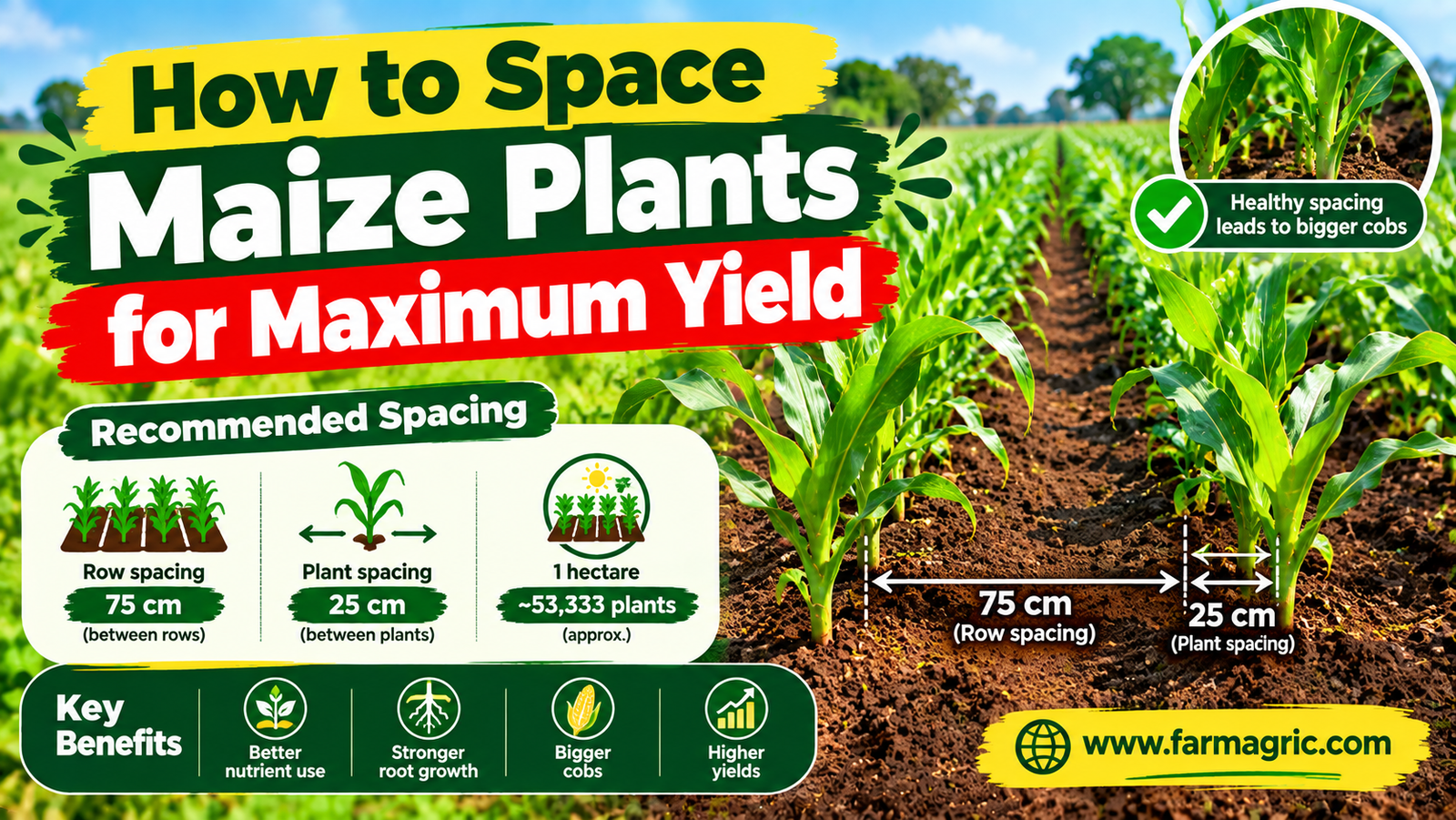
So let me answer you straight, because I know you’re trying to decide right now how close together to drop your seed. Maize should be spaced to achieve roughly 25,000 to 30,000 plants per acre for most hybrid and open-pollinated varieties, which generally works out to about seventy-five centimeters between rows and twenty-five to thirty centimeters between plants within the row, adjusted slightly based on your variety, soil fertility, and rainfall reliability. Spacing isn’t just about avoiding overcrowding, it’s about giving every single plant enough access to sunlight, water, and nutrients to develop a full, well-filled cob, and getting it wrong in either direction, too tight or too wide, costs you yield in different but equally real ways.
Why Spacing Affects Yield So Much
Every maize plant needs a certain amount of light, water, and root space to reach its full genetic potential. Plant too many in too small an area and every single plant suffers some degree of competition, resulting in smaller cobs across the board, sometimes even barren plants that produce no cob at all because they simply couldn’t access enough resources to support kernel development. Plant too few, too widely spaced, and you leave bare soil that could have been producing an additional cob, wasting land and often letting weeds take over the open ground instead. The goal is finding the density where the field as a whole produces the maximum total yield, which isn’t the same as maximizing any single plant’s individual size, it’s about optimizing the collective output of the whole area.
What Most Farmers Get Wrong
The first mistake, the one I made for years, is planting multiple seeds per hole out of fear of poor germination, then never following through with proper thinning. Farmers plant three or four seeds per station meaning to leave just one, then get busy with other work, and by the time they think about thinning the plants have already begun competing heavily, so even a late thinning doesn’t fully undo the damage of those first several weeks of crowding.
The second mistake is applying the same spacing to every variety and every soil type without adjustment. A vigorous hybrid on fertile, well-watered soil can support a higher population than a local open-pollinated variety on marginal, drought-prone land. Using one fixed spacing rule everywhere ignores real differences in what the specific variety and specific field can actually support.
The third mistake is spacing too tightly in the belief that more plants automatically means more yield. This feels intuitive, but maize yield per acre follows a curve, it increases with population up to a point, then plateaus, then actually declines as overcrowding causes barren plants, smaller cobs, and increased susceptibility to lodging and disease from poor airflow between crowded plants.
The fourth mistake is inconsistent spacing within the same row, planting by eye rather than measuring, resulting in some plants crowded close together and others left with unusually wide gaps. This unevenness means you get the downsides of both overcrowding and underutilized space in the same field, rather than the benefits of either.
The fifth mistake is ignoring row orientation and its effect on light interception, particularly on sloped land or in fields with a strong prevailing wind direction, both of which can be managed better with thoughtful row placement alongside correct spacing.
Step-by-Step Guide to Proper Maize Spacing
1. Determine your target plant population based on variety and conditions. For most hybrid varieties on reasonably fertile, well-watered soil, aim for 25,000 to 30,000 plants per acre. On more marginal or drought-prone land, or with local open-pollinated varieties, a somewhat lower population, closer to 20,000 to 25,000 plants per acre, often produces better results by reducing competition for limited moisture.
2. Calculate your row and plant spacing from your target population. A common effective layout is rows spaced seventy-five centimeters apart with plants spaced twenty-five to thirty centimeters apart within the row, which lands you in that 25,000 to 30,000 plant per acre range. Narrower row spacing, down to around sixty centimeters, paired with slightly wider in-row spacing, is another effective option some farmers use for better early canopy closure and weed suppression.
3. Plant one to two seeds per station, not three or four. If your seed has good germination quality, generally above ninety percent for certified seed, planting one seed per station and accepting the occasional gap is often more efficient than planting multiple seeds and relying on thinning, since thinning is labor that many farmers skip or delay in practice.
4. Measure spacing rather than planting by eye. Use a marked rope, a spacing stick cut to the right length, or a simple string with knots at the correct intervals to keep both row spacing and in-row spacing consistent across the whole field. This feels slow at first but pays off enormously in even, predictable plant development.
5. Thin promptly if you planted multiple seeds per station. If you did plant two seeds per hole as insurance against poor germination, thin down to the strongest single seedling within the first two to three weeks after emergence, before competition between the two seedlings has meaningfully affected either one’s development.
6. Adjust spacing slightly for soil fertility differences within the same field. In a field with a known fertile section and a known poorer section, it’s reasonable to plant slightly denser in the fertile area and slightly wider in the poorer area, rather than forcing one uniform spacing across soil that clearly varies in its capacity to support plants.
7. Consider row orientation relative to slope and prevailing wind. On sloped land, planting rows across the slope rather than straight down it helps reduce soil erosion and water runoff between plants. In areas with strong prevailing winds, row orientation can also influence lodging risk, worth considering alongside your spacing decisions.
8. Avoid the temptation to increase density purely for insurance against a poor season. Some farmers overplant expecting some plants to fail, but if germination is good and management is solid, overcrowding a good season to guard against a bad one usually costs more in reduced yield than it protects against.
Warning Signs Your Spacing Needs Adjustment
Thin, spindly stalks growing unusually tall and pale in search of light are a clear sign of overcrowding, since plants stretching competitively for sunlight put energy into height rather than into building a strong stalk and a well-developed cob. Small or barren cobs on otherwise healthy-looking plants, especially in the more crowded sections of a field, often trace directly back to competition during the critical pollination period rather than any fertility or disease problem. Noticeable bare soil with sparse, isolated plants signals underplanting, wasting land that could be producing yield and often inviting weed growth into the open space instead. And uneven plant height and development across a field planted the same day is frequently a sign of inconsistent spacing rather than soil variation, since evenly spaced plants with the same access to resources tend to develop far more uniformly.
What I’d Do Differently If Starting Again Today
If I were starting over, I’d measure my spacing with a marked rope from the very first season instead of planting by eye and feel the way I did for years, since the consistency alone would have improved my yields long before I understood the deeper reasoning behind proper population. I’d trust good quality certified seed enough to plant one seed per station rather than defaulting to multiple seeds out of old habit and fear, and I’d actually follow through on thinning promptly on the seasons I did plant extra as insurance, rather than letting it slide the way I often did. I’d also pay more attention to matching my population to my actual soil fertility and rainfall reliability instead of using one fixed spacing rule everywhere, since I now understand how much a slightly lower population on my more marginal plots would have reduced the drought stress I used to blame entirely on rainfall alone.
Frequently Asked Questions About Maize Spacing
What is the ideal spacing between maize plants for maximum yield?
Most hybrid and open-pollinated varieties perform best with rows spaced around seventy-five centimeters apart and plants spaced twenty-five to thirty centimeters apart within the row, producing a population of roughly 25,000 to 30,000 plants per acre, though this should be adjusted based on variety and growing conditions.
Is it better to plant maize too close together or too far apart if I have to choose?
Neither is ideal, but slight underplanting is generally the safer error, since it costs some yield potential from unused land, while overcrowding actively increases the risk of barren plants, smaller cobs, lodging, and disease pressure from poor airflow between plants.
Should I plant more than one seed per hole to guard against poor germination?
With good quality certified seed showing strong germination rates, planting one seed per station is usually more efficient, since it avoids the labor and frequent neglect of thinning, though planting two seeds with a firm commitment to prompt thinning is a reasonable approach with lower quality or older seed.
Does row spacing or in-row spacing matter more for yield?
Both matter, but the combination that determines final plant population matters most, since a field can reach the same optimal population through several different combinations of row spacing and in-row spacing, giving farmers some flexibility based on their equipment and preferred row width.
Can I use the same maize spacing on all my different plots?
Not ideally, since fields with different soil fertility, moisture reliability, and even different maize varieties can support different optimal populations, so adjusting spacing slightly for each specific plot’s conditions generally produces better results than one fixed spacing rule applied everywhere.
If there’s one thing I want you to remember from all this, it’s that every maize plant is sharing its patch of ground with its neighbors whether you planned it that way or not, so give each one enough room to actually finish what it started, and the field as a whole will reward you far more than a crowded row of stunted competitors ever could.