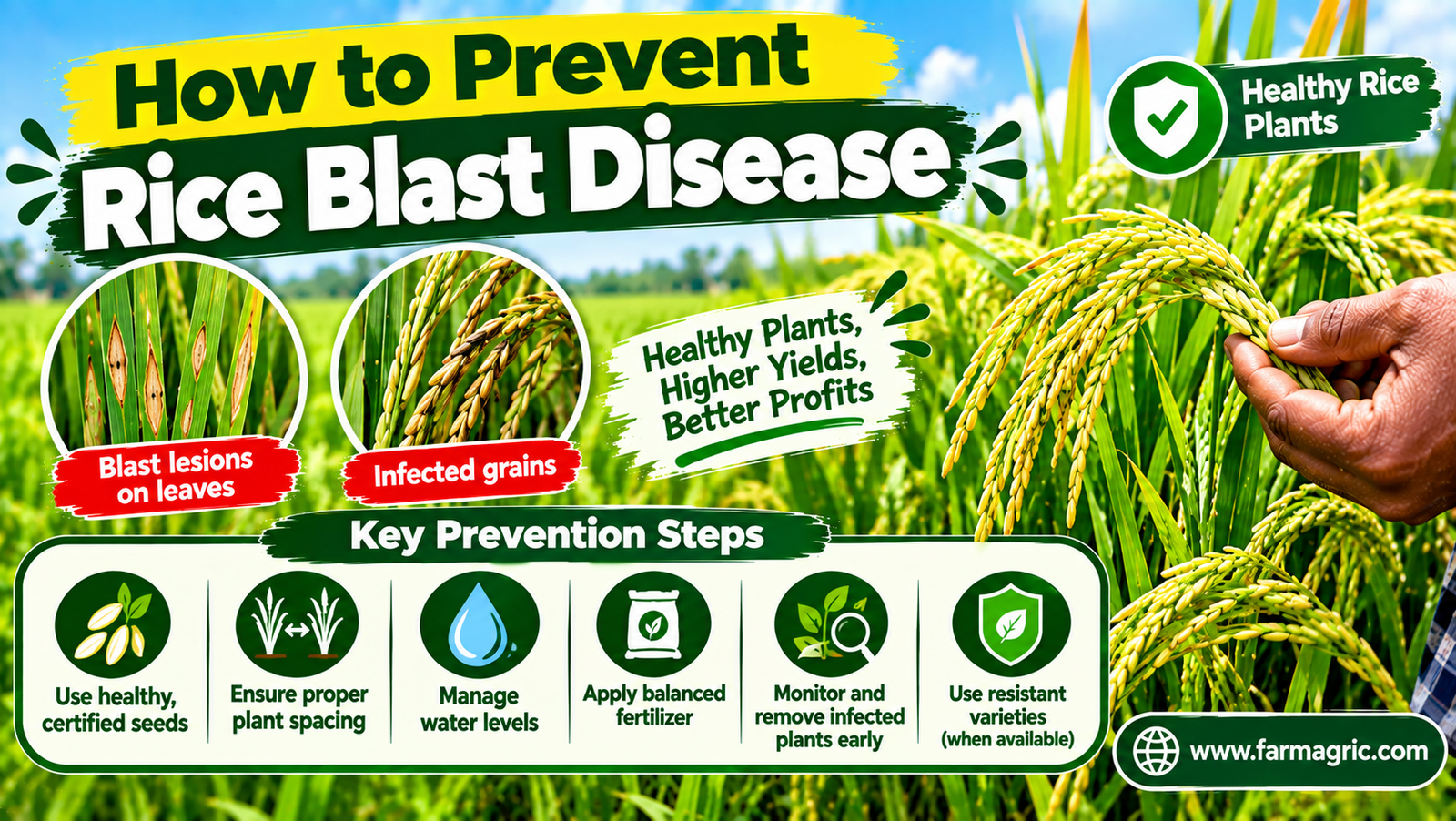
How to Prevent Rice Blast Disease
How to Prevent Rice Blast Disease
How to Prevent Rice Blast Disease: A Farmer’s Guide to Staying Ahead of the Most Destructive Rice Disease
I lost a section of paddy to blast so fast once that it genuinely scared me, and I’d been growing rice for close to a decade by that point, so it wasn’t inexperience that caught me off guard, it was the sheer speed of it. One week I noticed a handful of small, spindle-shaped lesions on a few leaves near a shaded, densely planted corner of the field. Ten days later, those lesions had spread across most of that section, and some of the panicles coming up in that area were already showing the neck rot that meant those particular heads would never fill properly no matter what I did at that point. Blast doesn’t give you the slow, forgiving timeline that a lot of other rice problems do. It moves fast under the right conditions, and by the time it’s obvious, you’re usually managing damage rather than preventing it. That season rebuilt my entire approach to this disease from the ground up, because I learned the hard way that blast has to be prevented, not reacted to.
So let me answer you straight, because I know you’ve either seen those telltale lesions already or you’re trying to make sure you never do. You prevent rice blast disease by planting resistant varieties where available, avoiding excessive nitrogen application which creates the dense, soft, susceptible growth blast favors, maintaining consistent water management since blast is worse under water stress, spacing plants to allow airflow that reduces the humid microclimate the fungus needs, and applying a protective fungicide preventively in high-risk conditions rather than waiting for symptoms to appear. Blast is a fungal disease that thrives on specific conditions you have real control over, dense wet canopies, excess nitrogen, and moisture stress, which means prevention through management is far more effective and far cheaper than trying to stop an active outbreak once it’s already spreading through your field.
Understanding What Makes Blast So Dangerous
Rice blast is caused by a fungus that can infect the plant at almost any growth stage and in several different parts of the plant, leaves, nodes, neck, and even the panicle itself, with each infection site causing a different kind of damage. Leaf blast shows up as distinctive spindle or diamond-shaped lesions with a grey or white center and a darker brown border, and while leaf blast alone can reduce photosynthesis and weaken the plant, the far more devastating form is neck blast, where the fungus infects the stem just below the panicle, cutting off the flow of nutrients and water to the developing grain entirely. A panicle infected with neck blast at the wrong stage can end up almost completely empty, since the grain simply never receives what it needs to fill, regardless of how healthy the rest of the plant looks. Understanding that blast can strike multiple points on the same plant, with wildly different consequences depending on where it hits, is central to understanding why prevention matters so much more than treatment after the fact.
What Most Farmers Get Wrong
The first mistake, the one that caught me off guard in that badly affected corner, is not recognizing how much shade and poor airflow contribute to blast risk. That section of my field sat near a treeline that blocked morning sun and slowed air movement, creating exactly the humid, slow-drying microclimate blast fungus thrives in, and I hadn’t connected that environmental detail to my disease risk until after the damage was done.
The second mistake is applying nitrogen heavily and all at once, assuming more nitrogen simply means a bigger, better crop. Excess nitrogen produces lush, soft, densely growing tissue that is significantly more susceptible to blast infection than a plant grown with properly timed, moderate nitrogen application, since the fungus infects that soft tissue far more easily than it does more moderately grown, sturdier plant material.
The third mistake is waiting for visible lesions before taking any action at all, when by that point the fungus has already established itself and started producing spores capable of spreading further through the field on wind and water splash. Preventive fungicide application timed to high-risk conditions works far better than reactive treatment applied only after symptoms confirm an active infection.
The fourth mistake is ignoring water stress as a contributing risk factor, assuming blast is purely a wet-weather, high-humidity disease. In reality, rice under moisture stress from inconsistent flooding is also more vulnerable to blast infection, since stressed plants generally have reduced natural resistance compared to consistently, properly watered plants.
The fifth mistake is planting the same susceptible variety season after season in a field with a known history of blast pressure, simply because that variety has always been used or is what’s locally available, without seeking out resistant alternatives that could meaningfully reduce risk from the very start of the season.
Step-by-Step Plan to Prevent Rice Blast Disease
1. Choose resistant or tolerant varieties wherever available, especially in high-risk areas. If your area or your specific field has a known history of blast pressure, prioritizing a resistant variety is by far the single most effective preventive step available, often reducing risk far more than any combination of management practices applied to a highly susceptible variety.
2. Avoid excessive nitrogen, and split what you do apply carefully. Apply nitrogen in properly timed splits matched to growth stage rather than large single doses, and avoid pushing nitrogen rates higher than your variety and soil conditions genuinely need, since lush, over-fertilized growth is measurably more susceptible to blast infection.
3. Manage plant spacing for adequate airflow. Avoid excessively dense transplanting, since tightly spaced plants create a humid, slow-drying microclimate within the canopy that favors fungal spore germination and infection, particularly in already humid or poorly ventilated field locations.
4. Address shaded or poorly ventilated sections of the field specifically. If part of your field sits near trees, structures, or anything else that blocks airflow or extends the period leaves stay wet with dew or humidity, recognize that section as higher risk and consider it a priority area for closer monitoring and potentially more conservative nitrogen application.
5. Maintain consistent water management rather than allowing moisture stress. Keep flooding depth consistent through the season according to your variety’s needs, avoiding unintentional dry periods that stress the plant and reduce its natural resistance to blast and other diseases alike.
6. Scout regularly, especially during weather conditions known to favor blast. Extended periods of high humidity, cool nights combined with warm days, and prolonged leaf wetness from dew or light persistent rain all favor blast development, so increase scouting frequency specifically during these weather patterns rather than maintaining the same checking schedule regardless of conditions.
7. Apply a preventive fungicide in high-risk situations before symptoms appear. In fields with a known history of blast, during a season with weather conditions favoring the disease, or when growing a variety with limited resistance, a preventive fungicide application timed ahead of the highest-risk period, often around the boot to heading stage when neck blast risk is highest, can prevent an outbreak that reactive treatment would struggle to control once established.
8. Treat leaf blast promptly if it appears, to reduce the risk of neck blast later. If leaf lesions are found early, prompt fungicide treatment at that stage can reduce the overall fungal population in the field, lowering the risk that the more damaging neck blast phase develops later as the crop moves toward heading.
9. Remove and manage infected plant residue after harvest. The blast fungus can survive on infected crop residue between seasons, so clearing or properly managing straw and stubble from a heavily affected field, rather than leaving it to potentially harbor the fungus into the next planting, helps reduce carryover risk for the following season.
10. Rotate varieties or fields where blast pressure has been historically severe. Continuous planting of the same susceptible variety in the same field allows blast populations adapted to that specific variety’s weaknesses to persist and build, so rotating varieties, or occasionally resting a severely affected field from rice entirely, can help break that cycle.
Warning Signs to Watch For
Small, spindle or diamond-shaped lesions with a grey or whitish center and a darker brown or reddish border appearing on leaves are the earliest visible sign of leaf blast, and catching this stage allows intervention before the disease has a chance to progress toward the far more damaging neck blast phase. A blackened, constricted section on the stem just below the panicle, sometimes causing the whole panicle to break over or turn prematurely white and empty, indicates neck blast has already set in, and unfortunately by this stage the affected panicle’s yield potential is largely already lost. Rapid spread of lesions across a section of the field within just a week or so, particularly following a period of high humidity or extended leaf wetness, signals conditions are highly favorable for the disease and that broader preventive action across the rest of the field is warranted immediately. And unusually lush, dark green, dense growth in sections of the field that received heavier nitrogen application is worth watching more closely than the rest of the crop, since that tissue is specifically more vulnerable to infection than moderately grown plants nearby.
What I’d Do Differently If Starting Again Today
If I were starting over, I’d assess my field’s specific microclimate risks, shade, airflow, low spots that hold humidity longer, from the very first season instead of only recognizing that badly affected corner’s risk factors after the damage had already happened. I’d split and moderate my nitrogen application far more carefully from the beginning, understanding now how directly excess nitrogen and blast susceptibility are connected, rather than pushing rates higher in the belief that more fertilizer simply meant a better crop. I’d also seek out resistant variety options actively rather than defaulting to whatever seed was most locally convenient, since I now know how much that single decision can reduce overall risk before the season even begins. And I’d scout specifically harder during exactly the humid, cool-night weather patterns that favor blast, rather than maintaining the same casual checking schedule regardless of conditions, since I now understand how quickly this particular disease can move once it establishes a foothold.
Frequently Asked Questions About Rice Blast Disease
What conditions cause rice blast disease to spread quickly?
High humidity, extended periods of leaf wetness from dew or light rain, cool nights combined with warm days, dense plant spacing that restricts airflow, and excessive nitrogen application all favor rapid blast development and spread, making these conditions worth monitoring closely during the growing season.
Is neck blast worse than leaf blast in rice?
Yes, neck blast is generally far more damaging since it infects the stem just below the panicle, cutting off nutrient and water flow to the developing grain, often resulting in a largely empty panicle, while leaf blast alone typically causes less severe yield impact if managed promptly.
Can too much nitrogen really increase blast risk in rice?
Yes, excess nitrogen produces lush, soft, densely growing plant tissue that is measurably more susceptible to fungal infection than plants grown with properly timed, moderate nitrogen application, making nitrogen management one of the most effective and lowest-cost blast prevention tools available.
Are there rice varieties resistant to blast disease?
Yes, plant breeders have developed varieties with meaningful resistance or tolerance to blast, and choosing these in fields or regions with a known history of the disease is one of the single most effective preventive steps a farmer can take.
Should I apply fungicide for blast even if I don’t see any symptoms yet?
In high-risk situations, a field with a known blast history, weather conditions favoring the disease, or a variety with limited resistance, a preventive fungicide application timed ahead of the highest-risk period is often more effective than waiting for symptoms, since blast can spread rapidly once established and become much harder to control reactively.
If there’s one thing I want you to remember from all this, it’s that blast rewards the farmer who manages the conditions it needs, moisture, density, and excess nitrogen, long before the first lesion ever appears, because once you’re looking at spindle-shaped spots on the leaves, you’re already playing catch-up against a disease that moves faster than almost anything else you’ll deal with in a rice paddy.