How Farmers Can Monitor Farm Water Usage With Technology?
Many farmers know how long a pump operated or how often a field was irrigated, but they may not know exactly how much water was delivered, how much reached each field, or whether the crop actually needed all of it.
That creates a difficult management problem. A pump can run for the same number of hours on two different days while delivering different volumes because flow changes with pressure, pump condition, water level, filters, valves or other parts of the irrigation system. Two fields can also receive the same irrigation duration but respond differently because their soils, crops, drainage and weather conditions are different.
Technology gives farmers several ways to make this information more visible. Flow meters can measure water delivered through pipes, soil moisture sensors can show conditions within the root zone, weather stations can help estimate crop water demand, pressure sensors can reveal irrigation-system problems, and satellite or remote-sensing systems can provide information about water use across larger areas.
The important point is that these technologies measure different parts of the water-management system. A flow meter answers a different question from a soil moisture sensor, while satellite data provides a different type of information from either one.
For effective farm water management, farmers need to understand what each technology measures, how the information can be combined, what infrastructure is required, and whether the resulting information is valuable enough to justify the cost.
What Does Farm Water Monitoring Mean?
Farm water monitoring means measuring or estimating where water comes from, how much is used or delivered, where it goes, and how it interacts with the soil and crop.
In an irrigated farm, there can be several points where water should be monitored. A farmer may want to know how much water is withdrawn from a borehole, how much leaves the pump, how much reaches an irrigation block, and what happens to the water after application.
These are not necessarily the same quantity.
Water can be lost or redistributed through leaks, evaporation, runoff, deep percolation and other processes. Some water is stored temporarily in the soil and later becomes available to plants. Crop transpiration and soil evaporation contribute to evapotranspiration.
FAO’s irrigation guidance emphasizes that measuring irrigation water helps farmers understand how much water is applied during irrigation and supports more efficient distribution and application.
This is why simply recording pump operating hours is often not enough.
Why Should Farmers Monitor Water Usage?
Water is both a production input and a resource that can carry significant operating costs.
For farms using pumps, excessive irrigation can also mean additional fuel or electricity consumption. Applying more water than the crop and soil can effectively use may contribute to runoff, deep percolation or nutrient movement below the root zone.
On the other hand, under-irrigation can reduce crop growth, particularly when rainfall is insufficient and the crop enters a period of high water demand.
Monitoring provides evidence for finding the balance.
It can also help a farm manager identify problems that are difficult to see from visual crop inspection alone. For example, a reduction in flow combined with an unexpected pressure change could justify checking a filter, pump, valve or irrigation line.
The objective is not simply to use less water. The objective is to apply and manage water according to crop requirements, soil conditions, irrigation-system performance and the farm’s production objectives.
What Technologies Can Farmers Use to Monitor Water Usage?
There is no single technology that measures everything a farmer needs to know.
| Technology | What it measures or estimates | Main agricultural use | Important limitation |
|---|---|---|---|
| Flow meter | Flow rate and cumulative water volume | Measuring water delivered through pipes | Requires correct sizing, installation and maintenance |
| Water meter | Volume passing through a measurement point | Water accounting and irrigation records | Does not explain crop water demand |
| Pressure sensor | Pressure within an irrigation system | Detecting abnormal operating conditions | Pressure does not directly measure water volume |
| Soil moisture sensor | Soil water status at selected locations and depths | Irrigation scheduling | Represents monitored points rather than the entire field |
| Weather station | Rainfall, temperature, humidity, wind and radiation, depending on equipment | Estimating crop water demand and irrigation scheduling | Does not directly measure irrigation water applied |
| ET or water-balance tools | Crop water demand or soil-water changes | Irrigation scheduling | Results depend on data and assumptions |
| Satellite remote sensing | Spatial indicators including evapotranspiration and vegetation conditions | Large-area water-use assessment | Often estimates water use rather than directly measuring irrigation volume |
| IoT gateway and dashboard | Connects and organizes sensor information | Remote monitoring and alerts | Requires power, communications and system maintenance |
The most useful setup depends on the question the farmer is trying to answer.
A commercial irrigated farm may need several of these technologies working together, while a small farm may only need a flow meter and a simple soil moisture monitoring method.
How Flow Meters Measure Farm Water Use
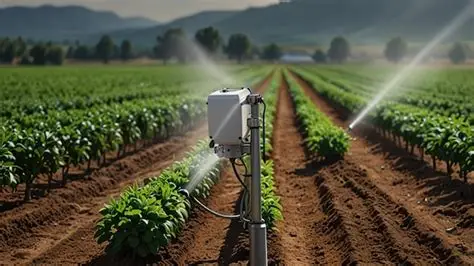
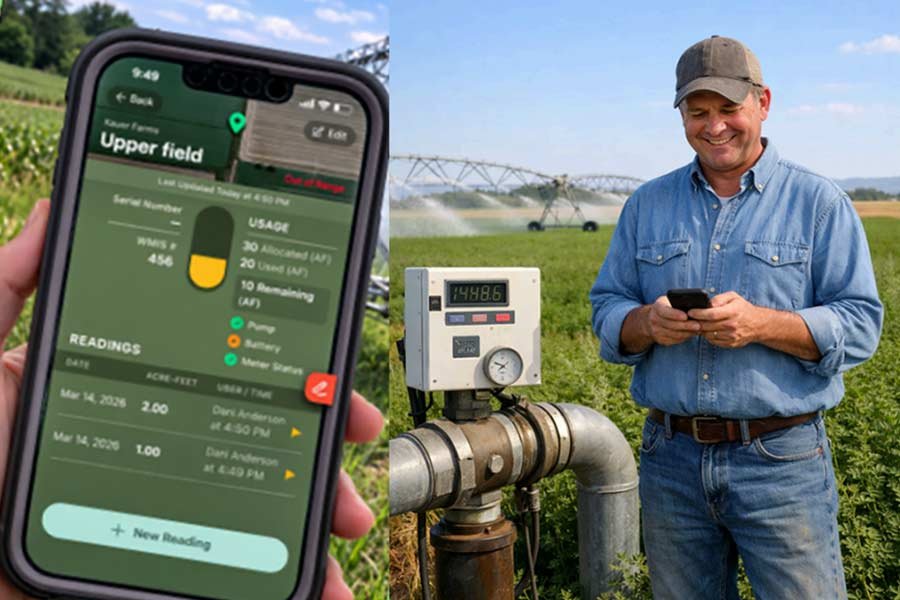
For many irrigated farms, a flow meter is the most direct starting point for measuring water applied through a pressurized irrigation system.
A flow meter measures the movement of water through a pipe. Depending on the equipment, it can provide an instantaneous flow rate, cumulative volume, or both.
This changes the farmer’s records from:
“Pump operated for five hours”
to:
“Approximately this volume of water passed through the monitored point during the irrigation event.”
That is a much more useful measurement for water accounting.
The University of Minnesota Extension notes that an irrigation flow meter can provide total volume pumped and instantaneous flow rate, and that monitoring flow can also reveal changes in well output that may indicate pump problems.
Water Meter vs Flow Meter
The terms are sometimes used interchangeably, but they can refer to different measurements.
A water meter generally records cumulative volume passing through the device. A flow meter may provide information about the rate at which water is moving, depending on the design.
For farm management, either type can be useful if it provides the information required for the decision.
A farmer who wants to know how many cubic metres were delivered to a field during an irrigation event needs reliable volume information. A farmer investigating pump performance may also want instantaneous flow and pressure information.
What About Open Irrigation Channels?
Not every farm moves water through enclosed pipes.
Surface irrigation systems and irrigation schemes may use canals or open channels. In these situations, water can be measured using structures such as weirs and flumes, provided they are correctly installed and used under the appropriate flow conditions.
FAO identifies weirs and flumes among established methods for measuring irrigation discharge in open systems.
The appropriate measurement method depends on the irrigation infrastructure, flow conditions, required accuracy and available technical support.
How Farmers Can Calculate Water Applied
When flow rate is known and remains reasonably stable, farmers can calculate the volume delivered from flow rate multiplied by operating time.
For example, suppose a hypothetical irrigation system delivers 20 cubic metres of water per hour and operates for five hours.
20 m³/hour × 5 hours = 100 m³
The calculated volume is therefore 100 cubic metres, assuming the measured flow remains representative throughout the five-hour period.
A cumulative flow meter reading is generally more useful when available because actual flow can change during irrigation.
Farmers can also relate water volume to field area.
For example, a farmer applying 100 cubic metres to a one-hectare field can convert the volume into an equivalent depth of water for irrigation analysis. This helps compare irrigation events with crop water requirements.
The calculation must be done carefully because cubic metres, hectares and millimetres describe different quantities.
Most importantly, water applied to a field should not automatically be described as water consumed by the crop.
Monitoring Pump Output and Irrigation Performance
A pump may deliver less water over time because of wear, changes in water level, clogged components, mechanical problems or operating conditions.
This is one reason monitoring pump output can be valuable.
If the same irrigation system normally produces a certain flow and suddenly produces substantially less under comparable operating conditions, the change deserves investigation.
Pressure monitoring can add another layer of information. An unusual pressure reading may indicate a problem with a filter, valve, pump, pipe, sprinkler system or other component.
Flow and pressure together can therefore provide a better picture of irrigation-system performance than either measurement alone.
Technology does not automatically diagnose the problem. It provides evidence that helps the farm team determine where to investigate.
How Soil Moisture Sensors Help Monitor Water Use
A flow meter tells a farmer how much water was delivered. A soil moisture sensor helps answer a different question:
What is happening to the water in the soil?
Soil moisture sensors measure soil water status at specific locations and depths. They can help farmers determine whether irrigation has increased moisture in the root zone and how quickly the soil dries afterwards.
This is particularly useful for irrigation scheduling.
University of Minnesota Extension identifies soil moisture sensors as a practical tool for irrigation scheduling and explains that different sensor technologies measure either volumetric water content or soil water tension.
A farmer can therefore combine:
Water applied + soil moisture response + crop condition + weather
rather than relying solely on irrigation duration.
Why Sensor Placement Matters
A soil sensor only measures the soil around its sensing location.
If it is installed directly beside an emitter, in a wet depression or in an area with unusual soil conditions, its reading may not represent the wider field.
For a variable field, multiple monitoring points may be necessary. Different soil textures, topography and irrigation zones may require separate management.
Sensor depth also matters. Monitoring only near the soil surface may not reveal what is happening deeper in the crop root zone.
The objective should be to install sensors where their readings represent the management question the farmer is trying to answer.
Using Weather Data and Evapotranspiration
Farmers can also monitor water demand using weather information.
Temperature, humidity, wind, solar radiation and rainfall influence how quickly water leaves the soil and crop system. Evapotranspiration, commonly abbreviated as ET, describes water loss through crop transpiration and evaporation from soil and other surfaces.
Weather-based irrigation scheduling estimates crop water demand from these conditions.
FAO explains that crop water requirements vary according to climate, season, crop and soil conditions, and that crop evapotranspiration can be estimated using reference evapotranspiration and a crop coefficient.
This gives farmers another important distinction:
Flow meter: How much water did we apply?
Soil moisture sensor: What is the water status in the monitored soil?
Weather and ET data: How much water is the crop likely to need?
Using these information sources together can provide a much stronger basis for irrigation decisions than any one measurement alone.
Can Satellite Technology Monitor Farm Water Use?
Yes, satellite remote sensing can provide useful information about agricultural water use, particularly across large areas.
Remote sensing systems can estimate variables such as actual evapotranspiration and provide information about crop and vegetation conditions.
FAO’s WaPOR platform uses remotely sensed data to monitor agricultural water productivity and provides information including evapotranspiration, precipitation, relative soil moisture and water productivity across relevant geographic areas.
This can be particularly valuable when farmers or agricultural managers need information across many fields or irrigation blocks.
However, satellite monitoring is not the same as installing a flow meter on an irrigation pipe.
A satellite-based estimate may help show how much water is being consumed or how crop water use varies spatially. It does not necessarily tell the farmer exactly how many cubic metres were pumped from a particular borehole.
Remote sensing is therefore best viewed as another layer of water-management information.
Can Drones Monitor Farm Water Use?
Drones can provide more localized aerial information than many satellite systems.
Depending on the sensors used, drones may help farmers identify vegetation differences, crop stress patterns, irrigation problems or areas requiring field inspection.
Thermal and multispectral imagery can be useful for identifying spatial differences that may be associated with crop water stress.
However, a drone does not directly measure the volume of irrigation water flowing through a pipe.
Its value is primarily in spatial diagnosis and field monitoring.
Farmers also need to consider drone regulations, operator requirements, weather, batteries, image-processing software, equipment maintenance and the time required to collect and interpret the data.
For many farms, drone services may be more practical than purchasing and maintaining a drone operation internally.
How IoT Connects Water Monitoring Devices
Internet of Things technology becomes useful when individual sensors and meters can communicate their measurements to a central system.
A connected irrigation system might include:
- Flow meters on irrigation lines
- Pressure sensors
- Soil moisture sensors
- Weather sensors
- Pump monitoring equipment
- A data logger or gateway
- Cellular, Wi-Fi, LoRaWAN or another communication system
- A dashboard or mobile application
The sensors collect measurements, the gateway or controller receives them, and the communication system transmits the information.
The farmer can then view current or historical data and receive alerts where the system supports them.
The physical measurement does not necessarily require internet access. Remote cloud monitoring generally does require a communication path, although some systems can store readings locally during network outages.
Detecting Leaks and Unusual Water Use
One of the practical benefits of monitoring is the ability to identify patterns that would otherwise go unnoticed.
For example, a farm may observe:
- Unexpected water flow when irrigation should be off
- A sudden reduction in normal flow
- A pressure change during irrigation
- Higher water use than expected for a particular field
- Pump operation without the expected water delivery
- A difference between source output and field delivery
- Continuous night-time water movement
- An unusual soil moisture response after irrigation
These patterns can indicate leaks, broken pipes, blocked filters, damaged valves, pump problems or other system issues.
The technology does not necessarily identify the physical cause. A technician or farm worker may still need to inspect the irrigation system.
Monitoring Water Use Across Different Farm Sizes
The technology should match the scale and complexity of the operation.
| Farm situation | Practical monitoring approach |
|---|---|
| Small rainfed farm | Rain gauge, rainfall records and occasional soil moisture checks may be sufficient |
| Small irrigated farm | Basic flow meter plus soil moisture monitoring can provide useful information |
| Commercial vegetable farm | Flow meters by irrigation block, soil sensors and weather monitoring |
| Large row-crop farm | Mainline and block-level water measurement combined with soil and weather data |
| Orchard or plantation | Zone-level flow, pressure and root-zone monitoring |
| Greenhouse | Flow monitoring, root-zone sensors and climate monitoring |
| Irrigation scheme | Measurement at delivery points, channels or farm intakes, supported by water accounting |
| Large geographically dispersed farm | IoT-connected sensors and remote dashboards can reduce the need for manual data collection |
A small farm should not feel that it needs the same monitoring architecture as a large commercial operation.
A simple measurement that answers an important question can be more useful than an expensive system producing data that nobody uses.
Water Monitoring for Drip Irrigation
Drip irrigation is often described as a precise irrigation method, but installing drip lines does not automatically guarantee uniform water application.
Farmers still need to know whether the system is delivering water as intended.
Flow measurement can show whether a zone is receiving the expected volume. Pressure measurements can help identify problems within the system.
Soil moisture monitoring can then show whether the applied water is reaching the intended root zone.
This combination is especially useful because a system can have apparently normal total flow while individual sections experience poor distribution.
Blocked emitters, pressure differences, damaged lines and other problems can cause uneven water delivery.
Water Monitoring for Sprinkler Systems
Sprinkler systems also benefit from monitoring.
Flow and pressure information can help the farmer verify that the irrigation system is operating within its intended conditions.
Soil moisture sensors can help evaluate whether irrigation is producing the desired soil-water response.
Weather information is also important because wind can influence sprinkler application patterns, while rainfall may reduce or eliminate the need for a planned irrigation event.
For large sprinkler systems, monitoring by irrigation block can provide more useful information than relying solely on the pump’s total water output.
Water Monitoring in Greenhouses
Greenhouses provide a different water-management environment.
Because irrigation is often more controlled, growers may be able to monitor water input, drainage, growing-media moisture and environmental conditions relatively closely.
Flow meters can measure water delivered to irrigation zones. Moisture sensors can monitor growing media or root-zone conditions. Environmental sensors can provide temperature and humidity data.
Where fertigation is used, electrical conductivity and other measurements may also be relevant, depending on the production system.
The objective is to understand the relationship between irrigation input, crop demand, root-zone conditions and drainage.
Water Monitoring for Livestock Farms
Water monitoring is not limited to crop irrigation.
Livestock farms can install meters on water supply lines to monitor consumption in areas such as animal drinking systems, cleaning, cooling and other operations.
Unexpected changes in water use can justify checking equipment, pipes, tanks, troughs or other infrastructure.
However, livestock water consumption naturally changes according to animal type, number, age, diet, weather and production stage.
A change in water use should therefore be interpreted within the context of the livestock operation rather than automatically classified as a leak or problem.
Water-quality monitoring is also a separate issue from measuring water volume.
How to Use Water Data for Better Irrigation Decisions
A useful water-monitoring system should connect measurement to action.
For example, a farm manager can compare irrigation volume with soil moisture and weather conditions.
If a field receives a large irrigation volume but soil moisture remains unusually low, the manager can investigate whether water distribution, sensor placement, soil conditions or irrigation duration is responsible.
If soil moisture remains high for an extended period while irrigation continues, the schedule may need review.
If water application increases while crop demand and weather conditions remain relatively unchanged, the manager can investigate the irrigation system.
The purpose of this analysis is not to follow a sensor blindly. It is to combine technology with agronomic knowledge and physical field inspection.
How Farmers Can Calculate Water Use by Field
For farms with multiple fields or irrigation zones, measuring only the total pump output can hide important differences.
Suppose a pump supplies three irrigation blocks. If only the pump discharge is measured, the farm knows how much water entered the system but may not know how much each block received.
Adding flow measurement at appropriate field or zone points can provide a more detailed water account.
The resulting records can show:
Source water → irrigation system → field or zone → irrigation event → cumulative volume
This makes it easier to compare water use among fields and investigate unusually high or low consumption.
FAO and irrigation-management guidance emphasize the value of flow measurement for understanding water distribution and supporting irrigation management.
A Practical Farm Water Monitoring System
A commercial farm does not necessarily need every available technology.
A practical system might look like this:
Water source
A flow meter measures water leaving a borehole, reservoir or other source.
Pump
Pump operation, pressure and energy use are monitored where useful.
Main irrigation line
A meter tracks the volume entering the irrigation network.
Irrigation blocks
Additional flow or pressure sensors monitor selected zones.
Root zone
Soil moisture sensors monitor representative crop areas.
Weather station
Rainfall and weather variables provide information for estimating crop water demand.
Data platform
An IoT gateway or data logger collects the measurements and transmits them to a dashboard.
Farm manager
The manager compares water applied with soil conditions, crop demand and irrigation performance before deciding what action to take.
This approach is more useful than buying sensors simply because they are marketed as “smart farming” equipment.
Hypothetical Example: A 200-Hectare Irrigated Farm
Consider a hypothetical 200-hectare vegetable and row-crop farm divided into irrigation blocks.
The farm currently records pump operating hours but does not measure water delivered to individual blocks.
The farm installs a flow meter at the main pump discharge and additional meters on major irrigation blocks. Pressure sensors are installed at selected points, while soil moisture sensors are placed in representative soil zones. A weather station records rainfall and other variables.
After several irrigation events, the farm begins comparing water volume with soil moisture response.
One irrigation block consistently receives less flow than expected and also shows an unusual pressure pattern. The farm team investigates the block and discovers an irrigation-system problem.
In another zone, soil moisture remains high after repeated irrigation. The manager reviews the irrigation schedule instead of automatically adding another irrigation event.
The technology did not solve either problem by itself. It made the problems visible sooner and provided evidence for investigating them.
Hypothetical Example: A Small Tomato Farm
Consider a hypothetical small tomato farm using a pump and drip irrigation.
The farmer does not have reliable internet coverage and cannot justify an expensive cloud-based system.
Instead, the farmer installs a basic flow meter and uses a portable soil moisture monitoring device at representative locations. Irrigation duration and meter readings are recorded manually.
The farmer can then compare how much water was applied with soil moisture conditions and rainfall.
This simple system may provide enough information to improve irrigation decisions without requiring a complex IoT platform.
Technology adoption should therefore be proportional to the farm’s actual information needs.
What Does Farm Water Monitoring Technology Cost?
There is no single price that applies to farm water monitoring.
The cost depends on what the farmer wants to measure and how many locations need monitoring.
Important cost components can include:
| Cost component | What can affect the cost |
|---|---|
| Flow meters | Pipe diameter, meter type, accuracy and installation |
| Soil moisture sensors | Sensor type, number of depths and monitoring locations |
| Pressure sensors | Number of measurement points and communication requirements |
| Weather station | Number and type of environmental measurements |
| Data logger | Number of connected sensors and recording requirements |
| IoT gateway | Network type and number of connected devices |
| Connectivity | Cellular service, data usage or other communication infrastructure |
| Power | Grid electricity, batteries, solar equipment or other supply |
| Software | Local software or recurring cloud subscription |
| Installation | Pipe modifications, wiring, mounting and field access |
| Maintenance | Sensor checks, calibration, cleaning, batteries and replacement |
| Technical support | Training, troubleshooting and professional services |
Farmers should evaluate total cost of ownership rather than comparing the purchase price of individual sensors.
A cheap sensor that frequently fails or produces unreliable readings may be more expensive over time than a better-supported system.
What Farmers Should Check Before Buying
Before purchasing a water-monitoring system, ask what specific problem it will solve.
Important questions include:
- What exactly does the device measure?
- Does it measure water volume directly or estimate it?
- What flow range does the meter support?
- Is it suitable for the farm’s pipe size and water quality?
- How accurate is the measurement under the intended operating conditions?
- What installation conditions are required?
- Does the system need electricity?
- Can it operate from batteries or solar power?
- What happens when communication fails?
- Is data stored locally?
- What communication networks are supported?
- Is a recurring software or data subscription required?
- Can the farmer export the data?
- Who owns the collected data?
- How often does the equipment require maintenance?
- How is calibration checked?
- Are spare parts available locally?
- Is technical support available in the farmer’s region?
- Can additional fields or sensors be added later?
- Can the system integrate with existing irrigation controls?
- What happens if a sensor fails?
These questions are especially important in Nigeria and other African markets where imported equipment, network coverage, power availability, spare parts and local technical support can strongly influence the practicality of a system.
Does Farm Water Monitoring Require Internet?
No.
A farmer can use a mechanical or electronic flow meter without an internet connection. Soil moisture sensors can also record information locally.
Internet connectivity becomes important when the farmer wants remote access to data, cloud dashboards, automated notifications or centralized monitoring across multiple locations.
For farms with weak connectivity, a system with local data storage may be more appropriate.
The farmer should also consider whether the monitoring location has reliable mobile coverage. A smartphone working normally at the farm office does not necessarily mean a sensor installed several kilometres away will have reliable connectivity.
Does It Require Electricity?
Not necessarily.
Some meters and sensors can operate using batteries or other low-power systems. Remote installations can also use solar power.
However, the power requirement depends on the sensor, measurement frequency, communication technology and monitoring architecture.
A system that transmits data frequently may consume more energy than one that stores readings and sends them periodically.
Power planning should therefore be part of the system design rather than an afterthought.
Benefits of Technology-Based Water Monitoring
The major benefit is visibility.
Farmers can move from assumptions about water use toward measurements and records.
Potential benefits include better water accounting, more informed irrigation scheduling, identification of leaks and abnormal flows, improved monitoring of irrigation-system performance, better allocation among fields and stronger historical records.
When irrigation decisions are improved, there may also be opportunities to reduce unnecessary pumping and associated energy costs.
However, technology does not guarantee water savings.
A farm can measure water accurately and still use too much water if the irrigation system is poorly designed or the management decisions are inappropriate.
Similarly, reducing water application is not automatically beneficial if the crop becomes water-stressed.
The target should be appropriate water management, not simply the lowest possible water consumption.
Limitations and Challenges
The first limitation is measurement coverage.
A meter installed at the pump measures what passes through that point. It does not necessarily reveal how water is distributed among individual fields.
A soil sensor measures the conditions around its installation point. It does not represent every part of a large or variable field.
Weather-based models estimate crop water demand. They do not directly measure irrigation volume.
Remote sensing provides spatial estimates and indicators, but it also involves models, satellite data quality, spatial resolution and other sources of uncertainty.
There are also practical challenges involving power, network coverage, equipment maintenance, calibration, data management and technical skills.
For farms in remote locations, equipment failure can be particularly difficult when spare parts or technicians are not readily available.
Why Measuring Water Use Is Not the Same as Measuring Water Efficiency
This is one of the most important distinctions for farmers.
Suppose a farm records exactly 500 cubic metres of irrigation water applied to a field.
The measurement itself is useful, but it does not tell the whole story.
The farmer still needs to know how much rainfall occurred, how much water was stored in the soil, how much the crop used through evapotranspiration, whether runoff occurred, whether water moved below the root zone and whether the irrigation system distributed water uniformly.
FAO water-balance guidance treats crop water use as part of a broader relationship involving evapotranspiration, precipitation and changes in soil moisture.
This is why water monitoring should be viewed as a management system rather than a single meter.
How Remote Sensing Can Support Large Farms
Large farms may benefit from combining field measurements with satellite information.
A flow meter can provide direct information about water entering a monitored irrigation system. Satellite data can then help the farm understand spatial differences in crop condition and water use across a much larger area.
FAO’s WaPOR system provides remotely sensed agricultural water-productivity information and includes actual evapotranspiration and other water-related datasets. Its data can support analysis at different spatial scales across relevant regions, including Africa.
This combination can be valuable when it is difficult or expensive to install physical sensors throughout every hectare.
However, remote sensing should complement rather than automatically replace physical measurements where direct water-volume accounting is required.
How to Start Monitoring Farm Water Use With Technology
Define what you need to measure
Start with the management problem.
If the question is “How much water am I applying?” a flow meter is a logical starting point.
If the question is “Does the root zone have enough water?” soil moisture monitoring may be more useful.
If the question is “Why is one irrigation block performing differently?” flow, pressure, soil and field observations may all be required.
Map the irrigation system
Identify the water source, pumps, mainlines, submains, irrigation zones, valves and fields.
This makes it easier to determine where measurements will provide useful information.
Measure source and field-level flows
If the farm has multiple irrigation zones, consider whether source-level measurement alone is sufficient.
Field or block-level measurement can provide more detailed information where water allocation and irrigation performance are important.
Add soil and weather monitoring
Once water application is measured, soil moisture and weather information can help explain whether that water matches field conditions and crop demand.
Connect the data if remote monitoring is useful
IoT connectivity can reduce the need for manual data collection, particularly across large or geographically dispersed farms.
But connectivity should be added because it provides a practical benefit, not simply because the equipment is marketed as IoT.
Set useful alerts and baselines
An alert should correspond to an action.
Examples include unexpected flow outside irrigation hours, an abnormal pressure reading, or a soil moisture condition that requires field inspection.
Compare water use with crop demand
Review irrigation volume alongside rainfall, soil moisture, crop stage and weather.
This creates a more complete picture of whether irrigation is appropriate.
Verify and maintain the system
Meters and sensors need periodic inspection. Check for damage, fouling, power problems, communication failures and other issues.
Do not assume that a dashboard showing a number means the measurement is automatically correct.
Expand only after proving usefulness
Start with a pilot area if appropriate.
If the information changes decisions and produces useful operational insight, expand the system to additional fields or zones.
Who Should Consider Farm Water Monitoring Technology?
Technology-based water monitoring may be particularly useful for farms where irrigation represents a significant production input and where water availability, pumping costs, field variability or irrigation-system performance are important management concerns.
It can also be useful for:
- Commercial irrigated farms
- Vegetable producers
- Orchards and plantations
- Greenhouse operations
- Large row-crop farms
- Irrigation schemes
- Agricultural research farms
- Farms with multiple irrigation blocks
- Farms experiencing recurring irrigation problems
- Farms where water or energy costs are significant
Small farms can also benefit, but the monitoring system should be scaled to the actual management problem.
Who May Not Need an Advanced System?
A farmer does not necessarily need IoT monitoring simply because the technology is available.
A small rainfed farm with little irrigation infrastructure may gain more from good rainfall records, soil management and practical agronomic observation.
Likewise, a small irrigated farm may find a simple flow meter and manual soil moisture checks sufficient.
The more expensive connected systems become more difficult to justify when the information does not change a management decision.
The best technology is therefore not necessarily the most advanced technology. It is the system that provides reliable information at a cost and complexity the farm can manage.
The Future of Farm Water Monitoring
The direction of agricultural water monitoring is toward greater integration.
Flow meters, soil sensors, weather stations, satellite imagery, irrigation controllers and farm-management software can increasingly contribute data to the same decision-making environment.
Remote sensing can provide field-scale information about evapotranspiration and water productivity, while physical sensors can provide direct measurements at selected locations. FAO’s current WaPOR platform illustrates how satellite-derived water information can be used for agricultural water-productivity monitoring across multiple spatial scales.
Artificial intelligence and machine learning may also be used to identify abnormal patterns, forecast soil moisture changes or support irrigation decisions. But the value of these systems will still depend on the quality of the underlying data.
The future of farm water technology is therefore not simply about installing more sensors.
It is about connecting reliable measurements to useful agricultural decisions.
Final Takeaway
Farmers have several technology options for monitoring water use, and each answers a different question.
Flow meters provide direct information about water moving through a monitored point. Soil moisture sensors show conditions within selected parts of the root zone. Pressure sensors help monitor irrigation-system operation. Weather and evapotranspiration tools help estimate crop water demand. Satellite and remote sensing technologies can provide a wider view of water use and crop conditions. IoT systems connect these measurements so farmers and managers can monitor them remotely.
The strongest approach is usually to combine the technologies that address the farm’s actual information gaps.
A farmer should therefore begin with the question, “What do I need to know about my water system?” rather than “Which smart farming device should I buy?”
Once that question is clear, the appropriate technology becomes much easier to identify.
Frequently Asked Questions
What is farm water usage monitoring?
Farm water usage monitoring is the process of measuring or estimating water withdrawn, delivered, applied and used within an agricultural operation. It can involve flow meters, soil moisture sensors, weather data, irrigation records, remote sensing and other technologies.
What is the best technology for measuring irrigation water?
The appropriate technology depends on the irrigation system. Flow meters are commonly used to directly measure water moving through pressurized pipelines, while weirs and flumes can be used in suitable open-channel systems. The measurement device must be correctly selected and installed for the conditions.
Can a flow meter measure how much water a farm uses?
A flow meter can measure the water passing through the point where it is installed. If it is installed at the pump discharge, it can measure water leaving the pump. Additional meters may be needed if the farmer wants to determine how much water individual fields or irrigation zones receive.
Can soil moisture sensors measure water consumption?
Not directly. Soil moisture sensors measure the water status of the soil at selected locations and depths. They can help farmers understand how soil moisture changes after rainfall or irrigation, but they do not directly measure the total volume of water pumped or delivered.
Can farmers monitor water use without internet?
Yes. Flow meters, water meters and many soil sensors can operate without internet. Internet connectivity becomes useful when farmers want remote dashboards, cloud storage or alerts. Some systems can store information locally when communication is unavailable.
Can satellite technology monitor farm water use?
Satellite remote sensing can estimate agricultural water-use indicators such as evapotranspiration and provide information about water productivity and crop conditions. It is especially useful for monitoring larger areas, but it does not necessarily replace direct measurement of irrigation volume with a physical meter.
How can farmers detect irrigation leaks with technology?
Farmers can compare expected and actual flow, pressure and irrigation schedules. Unexpected flow when irrigation is off, abnormal pressure or a sudden change in normal flow can indicate a possible leak or equipment problem. Physical inspection is still required to identify and repair the cause.
Is farm water monitoring technology suitable for small farmers?
Yes, but a small farm may not need a sophisticated IoT network. A simple flow meter, portable soil moisture device, rainfall record or basic monitoring service may provide enough information. The system should match the farm’s size, irrigation method, budget and management needs.