How Farmers Can Monitor Farm Water Usage With Technology?
Many farmers know how long a pump operated or how often a field was irrigated, but they may not know exactly how much water was delivered, how much reached each field, or whether the crop actually needed all of it.
That creates a difficult management problem. A pump can run for the same number of hours on two different days while delivering different volumes because flow changes with pressure, pump condition, water level, filters, valves or other parts of the irrigation system. Two fields can also receive the same irrigation duration but respond differently because their soils, crops, drainage and weather conditions are different.
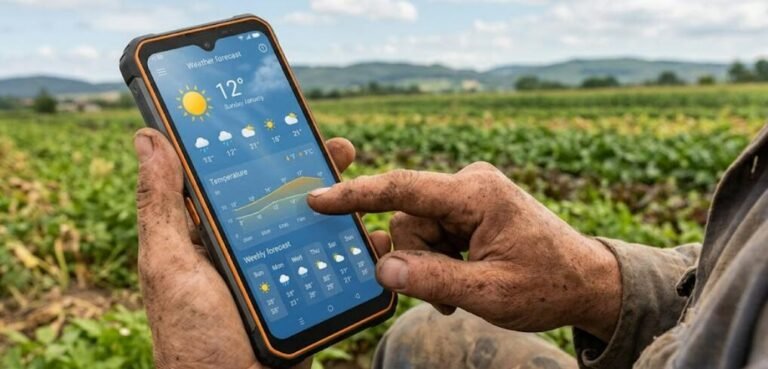
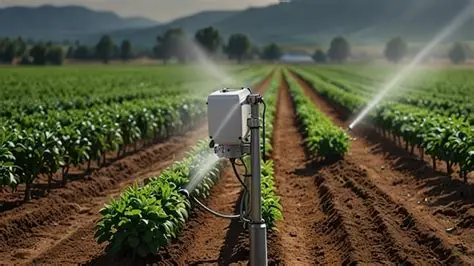
Technology gives farmers several ways to make this information more visible. Flow meters can measure water delivered through pipes, soil moisture sensors can show conditions within the root zone, weather stations can help estimate crop water demand, pressure sensors can reveal irrigation-system problems, and satellite or remote-sensing systems can provide information about water use across larger areas.
The important point is that these technologies measure different parts of the water-management system. A flow meter answers a different question from a soil moisture sensor, while satellite data provides a different type of information from either one.
For effective farm water management, farmers need to understand what each technology measures, how the information can be combined, what infrastructure is required, and whether the resulting information is valuable enough to justify the cost.
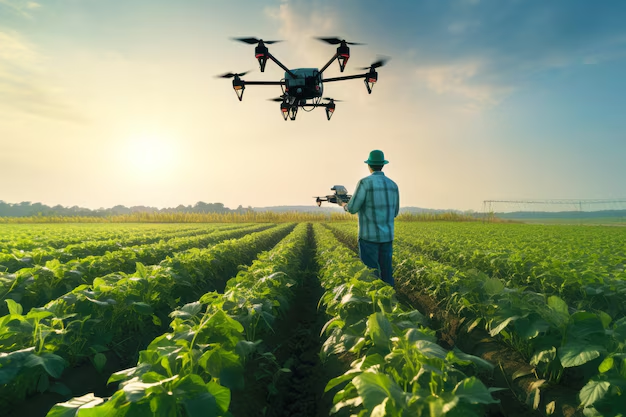
Drones can provide more localized aerial information than many satellite systems.
Depending on the sensors used, drones may help farmers identify vegetation differences, crop stress patterns, irrigation problems or areas requiring field inspection.
Thermal and multispectral imagery can be useful for identifying spatial differences that may be associated with crop water stress.
However, a drone does not directly measure the volume of irrigation water flowing through a pipe.
Its value is primarily in spatial diagnosis and field monitoring.
Farmers also need to consider drone regulations, operator requirements, weather, batteries, image-processing software, equipment maintenance and the time required to collect and interpret the data.
For many farms, drone services may be more practical than purchasing and maintaining a drone operation internally.
One of the practical benefits of monitoring is the ability to identify patterns that would otherwise go unnoticed.
For example, a farm may observe:
- Unexpected water flow when irrigation should be off
- A sudden reduction in normal flow
- A pressure change during irrigation
- Higher water use than expected for a particular field
- Pump operation without the expected water delivery
- A difference between source output and field delivery
- Continuous night-time water movement
- An unusual soil moisture response after irrigation
These patterns can indicate leaks, broken pipes, blocked filters, damaged valves, pump problems or other system issues.
The technology does not necessarily identify the physical cause. A technician or farm worker may still need to inspect the irrigation system.
For farms with multiple fields or irrigation zones, measuring only the total pump output can hide important differences.
Suppose a pump supplies three irrigation blocks. If only the pump discharge is measured, the farm knows how much water entered the system but may not know how much each block received.
Adding flow measurement at appropriate field or zone points can provide a more detailed water account.
The resulting records can show:
Source water → irrigation system → field or zone → irrigation event → cumulative volume
This makes it easier to compare water use among fields and investigate unusually high or low consumption.
FAO and irrigation-management guidance emphasize the value of flow measurement for understanding water distribution and supporting irrigation management.
Consider a hypothetical small tomato farm using a pump and drip irrigation.
The farmer does not have reliable internet coverage and cannot justify an expensive cloud-based system.
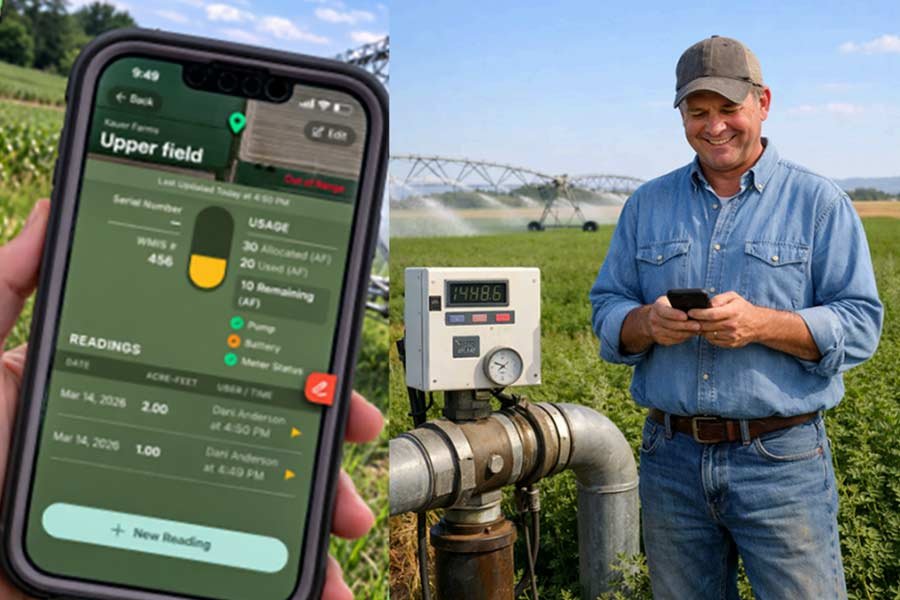
Instead, the farmer installs a basic flow meter and uses a portable soil moisture monitoring device at representative locations. Irrigation duration and meter readings are recorded manually.
The farmer can then compare how much water was applied with soil moisture conditions and rainfall.
This simple system may provide enough information to improve irrigation decisions without requiring a complex IoT platform.
Technology adoption should therefore be proportional to the farm’s actual information needs.
Large farms may benefit from combining field measurements with satellite information.
A flow meter can provide direct information about water entering a monitored irrigation system. Satellite data can then help the farm understand spatial differences in crop condition and water use across a much larger area.
FAO’s WaPOR system provides remotely sensed agricultural water-productivity information and includes actual evapotranspiration and other water-related datasets. Its data can support analysis at different spatial scales across relevant regions, including Africa.
This combination can be valuable when it is difficult or expensive to install physical sensors throughout every hectare.
However, remote sensing should complement rather than automatically replace physical measurements where direct water-volume accounting is required.
Meters and sensors need periodic inspection. Check for damage, fouling, power problems, communication failures and other issues.
Do not assume that a dashboard showing a number means the measurement is automatically correct.
What is farm water usage monitoring?
Farm water usage monitoring is the process of measuring or estimating water withdrawn, delivered, applied and used within an agricultural operation. It can involve flow meters, soil moisture sensors, weather data, irrigation records, remote sensing and other technologies.
What is the best technology for measuring irrigation water?
The appropriate technology depends on the irrigation system. Flow meters are commonly used to directly measure water moving through pressurized pipelines, while weirs and flumes can be used in suitable open-channel systems. The measurement device must be correctly selected and installed for the conditions.
Can a flow meter measure how much water a farm uses?
A flow meter can measure the water passing through the point where it is installed. If it is installed at the pump discharge, it can measure water leaving the pump. Additional meters may be needed if the farmer wants to determine how much water individual fields or irrigation zones receive.
Can soil moisture sensors measure water consumption?
Not directly. Soil moisture sensors measure the water status of the soil at selected locations and depths. They can help farmers understand how soil moisture changes after rainfall or irrigation, but they do not directly measure the total volume of water pumped or delivered.
Can farmers monitor water use without internet?
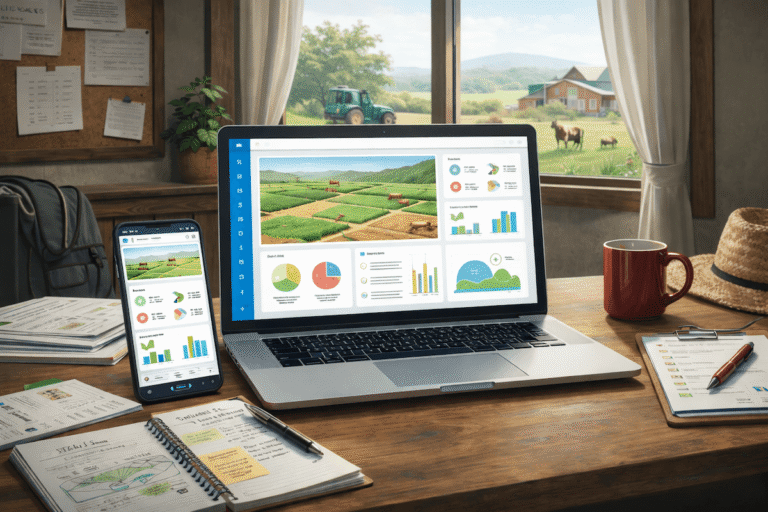
Yes. Flow meters, water meters and many soil sensors can operate without internet. Internet connectivity becomes useful when farmers want remote dashboards, cloud storage or alerts. Some systems can store information locally when communication is unavailable.
Can satellite technology monitor farm water use?
Satellite remote sensing can estimate agricultural water-use indicators such as evapotranspiration and provide information about water productivity and crop conditions. It is especially useful for monitoring larger areas, but it does not necessarily replace direct measurement of irrigation volume with a physical meter.
How can farmers detect irrigation leaks with technology?
Farmers can compare expected and actual flow, pressure and irrigation schedules. Unexpected flow when irrigation is off, abnormal pressure or a sudden change in normal flow can indicate a possible leak or equipment problem. Physical inspection is still required to identify and repair the cause.
Is farm water monitoring technology suitable for small farmers?
Yes, but a small farm may not need a sophisticated IoT network. A simple flow meter, portable soil moisture device, rainfall record or basic monitoring service may provide enough information. The system should match the farm’s size, irrigation method, budget and management needs.