How to Start a Drone Spraying Business in Agriculture in Nigeria
Starting a drone spraying business is not simply a matter of buying an agricultural drone and finding farms that need spraying. The real business is providing a reliable crop protection service at the right time, with the right equipment, trained operators, proper application practices, and compliance with aviation and pesticide requirements.
Farmers may need an alternative to knapsack and tractor spraying when fields are wet, crops are tall, terrain is difficult, labour is limited, or a crop protection treatment needs to be completed within a narrow window. Agricultural spraying drones can operate without putting wheels through the crop and can reach fields where conventional ground equipment is difficult to use. Research reviews also identify pesticide application, crop monitoring, and other precision agriculture tasks as important applications for agricultural drones.
However, a drone spraying business has substantial costs and responsibilities. The aircraft is only one part of the operation. Batteries, charging equipment, transport, spare parts, water logistics, operator training, software, insurance where applicable, regulatory compliance, chemical handling procedures, maintenance, and customer acquisition all affect the economics.
In Nigeria, the regulatory side is particularly important. The Nigeria Civil Aviation Authority, NCAA, states that organizations carrying out commercial remotely piloted aircraft system operations require an appropriate operations certificate, while its current Part 21 regulation covers certification, registration, operation, and surveillance of RPAS.
This guide explains how to approach the business from the ground up, including choosing a service model, selecting equipment, finding customers, estimating costs, understanding Nigerian requirements, pricing jobs, managing spraying operations, and deciding whether the business model makes sense for you.
What Is a Drone Spraying Business?
A drone spraying business provides agricultural application services using remotely piloted aircraft equipped with tanks, pumps, nozzles, and flight-control systems.
Instead of selling the drone itself, the business normally sells an agricultural service. A farmer or agribusiness pays the operator to treat a specified area according to an agreed application plan.
Depending on the equipment and the customer’s requirements, services may include the application of registered crop protection products, foliar fertilizers, biostimulants, or other permitted agricultural products. Some agricultural drones can also be converted from spraying to granular spreading using a separate spreading system.
For example, DJI’s AGRAS T25P has a 20-litre spraying tank and a separate spreading system capable of carrying up to 25 kg of dry granules. The larger AGRAS T50 has a 40-litre spray tank and a separate spreading system with a 50 kg internal load capacity. These are manufacturer specifications and should not be interpreted as guaranteed field performance.
The important business distinction is that customers are paying for an outcome, not merely flight time. They want a crop treated properly, safely, on schedule, and with adequate records.
That means a serious drone spraying company needs agricultural knowledge in addition to flight skills.
Why Farmers May Pay for Drone Spraying
The business opportunity starts with a farming problem.
A farmer using a knapsack sprayer may have to deploy many workers across a large field. This becomes increasingly difficult when labour is scarce, crops are tall, fields are muddy, or treatment has to be completed quickly.
Tractor-mounted sprayers provide greater ground capacity but require suitable access and can create wheel traffic through fields. A tractor may also struggle with saturated soil, steep terrain, narrow fields, or crops where ground traffic can cause damage.
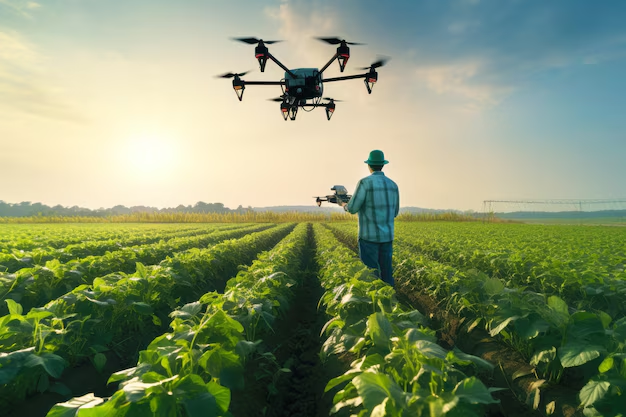
A spraying drone offers another application method. It can fly over the crop without driving wheels through the field, and its ability to operate from field edges can be useful where conventional machinery cannot easily enter.
A 2026 review of agricultural drone research identifies crop spraying, fertilizer application, crop monitoring, and other precision agriculture applications as growing areas of use, while also noting challenges such as drift, labour impacts, and other operational considerations.
The business therefore becomes more attractive when you can solve a problem that farmers already have.
For example, a farmer may not care that your drone has advanced radar. The farmer cares that a 30-hectare field needs to be treated within a particular crop protection window and that ground machinery cannot conveniently enter the field after rainfall.
That is the problem your service should solve.
Choose Your Drone Spraying Business Model
There are several ways to structure the business.
The simplest is a direct spraying service. You own the drone, employ or operate it yourself, and charge farmers according to the area treated or another agreed service basis.
A second model is contract spraying for commercial farms. Instead of constantly searching for individual farmers, you establish agreements with plantations, large farms, cooperatives, outgrower schemes, agro-processors, or agricultural companies.
A third model is a cooperative or shared-equipment model. Several farmers contribute to access the equipment, while a trained operator manages the actual spraying operations.
Another option is to operate as a broader precision agriculture company. Drone spraying can become one service alongside farm mapping, crop monitoring, multispectral imaging, field scouting, and agricultural data services.
For a new operator, starting with a clearly defined spraying service can make the business easier to understand and manage. Additional services can be added after the spraying operation has become reliable.
Decide Which Customers You Want to Serve
Customer selection should happen before purchasing an expensive drone.
A common mistake is to buy equipment first and then search for enough acreage to keep it busy. The better approach is to identify the farms and crops in your target area, determine their spraying problems, and estimate how much service demand exists.
Potential customers include commercial crop farms, plantations, farmer cooperatives, outgrower schemes, agricultural input companies, government-supported farming programmes, research farms, and professional farm management companies.
Crops that may present opportunities include maize, rice, soybean, vegetables, cotton, cocoa and other plantation crops, although suitability depends on the particular crop, product, field conditions, application objective, and local regulatory requirements.
Do not assume that every crop treatment is suitable for drone application.
Your sales process should begin with questions such as:
What crops do you grow?
How many hectares require treatment?
How many spraying operations are normally required each season?
What type of sprayer do you currently use?
What problems do you experience with conventional spraying?
When are the critical spraying windows?
Are fields accessible to tractors?
Are there nearby houses, livestock areas, water bodies, roads, power lines, schools, or other sensitive locations?
What products are being applied?
Does the product label permit the intended method of application?
These questions tell you much more about the potential customer than simply asking how many hectares they own.
Understand the Equipment You Actually Need
The drone is the centre of the business, but it is not the complete business system.
A commercial spraying operation normally needs an aircraft, flight controller, spraying equipment, batteries, charging equipment, transport arrangements, spare parts, chemical handling equipment, water logistics, safety equipment, and appropriate software or mission-planning tools.
The exact package varies by drone model.
| Business requirement | What you may need | Why it matters |
|---|---|---|
| Aircraft | Agricultural spraying drone | Main operating platform |
| Spray system | Tank, pumps, nozzles and plumbing | Determines application capability |
| Batteries | Multiple flight batteries | Reduces downtime between missions |
| Charging | Charging station, generator or suitable power supply | Keeps batteries available for operations |
| Positioning | GNSS and, where appropriate, RTK equipment | Supports accurate flight planning and repeatability |
| Spares | Propellers, nozzles, pumps, seals and other parts | Reduces downtime |
| Water logistics | Water tanks, transfer pump and clean filling area | Necessary for practical field operations |
| Transport | Vehicle and secure equipment storage | Moves the drone and support equipment between farms |
| Safety | PPE, first-aid equipment and operational safety equipment | Protects operators and other people |
| Software | Mission planning and field-recording tools | Supports planning and documentation |
| Communication | Phone and reliable field communication | Customer coordination and operational support |
| Maintenance | Cleaning and inspection tools | Keeps the equipment operational |
The most important point is to ask what is included in the quoted drone price.
A drone advertised at a particular price may not include enough batteries, a charging system, a generator, spreading hardware, additional spray components, transport equipment, training, or spare parts.
How Much Does Agricultural Drone Equipment Cost in Nigeria?
There is no single nationwide price for an agricultural spraying drone in Nigeria because prices vary with model, exchange rates, logistics, configuration, accessories, warranty arrangements, and dealer support.
As a current public Nigerian dealer example, IAPrecision lists the DJI AGRAS T25P at ₦10.5 million and the AGRAS T50 at ₦17.975 million. The T50 listing explicitly states that the quoted price excludes accessories and that prices are indicative and subject to exchange-rate and logistics changes.
The same dealer currently lists several additional T50 components, including a DB1560 intelligent battery at ₦3.09 million, a C10000 charging station at ₦2.865 million, a T50 spreading system at ₦1.37 million, and a D14000iE generator at ₦7.425 million on its detailed T50 page.
These figures should be treated as public dealer asking prices rather than a nationwide market average.
| Example | Public Nigerian listing | Important point |
|---|---|---|
| DJI AGRAS T25P | ₦10,500,000 | Dealer-listed aircraft price, with accessories potentially additional |
| DJI AGRAS T50 | ₦17,975,000 | Dealer-listed price excluding accessories |
| T50 additional battery | ₦3,090,000 | Listed separately |
| T50 charging station | ₦2,865,000 | Listed separately |
| T50 spreading system | ₦1,370,000 | Separate application hardware |
| D14000iE generator | ₦7,425,000 | Separate charging power equipment |
The figures can change, so a prospective operator should obtain a written quotation before building a financial plan around them.
More importantly, do not calculate the business investment from the aircraft price alone.
Build the Total Startup Budget
Your startup budget should be divided into capital expenditure and working capital.
Capital expenditure covers the equipment required to establish the operation. Working capital covers the money required to keep the business operating before customer payments arrive.
A realistic budget should consider:
| Cost area | Examples |
|---|---|
| Drone platform | Agricultural spraying aircraft |
| Application hardware | Spray system and optional spreader |
| Batteries | Initial and backup batteries |
| Charging | Charging station, generator or power infrastructure |
| Transport | Vehicle, trailer or secure transportation |
| Spare parts | Nozzles, propellers, pumps, seals and other consumables |
| Safety equipment | PPE and operational safety equipment |
| Water system | Tanks, pumps, hoses and filling equipment |
| Training | Flight, equipment and agricultural application training |
| Business setup | Company formation and ordinary business administration |
| Regulatory compliance | Applicable aviation and operating requirements |
| Insurance | Coverage appropriate to the business and risks |
| Marketing | Branding, sales materials and customer acquisition |
| Staff | Operators, field assistants and administrative support |
| Working capital | Fuel, transport, repairs and operating expenses |
| Maintenance | Routine servicing and unexpected repairs |
This is why two people can buy similar drones but end up with very different total investments.
One operator may already have a suitable vehicle, water tank, trained pilot, workshop and customer base. Another may need to establish everything from zero.
Do You Need a Generator or Special Charging System?
Power availability is a major issue for a drone spraying business.
Agricultural drones use high-capacity batteries, and a commercial service provider cannot afford to discover halfway through a spraying contract that batteries cannot be recharged quickly enough.
A suitable charging system may therefore be one of the most important pieces of infrastructure after the aircraft itself.
For example, the Nigerian dealer IAPrecision currently lists DJI charging generators separately from the drone. Its D14000iE listing is specifically marketed for charging Agras batteries, while a smaller D6000i generator is listed for compatible Agras battery systems.
The correct solution depends on the drone model and your operating environment.
If you will work far from reliable electricity, mobile charging capability can become part of the service logistics. If you will operate from a permanent commercial farm with suitable electrical infrastructure, the power arrangement may be different.
Do not choose a charging system before confirming compatibility with the aircraft and battery system you intend to purchase.
Understand Spray Capacity Before Promising Customers a Service
The size of the tank matters, but tank capacity alone does not determine how much land you can treat.
The DJI AGRAS T25P, for example, has a 20-litre spray tank, while the T50 has a 40-litre spray tank. Their manufacturer-listed effective spray widths are also different.
In the field, actual service capacity depends on much more than those specifications.
You must account for:
- Spray volume per hectare
- Flight speed
- Spray width
- Field shape
- Battery turnaround
- Refilling time
- Water availability
- Travel distance
- Obstacles
- Terrain
- Weather
- Crop height
- Application method
- Operator experience
- Time spent setting up and packing down
This is why you should not sell customers a guaranteed number of hectares per hour simply because a manufacturer advertises a theoretical or ideal operating figure.
For example, DJI markets the T50 with high payload and high flow capabilities, but those specifications do not mean every farm will achieve the same practical field capacity.
Your own operating records will eventually become more valuable than manufacturer marketing figures.
Record the time required for setup, calibration, spraying, refilling, battery changes, transport within the farm and shutdown. After several jobs, you will have a much better estimate of your real service capacity.
Learn the Difference Between Spraying and Spreading
A drone spraying business can sometimes offer more than liquid pesticide application.
Some agricultural drones use a separate spreading system for dry granules.
Liquid spraying involves a tank, pump and nozzles. Spreading involves a hopper and a mechanism for distributing dry material.
The distinction matters commercially because the hardware may be sold separately.
For example, the T50’s official specifications list a 40-litre spray tank and a separate 75-litre spreading system capable of carrying up to 50 kg of material.
The T25P similarly has a separate spreading configuration with a 30-litre hopper and a 25 kg maximum load.
Do not advertise granular fertilizer spreading as part of your service until you have confirmed that the drone configuration actually supports it.
Get Proper Training Before Taking Paid Jobs
Being able to fly a drone does not automatically make someone a competent agricultural spray operator.
A commercial operator needs to understand flight safety, field assessment, application planning, calibration, weather conditions, chemical handling, emergency procedures, equipment maintenance, battery management, and record keeping.
Agricultural application also requires an understanding of why a particular treatment is being performed.
For example, a fungicide application may require adequate deposition on the target canopy. Herbicide application may require particularly careful drift management. Foliar nutrition has different agronomic objectives.
Training should therefore cover both the aircraft and the agricultural application process.
A business should also have written operating procedures rather than depending entirely on the pilot’s memory.
Understand Drone Regulations in Nigeria
Regulatory compliance should be addressed before the first commercial flight, not after acquiring customers.
The NCAA’s current Part 21 regulation sets requirements for certification, registration, operations, and surveillance of remotely piloted aircraft systems in Nigeria.
The NCAA also states that it issues a Remotely Piloted Aircraft Systems Operations Certificate for organizations wishing to conduct commercial RPAS operations in Nigeria.
The NCAA’s current RPAS portal also describes registration and approval processes for RPA/UAV operations and distinguishes operational categories.
This means a drone spraying entrepreneur should contact the NCAA and establish exactly which registration, approval, operational certification, pilot and organizational requirements apply to the intended operation and aircraft.
Do not assume that purchasing a drone automatically gives you permission to operate commercially.
Likewise, do not assume that a certificate obtained for one type of operation automatically covers every other aviation activity.
Because regulations and administrative requirements can change, verify the current requirements directly with the relevant authority before beginning commercial operations.
Understand Pesticide Regulations Too
A drone business that applies pesticides has another responsibility beyond aviation compliance.
The chemical being applied must be appropriate for the intended use.
NAFDAC’s Pesticide Registration Regulations require pesticide directions to cover matters including dosage, fields of application, methods of application, target pest, re-entry period, pre-harvest period, and target crop. The regulations also require pesticide labels to be approved and accurate.
This has an important implication for your business.
You should never tell a customer that every pesticide can simply be loaded into an agricultural drone.
Before an application, confirm the product, crop, target pest or disease, approved method of application, label directions, PPE requirements, environmental precautions, and any restrictions relevant to the operation.
International guidance also emphasizes that aerial pesticide application requires attention to drift, environmental conditions, equipment, operator practices, and national regulation.
The business should therefore have a clear policy that operators will not apply products when the intended application is not legally or agronomically appropriate.
Take Spray Drift Seriously
Spray drift is one of the most important technical risks in drone spraying.
A drone does not eliminate drift simply because the application is more automated.
Droplet size, wind, flight height, flight speed, nozzle characteristics, formulation, temperature, humidity, and surrounding conditions can affect where droplets travel.
Research reviews have identified spray drift as a significant consideration in unmanned aerial spraying systems and emphasize the importance of operating parameters and environmental conditions.
The rotor downwash can influence deposition, but it should not be treated as a guarantee that spray will remain inside the target field.
This becomes particularly important near houses, livestock, water bodies, neighbouring farms, roads, schools, sensitive crops, and other non-target areas.
A professional operator should assess the field before spraying and stop or postpone operations when conditions are unsuitable.
Use Weather Information as Part of the Business
Weather is not just a background consideration for a drone spraying company.
Wind can influence drift. Rain can affect application and product performance. Temperature and humidity can influence evaporation and spray behaviour.
NiMet provides weather and climate information for agricultural planning as well as aviation-related weather services. Its 2026 Seasonal Climate Prediction includes rainfall, temperature, dry-spell and growing-season information relevant to agricultural planning.
Your business should therefore develop a simple weather decision process.
Before dispatching the aircraft, check the forecast and current conditions, assess the field, and confirm that conditions are appropriate for the particular application.
Do not make a blanket rule that a drone can spray simply because the aircraft can physically fly.
Develop a Clear Service Pricing Model
Pricing is one of the most difficult parts of the business because the cost of operating a drone is not the same as the price charged to the customer.
A service price must cover your direct costs and contribute toward recovering your equipment investment.
Possible pricing structures include charging per hectare, minimum job charges, mobilisation charges for distant farms, or negotiated seasonal contracts.
A per-hectare model is easy for farmers to understand, but it should clearly define what the price includes.
For example, your quotation could specify whether the price covers:
- Drone and operator
- Batteries
- Charging
- Transport within a defined service area
- Flight planning
- Spraying
- Basic application records
- Water
- Product loading
- Mobilisation
- Additional travel
- Difficult terrain or remote locations
There is no single reliable nationwide Nigerian price per hectare that should be treated as the standard market rate. Publicly advertised prices vary considerably between providers and service packages.
For example, one Nigerian agricultural service provider currently publishes a price of ₦28,000 per hectare for drone spraying. That is a provider-specific advertised price, not an industry-wide Nigerian benchmark, so a new business should use local competitor quotations and its own cost records when establishing prices.
A useful pricing formula is:
Service price per hectare = direct operating cost per hectare + equipment recovery allocation + overhead allocation + business margin
The exact figures should come from your own operation rather than an internet estimate.
Calculate Your Real Cost Per Hectare
Your real operating cost should include more than fuel.
Consider a hypothetical operation that travels from its base to a customer’s farm. The business may incur vehicle fuel, generator fuel, operator labour, battery charging, maintenance, equipment depreciation, spare parts, water transport, accommodation if the farm is distant, and administrative expenses.
If these costs are ignored, a business can appear profitable on paper while losing money in reality.
Track each job separately.
A useful job record can contain:
| Metric | What to record |
|---|---|
| Customer | Farm or organization |
| Location | Farm location and travel distance |
| Crop | Crop treated |
| Area | Hectares treated |
| Product | Agricultural product used |
| Application | Type of treatment |
| Start time | Operational start |
| Finish time | Operational finish |
| Batteries | Number of battery cycles used |
| Charging | Charging time and energy or fuel |
| Water | Quantity transported or used |
| Labour | Operators and assistants |
| Transport | Vehicle and travel cost |
| Repairs | Job-related maintenance |
| Revenue | Amount invoiced |
| Collection | Amount actually received |
| Notes | Weather, obstacles and operational problems |
After several months, these records can show which customers, crops, locations, and job types are commercially attractive.
Do Not Confuse the Customer’s Chemical Cost With Your Service Cost
This is an important distinction when quoting farmers.
If the customer supplies the pesticide or fertilizer, your quotation should clearly state that the service price covers the application service rather than the agricultural input itself.
If your company supplies the product, the quotation must separately account for product procurement, storage, handling, compliance, and liability.
A professional business should avoid unclear arrangements where the farmer assumes the quoted spraying price includes everything.
The contract should identify exactly what the customer is paying for.
Build a Reliable Field Logistics System
The biggest operational problem may not be flying the drone.
It may be moving water, batteries, people and equipment around the farm.
A 40-litre spray tank still requires repeated refilling during a large job. The drone therefore depends on a ground support system.
Your field team may need:
A clean water source or transported water, filling tanks, pumps, hoses, charging equipment, batteries, tools, PPE, chemical handling equipment, communication devices, spare parts, and a suitable vehicle.
The field should also have a safe launch and support area.
This is especially important in Nigeria, where farms may be far from reliable power, paved roads, workshops, and equipment suppliers.
A drone spraying company that has a technically excellent aircraft but poor field logistics can still provide a poor service.
Start With a Defined Service Area
Do not promise nationwide service from the first day unless you already have the logistics and staff to support it.
A better approach is to establish a practical operating radius.
For example, a new business might focus on farms within a defined area and gradually expand when it has sufficient customers and operational capacity.
Your service area should consider road conditions, travel time, customer density, availability of water, charging logistics, accommodation, technical support, and access to spare parts.
The aim is to spend more time performing paid agricultural work and less time travelling between scattered jobs.
Find Customers Before Expanding Your Fleet
One drone can be enough to prove the business model.
Before buying a second aircraft, measure how much work the first operation actually receives.
Potential customer acquisition channels include direct visits to commercial farms, relationships with agronomists, agricultural input dealers, cooperatives, farm managers, plantation companies, farmer associations, agricultural consultants, processors with outgrower networks, and agricultural development programmes.
Demonstration days can also be useful, but the demonstration should focus on the customer’s agricultural problem rather than simply showing the drone flying.
For example, a demonstration could show how a drone can access a wet field without tractor wheel traffic or how a service team plans and documents an application.
The objective is to convert demonstrations into repeat contracts.
Build Relationships With Agronomists
Drone operators should not try to become crop protection experts overnight.
An agricultural drone is an application tool. It does not diagnose every pest, disease, nutrient deficiency, or agronomic problem.
Working with qualified agronomists, crop consultants, extension professionals, or knowledgeable farm managers can improve the quality of your service.
For example, the agronomist may determine that a field requires a particular treatment, while the drone company provides the application service according to the approved product instructions.
This division of responsibilities can reduce the risk of the drone operator making unsupported chemical recommendations.
Offer Records as Part of the Service
Farmers increasingly need records of what was done in their fields.
Your company can provide an application report containing the farm location, date, area treated, crop, product supplied by the customer, application details, operator, and relevant operational notes.
Where the equipment supports it, flight logs and mission records can also help document the operation.
This does not require turning the business into a complicated data platform.
Even a well-organized digital job record can be valuable to a commercial farm manager.
Over time, these records can also help you identify repeat spraying schedules, customer demand patterns, equipment utilization, and operational bottlenecks.
Consider Drone-as-a-Service Instead of Selling Drones
A major opportunity in agricultural drone services is that farmers do not necessarily need to own the aircraft.
A small or medium-sized farm may only need a few spraying operations each season. Purchasing an expensive aircraft, batteries, charging equipment, spare parts, and training may not make financial sense for that farm.
Hiring a professional operator transfers much of the equipment ownership and maintenance burden to the service provider.
This creates the foundation for a drone-as-a-service model.
Your company owns the equipment and sells application capacity.
This model can also work with cooperatives, where many farmers collectively create enough demand to keep a service provider busy.
The important issue is utilization. A drone that spends most of the year sitting in storage still has a large amount of capital tied up in it.
When Does Buying a Drone Make Sense for a Farm?
Ownership becomes more attractive when a farm has enough recurring acreage to keep the equipment meaningfully occupied and has the staff and infrastructure to operate it.
Hiring may be more practical when spraying requirements are occasional or the farm does not want to take responsibility for aircraft maintenance, training, regulatory compliance, batteries, charging equipment, and field logistics.
For your business, this difference creates the customer opportunity.
Instead of asking whether every farmer should buy a drone, ask whether enough farmers need professional drone application services.
Avoid the Mistake of Promising Chemical Savings
Marketing claims about chemical and water savings are common in the agricultural drone industry, but the actual result depends on the application.
A drone can potentially enable lower-volume application in situations where the product label and agronomic requirements permit it. However, lower water volume does not mean that the farmer can arbitrarily reduce pesticide dose.
The product label and application objective determine the appropriate use.
Research also shows that application results depend on factors such as flight parameters, droplet characteristics, weather, and spray-system configuration.
Therefore, your marketing should avoid promises such as “50 percent less pesticide” or “90 percent less water” unless you have reliable evidence for the specific application and conditions.
A better message is that your service is designed to apply products according to the approved application requirements while reducing unnecessary ground traffic and improving operational flexibility where appropriate.
Common Mistakes New Drone Spraying Businesses Make
One of the biggest mistakes is buying the most expensive drone before establishing customer demand.
Another is underestimating batteries, charging, water and transport.
Some operators also focus heavily on flight skills and overlook pesticide application technique.
Another problem is setting a low price simply to win customers without calculating actual operating costs.
Poor record keeping is another serious weakness. Without records, you cannot determine whether a job was profitable or whether equipment downtime is increasing.
Regulatory compliance should also never be treated as an optional administrative detail.
Finally, do not assume that the drone can operate in every weather condition. Wind, rain, temperature, obstacles and surrounding land uses all affect operational decisions.
A Practical Launch Sequence for a New Drone Spraying Business
The safest approach is to build the business in stages.
Stage One: Validate the Market
Identify the crops, farms and agricultural clusters within your proposed service area.
Speak to farm managers and farmers about their current spraying methods, acreage, labour challenges, crop access problems, treatment schedules and willingness to use a professional drone service.
The objective is to determine whether there is genuine demand before committing significant capital.
Stage Two: Establish the Business
Formalize the business structure appropriate to your operation, establish accounting and payment systems, develop contracts and define who is responsible for chemicals, water, transport and application decisions.
At the same time, begin the applicable NCAA compliance process for your planned commercial RPAS operation.
Stage Three: Select the Equipment
Choose the drone according to the customers you have identified rather than buying according to headline specifications.
Consider tank capacity, payload, battery system, charging requirements, spare-part availability, support, software, spreading capability, field conditions and expected utilization.
Stage Four: Train the Team
Train operators on the aircraft, agricultural spraying, safety, calibration, weather assessment, chemical handling, emergency procedures, battery management and maintenance.
Stage Five: Conduct Controlled Jobs
Begin with manageable operations where you can closely supervise the complete process.
Measure actual time, water use, battery cycles, transport costs, labour and maintenance.
Stage Six: Build Repeat Contracts
Once the service is reliable, focus on recurring customers rather than constantly finding one-off jobs.
Commercial farms, cooperatives and agricultural businesses with repeated seasonal requirements can provide more predictable demand than individual emergency jobs.
Stage Seven: Expand Carefully
Only add another drone or move into new geographical areas when the first operation has sufficient utilization and the business can support the additional equipment and staff.
What Should You Ask a Drone Supplier Before Buying?
A serious buyer should ask for more than the aircraft price.
Ask whether the quotation includes the aircraft, controller, spray system, batteries, charger, RTK equipment, spreading hardware, training, warranty and transportation.
Ask how quickly spare parts can be obtained locally.
Ask what happens if a pump, motor, controller, battery or spraying component fails during the crop protection season.
Ask what software is required and whether any recurring subscription costs apply.
Ask about battery management and replacement arrangements.
Ask whether technical support is available in Nigeria.
Ask for training that covers both aircraft operation and agricultural application.
Finally, ask what the realistic field capacity is under conditions similar to your intended customers’ farms.
A manufacturer specification is useful for understanding the equipment, but your business plan should be based on measured operating performance.
What Makes a Good Drone Spraying Business?
A successful operation is not necessarily the company with the most expensive drone.
The stronger business is the one that can consistently deliver the required agricultural treatment when the farmer needs it.
That requires five things working together: suitable equipment, competent operators, sound agricultural application practices, reliable field logistics, and enough customer demand.
The aircraft is only one component.
If the operator arrives late, cannot recharge batteries, has no water, cannot obtain a replacement nozzle, or sprays under unsuitable conditions, the technology does not solve the customer’s problem.
The business therefore needs to be managed like an agricultural field operation, not simply like a drone business.
Is a Drone Spraying Business Profitable?
It can be commercially viable, but profitability cannot be guaranteed from the purchase of a drone alone.
The key variables are equipment utilization, service price, acreage treated, operating cost, downtime, labour, transport, maintenance, financing costs, customer payment behaviour, and the length of the spraying season.
A simple way to think about the business is:
Annual operating contribution = service revenue – direct operating costs
Then:
Business profit = operating contribution – fixed costs – financing costs – taxes and other applicable expenses
If the drone is only used occasionally, the equipment recovery cost per hectare can become high.
If the business has a strong customer base and the equipment is used regularly during appropriate spraying windows, the fixed equipment cost can be distributed across more hectares.
This is why market validation should come before fleet expansion.
Final Considerations
Starting a drone spraying business in agriculture requires much more than learning how to operate an agricultural drone.
You are building a field service company that combines aviation, agricultural application, logistics, equipment maintenance, customer management, safety, and business economics.
Nigeria already has a regulatory framework for RPAS operations, and commercial operators need to take the NCAA requirements seriously. Pesticide application also has its own regulatory considerations, including approved product labels and application methods.
The equipment investment can be substantial. Current public Nigerian dealer listings show agricultural spray drones costing millions of naira before all accessories and operating infrastructure are included.
For that reason, the first question should not be, “Which drone should I buy?”
The better question is, “How many hectares of legitimate, recurring agricultural spraying demand can my business realistically serve, and what will it cost me to serve them properly?”
If the answer supports the investment, a drone spraying service can become a specialized AgricTech business serving farms that need timely, flexible and professionally managed crop application.
If the demand is uncertain, starting with partnerships, contracted work, or a smaller service operation can provide a way to test the market before committing to a larger fleet.
The technology should follow the agricultural problem, not the other way around.
Frequently Asked Questions
How much does it cost to start a drone spraying business?
There is no single startup figure because the investment depends on the drone, batteries, charging system, transport, spare parts, training, regulatory requirements, insurance, water logistics and working capital. Current public Nigerian dealer listings show examples such as ₦10.5 million for a DJI AGRAS T25P and ₦17.975 million for an AGRAS T50 before all accessories are included.
How much can I charge for drone spraying per hectare?
There is no reliable nationwide standard price per hectare. Nigerian providers publish different rates depending on the crop, location, service package, acreage and operating conditions. One provider currently advertises ₦28,000 per hectare, but this should be treated as an individual provider’s public price rather than a national market rate.
Do I need approval to operate an agricultural spraying drone commercially in Nigeria?
Commercial RPAS operations in Nigeria are regulated by the NCAA. The authority states that organizations conducting commercial RPAS operations require an appropriate Remotely Piloted Aircraft Systems Operations Certificate, while Part 21 establishes requirements for certification, registration and operation. Confirm the current requirements for your specific aircraft and business before operating commercially.
Can an agricultural drone spray pesticides and fertilizer?
Many agricultural drones can apply liquid agricultural products, while some models can also use a separate spreading system for dry granules. The ability of the aircraft to carry a product does not automatically mean that every pesticide or fertilizer is legally or agronomically suitable for drone application. Product labels and applicable regulations must be followed.
Do I need an agronomist to run a drone spraying business?
The exact staffing requirements depend on the business and applicable regulations, but agricultural knowledge is extremely valuable. A drone operator should not assume that flying skills alone qualify them to diagnose pests or diseases, prescribe pesticides, or determine agronomic treatment programmes. Working with qualified agronomic professionals can help separate crop-management decisions from the mechanical application service.
Is it better to buy a drone or offer drone spraying as a service?
For farmers, the answer depends on acreage, spraying frequency, capital availability, technical capacity and equipment utilization. A service model can make sense for farms that do not have enough recurring work to justify owning the equipment. For a business operator, the service model is the actual opportunity because several farms can collectively create enough demand to keep the equipment working.
What is the biggest mistake when starting a drone spraying business?
One of the biggest mistakes is buying expensive equipment before validating customer demand. Other common problems include underestimating charging and water logistics, failing to calculate real operating costs, inadequate training, poor maintenance planning, weak record keeping and ignoring aviation or pesticide requirements.
Can a small farmer use a drone spraying service?
Yes, a farmer does not necessarily need to own the equipment to benefit from drone spraying. Hiring a professional service can allow smaller farms or farmer groups to access the technology without purchasing the aircraft, batteries, charging equipment and spare parts themselves. The practicality still depends on service availability, farm location, crop, application requirements and cost.