How to Space Onion Seedlings for Maximum Yield
How to Space Onion Seedlings for Maximum Yield
I used to believe that the more onion seedlings I pushed into a bed, the more money I would pull out of it. One season I tested that belief the hard way. I planted one bed tight, almost touching, and another at a more generous spacing, and I watched both all season. The tight bed gave me a lot of onions, but they were small, uneven and slow to cure. The wider bed gave me fewer onions, but they were big, clean and easy to sell. When I weighed everything at the end, the difference in total weight was far smaller than I had expected, and the difference in price was far larger. That was the day I stopped asking “how many can I fit?” and started asking “what size onion does my market pay for?”
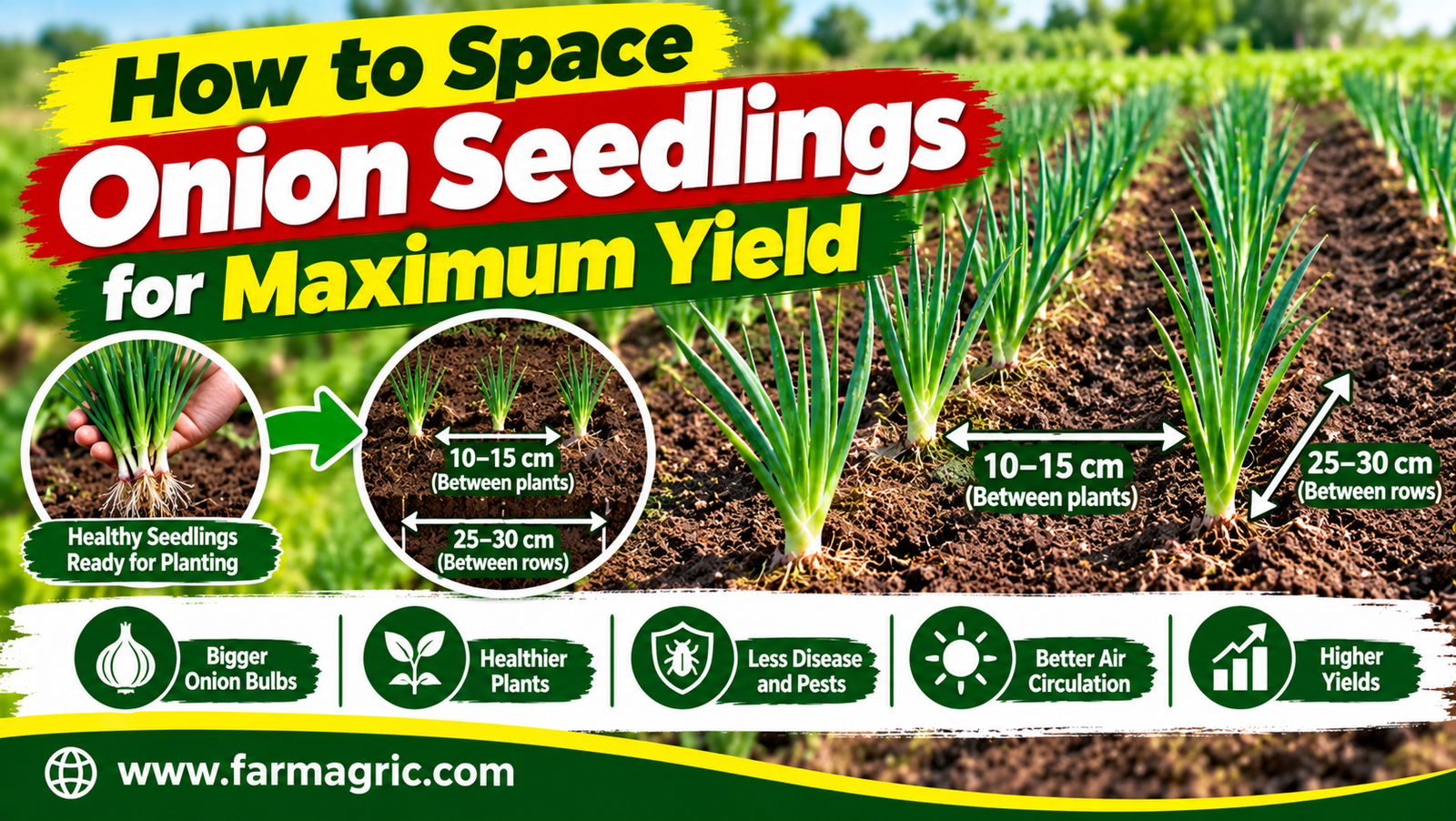
Here is the direct answer. For most farmers, a good starting spacing for onion transplants is about 10 to 15 centimeters between plants in the row, with rows about 30 to 45 centimeters apart. Closer spacing, around 8 to 10 centimeters, packs in more plants and can raise the total weight per area, but gives smaller bulbs. Wider spacing, around 12 to 15 centimeters or more, gives fewer but larger bulbs. Maximum yield in the way that matters to your wallet means the best combination of total weight and bulb size for the market you sell into, not simply the highest plant count. The right spacing depends on your variety, soil fertility, water, weed control and what size of bulb earns the best price.
The rest of this article shows you how to choose and apply the right spacing, and the mistakes that quietly cost farmers money.
What most farmers get wrong
They chase plant numbers instead of income. More plants per area does not always mean more money. Past a certain density, extra plants steal water, light and nutrients from their neighbors, and the whole bed produces small, uneven bulbs that sell for less.
They ignore their market. Some markets pay a premium for large bulbs, and others prefer medium, uniform bulbs, which are easier to pack, store and sell. If you plant for large bulbs when your buyers want medium ones, or the other way around, you lose either way. Talk to your buyers before you decide on a spacing.
They plant by eye. Spacing by eye drifts. Some plants end up crowded and others isolated, and the result is uneven bulb size across the field. Marking rows and plant positions with a string line, a measuring stick or a simple marking board costs almost nothing and pays back at harvest.
They mix big and small seedlings. Transplanting seedlings of very different sizes together gives uneven plants, and the big ones overshadow the small ones. Grade your seedlings by size before planting, and plant similar sizes together.
They plant too deep or too shallow. Seedlings buried deeply struggle to swell their bulbs, and seedlings left too shallow dry out and tip over. Good spacing does not help if the planting depth is wrong.
They forget the space needed for weeding and walking. Onions are poor competitors against weeds. If the rows are so tight that you cannot hoe or hand-weed between them without damaging the plants, weeds will win. Leave working room.
They copy a neighbor’s spacing without checking the conditions. What works on a rich, well-watered, well-weeded field may fail on a poorer one. Variety, soil, irrigation and climate all change the answer.
How spacing actually affects yield
Yield is a trade between the number of bulbs and the size of each bulb. When you plant closer, you increase the number of plants per area. Total yield per area generally rises as density increases, up to a point, then levels off, because the plants begin to compete too hard. Meanwhile, the average size of each bulb falls steadily as plants get closer. So you have a curve where total weight peaks and then flattens, while bulb size keeps shrinking.
At wider spacing, each plant has more room to grow leaves and a larger root zone, so bulbs grow bigger. But if you go too wide, you waste land, water and fertilizer on empty ground, and weeds fill the gaps.
There is also a disease effect. Dense canopies stay damp longer and favor leaf diseases such as purple blotch and downy mildew, especially in warm, humid weather. Wider spacing improves airflow and helps leaves dry. And there is a thrips effect, since crowded, stressed plants often show more damage.
The best spacing is therefore the point where total marketable yield is highest, meaning the weight of bulbs in the size range your buyers pay for, with a canopy open enough to stay healthy.
Step-by-step: how to find and apply the right spacing
Step 1: Decide what size of onion you are growing for. Before anything else, find out which bulb sizes sell best and fetch the best price in your market. Large bulbs, medium bulbs and small bulbs may each have a different buyer. Write down your target size range. This decision shapes everything that follows.
Step 2: Choose a starting spacing. As a baseline, plant about 10 to 15 centimeters apart in the row, with rows 30 to 45 centimeters apart. If your goal is medium, uniform bulbs and a high total yield, lean toward the closer end, around 8 to 10 centimeters within the row. If your goal is large bulbs, lean toward 12 to 15 centimeters or a little more, and make sure your soil, water and feeding can support bigger plants. These are starting points, not laws.
Step 3: Work out your plant population. It helps to know how many plants you are putting in the ground, so you can plan seedlings, labor and budget. Multiply the in-row distance by the row distance to get the area for each plant, then divide the area of your field by that number. For example, 10 centimeters by 30 centimeters gives each plant 0.03 square meters, which is roughly 333,000 plants per hectare. Fifteen centimeters by 30 centimeters gives roughly 222,000 plants per hectare. Ten centimeters by 45 centimeters also gives roughly 222,000 per hectare. Doing this simple sum shows you how much a few centimeters change the number of seedlings you must raise and plant.
Step 4: Choose a layout that suits your field. On flat ground, single rows with 30 to 45 centimeters between them work well and are easy to weed. On raised beds, many growers plant several rows per bed, for example three to five rows across a bed about one meter wide, with a closer row spacing of around 20 to 25 centimeters, and leave a path between beds. This makes good use of the land and makes watering and weeding easier. Staggering the plants slightly in neighboring rows, like a zigzag, gives each plant a little more room for the same land.
Step 5: Adjust for your variety. Large, vigorous varieties that make big bulbs and tall leaves need more room than compact ones. Check the seed packet, ask your supplier, and look at what local successful growers use for the same variety. Different varieties, and different day-length types, behave differently, so do not assume a spacing that suited one will suit another.
Step 6: Adjust for your soil and management. On rich, well-drained, well-irrigated soil with good weed control, plants can support a closer spacing because each has enough water and nutrients. On poorer or drier soil, or where you cannot irrigate or feed adequately, wider spacing gives each plant a better chance. If you are growing in a hot, humid climate with high disease pressure, consider a little more space for airflow.
Step 7: Raise strong, uniform seedlings. Spacing in the field only works well if the seedlings are good. Sow seed in the nursery at a sensible density, not heaped together, so seedlings grow sturdy and not thin and leggy. Transplant when seedlings are around pencil-thick, usually about six to eight weeks after sowing, depending on conditions. Sort them by size, and discard weak, diseased or oversized ones. Uniform seedlings spaced evenly give uniform bulbs.
Step 8: Mark out the field accurately. Use a string line and a measuring stick, or a homemade marker board with pegs at the right spacing, to mark each row and each planting position. This is faster than it sounds once you have the tool, and it keeps your plant population close to what you planned. Even spacing gives even bulbs.
Step 9: Plant at the right depth. Set each seedling shallowly, with the roots covered and the base of the plant near the soil surface. Firm the soil lightly, and water straight away. Do not bury the neck of the plant, because deep planting restricts bulb swelling.
Step 10: Run a small trial each season. The best way to learn your own ideal spacing is to test it. Plant three small blocks of the same variety at, say, 8, 10 and 15 centimeters in-row, keeping everything else the same. Label them, record the total weight and the number of bulbs in each size grade, and compare what each block would earn at your market prices. One season of notes will teach you more than any chart.
Step 11: Keep the field clean and watered. Spacing is only one part of the picture. Even the best layout will fail if weeds crowd the plants or water supply is erratic. Keep the field weed-free, water steadily, and feed in a balanced way, as the crop needs, so the plants can use the space you gave them.
Step 12: Adjust for next season. At harvest, write down what you saw. If the bulbs were small and the canopy was damp and diseased, widen next time. If bulbs were large but total weight was low and weeds took the gaps, tighten up. Each season’s notes bring you closer to the spacing that makes the most money on your own land.
Warning signs your spacing is wrong
If your spacing is too tight, you may see thin, tall, pale plants stretching for light, leaves that stay wet and show more disease, lots of small, uneven bulbs, and plants that are hard to weed and scout. If your spacing is too wide, you may see large areas of bare soil with fast weed growth, fewer bulbs than expected, a low total yield, and wasted water and fertilizer. In either case, take note, make small corrections within the current crop where possible, such as better weeding and watering, and fix the spacing at the next planting.
What I would do differently if I were starting again today
I would start from the market and work backward. Before I bought a single packet of seed, I would ask buyers what sizes they wanted, and set my spacing to produce that size. I would build a simple marker board so every plant went in exactly where it was meant to, and I would grade my seedlings by size before planting. I would run a three-spacing trial every season until I knew my numbers by heart. And I would spend the money I used to waste on extra seedlings on better weeding and steadier water instead, because a well-cared-for plant at the right spacing beats a crowded, neglected one every time.
I used to think the secret to maximum yield was packing in more plants. It turned out the secret was giving each plant exactly what it needed, and no less.
FAQ
How far apart should I plant onion seedlings?
A good starting point is about 10 to 15 centimeters between plants in the row, with rows 30 to 45 centimeters apart. Closer spacing gives smaller bulbs, and wider spacing gives larger bulbs. Adjust for your variety, soil, water management and market.
How many onion plants per hectare is ideal?
It depends on spacing. For example, 10 by 30 centimeters gives roughly 333,000 plants per hectare, and 15 by 30 centimeters gives roughly 222,000. The ideal number is the one that gives the best marketable yield for your conditions, which a small trial can help you find.
Can I plant onions closer to get a higher yield?
Closer spacing can raise total weight per area up to a point, but it reduces bulb size and can increase disease and competition. Beyond that point, extra plants stop adding yield. Choose the spacing that gives the best return for the bulb size your buyers want.
Should I thin onion seedlings after transplanting?
Normally no. Onion transplants are placed at their final spacing, so thinning is not needed. Thinning is more relevant for direct-seeded crops, where seedlings emerge thickly and need to be reduced.
How deep should I plant onion seedlings?
Shallowly. Cover the roots and the base of the plant, keeping the neck near the surface. Planting too deep can restrict bulb swelling.
Bookmark this
The best onion spacing is not the one with the most plants, it is the one that grows the bulb size your buyer pays for.