How to Space Cabbage Seedlings for Bigger Heads
How to Space Cabbage Seedlings for Bigger Heads: A Farmer’s Guide to Giving Every Plant Room to Fill Out
I once transplanted a bed of cabbage seedlings so close together that from a distance, once they had grown for a few weeks, the whole bed looked like a single unbroken carpet of leaves with no real gaps between individual plants at all. I remember feeling pleased with how full and productive that bed looked walking past it each morning, certain I was about to get an unusually heavy harvest from a relatively small area. When harvest came, the heads were disappointing, small, loosely formed, several of them barely bigger than a fist, in a season where a properly spaced bed nearby had produced heads nearly three times that size on the very same soil. That comparison taught me something that has shaped every cabbage planting I have done since, that packing more seedlings into a bed does not give you more cabbage, it gives you more plants fighting each other for the light and space that a proper head actually needs to form.
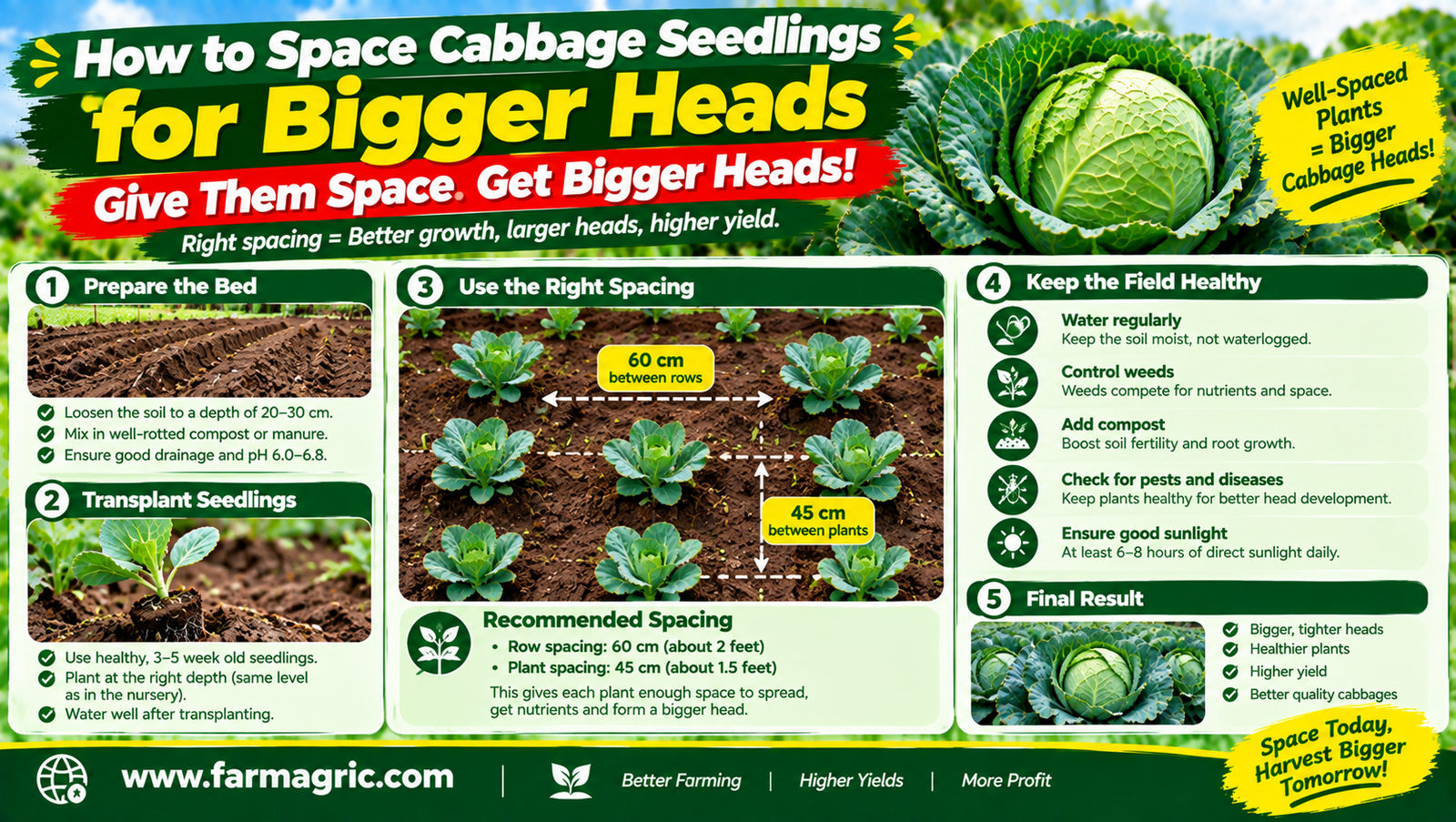
So let me answer you straight, because I know you are getting ready to transplant seedlings right now and trying to decide how close together to put them. Cabbage seedlings should generally be spaced about forty-five to sixty centimeters apart within rows that are also about forty-five to sixty centimeters apart, with the wider end of that range reserved for larger, longer-season varieties that naturally produce bigger heads and the closer end suited to smaller, quicker-maturing types, since proper spacing gives each plant enough direct access to sunlight and enough uncontested root space in the soil to actually build the kind of dense, heavy head you are growing the crop for in the first place. Spacing is one of the simplest, lowest-cost decisions you make in the whole cabbage growing process, and it is also one of the most directly responsible for whether your harvest consists of a modest number of genuinely large, marketable heads or a larger number of disappointing small ones competing against each other the entire season.
Why Spacing Affects Head Size So Directly in Cabbage
A cabbage head is essentially a tightly packed bundle of leaves curling inward around the plant’s growing point, and building a large, dense head requires the plant to produce and support a considerable amount of leaf tissue before and during that curling process. When seedlings are planted too close together, their outer leaves begin overlapping and shading each other relatively early in the season, and this competition for light directly limits how much total leaf area each individual plant can develop and support, which in turn limits how much material is available to build into a large, well-formed head later on. At the same time, root systems below ground are competing for the same limited soil volume and nutrient supply across more plants than that space can properly support, further constraining each plant’s overall growth and resource availability. The result, consistently, is a tradeoff between the number of plants you can fit into a given area and the average size each of those plants is able to reach, and pushing density too far in pursuit of more total plants very often costs you more in reduced head size than it gains you in plant count.
What Most Farmers Get Wrong
The first mistake, the one behind that disappointing carpet of a cabbage bed, is treating close spacing as a straightforward way to get more total cabbage from a given area, without accounting for how directly crowding limits the size each individual head is able to reach, often resulting in more total plants but a lower total harvest weight than a properly spaced planting of fewer, larger heads would have produced on the same ground.
The second mistake is applying one fixed spacing number to every variety regardless of how large that particular variety is bred to grow, using the same close spacing for a large, long-season variety that a smaller, quick-maturing type might tolerate reasonably well, and ending up with significant overcrowding specifically because the variety’s natural mature size was never factored into the spacing decision.
The third mistake is spacing by eye or by habit rather than measuring consistently, resulting in a bed with some seedlings crowded close together and others left with unusually wide gaps, producing the downsides of both overcrowding and wasted space within the very same planting.
The fourth mistake is not accounting for soil fertility when finalizing spacing decisions, using the same spacing on both rich and poor soil without recognizing that plants on richer ground can often be spaced slightly closer while still developing good head size, while the same spacing on poorer soil may need to be widened to give each plant access to a larger share of limited available nutrients.
The fifth mistake is prioritizing a packed, full-looking bed for its own sake, valuing the visual impression of a dense, leafy planting over the actual measurable outcome at harvest, which is head size and total usable weight rather than how impressively green and full the bed appears while it is still growing.
Step-by-Step Guide to Spacing Cabbage Seedlings Properly
Identify which type of variety you are growing before finalizing your spacing plan, since this genuinely changes the right answer for your specific planting. A large, long-season variety bred to produce substantial, heavy heads generally performs best with spacing toward the wider end of the typical range, often around sixty centimeters between plants and between rows, while a smaller, quicker-maturing variety can usually be spaced somewhat closer, sometimes down toward forty-five centimeters, without the same degree of competition developing between neighboring plants.
Assess your soil fertility honestly before settling on your exact spacing, since richer, well-fertilized soil with good organic matter content can generally support slightly closer spacing without a meaningful reduction in head size, while poorer, less fertile soil benefits from spacing toward the wider end of the appropriate range for your variety, giving each plant access to a larger share of the more limited nutrients available in that ground.
Measure your spacing using a marked rope, a cut stick of the correct length, or a simple string with knots tied at the intended intervals when laying out your transplanting rows, rather than placing seedlings by eye or by habit, since this single practice does more than almost anything else to produce an evenly developed bed rather than a patchwork of crowded and underused sections scattered inconsistently across the same planting.
Transplant seedlings at the appropriate stage of development, generally once they have developed several true leaves and are sturdy enough to handle the transition, rather than transplanting either too early, when seedlings are fragile and more vulnerable to the stress of transplant shock, or too late, when seedlings have become overly leggy or root-bound in their starting trays or nursery bed.
Water newly transplanted seedlings thoroughly and consistently during their first week or two in the main bed, since proper spacing alone does not guarantee strong development if the plants are simultaneously struggling with transplant stress or inconsistent moisture during this vulnerable early establishment period.
Thin any seedlings that were originally sown too closely together in a direct-seeded planting, rather than transplanted individually, down to the proper spacing for your variety within the first few weeks after germination, removing the weaker of any two seedlings growing too close together so the stronger one has the full space and resources it needs going forward.
Avoid the temptation to fill in every available gap in a bed with an extra seedling simply because the space appears open, particularly later in the season once you can see how the already-planted seedlings are developing, since adding late additions into spaces that were intentionally left for airflow and light access reintroduces the same competition problems you were trying to avoid with your original spacing plan.
Consider your row orientation relative to the sun’s path across your specific growing area, since rows oriented to minimize one plant’s shadow falling across its neighbor for large portions of the day can provide a modest additional benefit to light access beyond spacing distance alone, particularly relevant in growing areas where the sun sits at a more consistently low angle through much of the day.
Monitor your planting as it develops through the season, watching for early signs that your spacing may have been too tight, such as outer leaves from neighboring plants beginning to heavily overlap and shade each other well before heads have begun to form, which can inform adjustments for your very next planting even if it is too late to meaningfully correct the current one.
Harvest with an understanding that spacing decisions made months earlier are now showing up directly in the size of the heads you are cutting, using any disappointing results as useful, concrete information about whether your spacing for that specific variety and that specific soil was too tight, appropriately set, or possibly even wider than it strictly needed to be.
Keep simple records from season to season noting the variety planted, the spacing used, and the resulting average head size and total harvest weight, since this record, built over a few plantings, often reveals a fairly clear and specific relationship relevant to your particular land, letting you fine-tune spacing with real confidence rather than general guesswork in future seasons.
Warning Signs Your Cabbage Spacing Needs Adjustment
Outer leaves from neighboring plants overlapping and shading each other heavily well before any heads have begun to form is an early visual sign that spacing was likely too tight for the variety being grown, and this competition for light typically translates directly into smaller final head size regardless of how well fertilized or watered the planting otherwise is. Heads that come in noticeably small, loose, or underfilled relative to what the specific variety is known to produce under good conditions, particularly in a bed that otherwise received adequate water and nutrition, often point back to spacing as the limiting factor rather than any problem with fertility or variety choice alone. A bed where some plants have developed into large, well-formed heads while immediate neighbors remain notably smaller and underdeveloped frequently reflects inconsistent spacing from planting by eye rather than any difference in the individual seedlings’ genetic potential or health at the time of transplanting. Visible bare, unused soil between widely scattered plants signals the opposite problem, representing wasted growing space that could have supported additional, properly spaced plants without creating the competition that tighter spacing in the already-crowded sections of the same bed may be causing elsewhere. And a pattern across multiple seasons where closer spacing consistently correlates with smaller average head size on your specific land, visible once you begin keeping records, confirms the general relationship in a way that is worth taking seriously when planning future plantings rather than continuing to guess at the right distance each season.
What I’d Do Differently If Starting Again Today
If I were starting over, I would measure my spacing with a marked rope from the very first cabbage planting instead of placing seedlings by eye and by the satisfying visual impression of a full, carpet-like bed, since that disappointing harvest taught me directly how much that impression was costing me in actual head size and total usable weight. I would research the mature size and spacing recommendations for each specific variety before transplanting rather than applying one generic spacing number across every type of cabbage I grew, understanding now how much that single piece of variety-specific information should have shaped my planting decisions from the beginning. I would pay closer attention to matching my spacing to the actual fertility of each bed rather than using the same distance everywhere regardless of how rich or poor that particular patch of soil happened to be. And I would keep proper records from season to season rather than trusting memory and general impression alone, since the clear, specific relationship between spacing and head size on my own land only became obvious to me once I started actually writing down what I had planted and what came out of the ground months later as a direct result.
Frequently Asked Questions About Spacing Cabbage Seedlings
What is the best spacing for cabbage seedlings to get large heads? Most varieties perform well with spacing between forty-five and sixty centimeters both between plants and between rows, with larger, longer-season varieties generally needing the wider end of that range and smaller, quicker-maturing types able to tolerate spacing toward the closer end without a significant reduction in head size.
Does closer spacing really produce smaller cabbage heads than wider spacing? Yes, crowded cabbage plants compete for both light and soil space in ways that directly limit how much leaf area each individual plant can develop and support, which in turn limits the size of the head that plant is able to build, often resulting in a larger total number of plants but a lower total harvest weight than a properly spaced planting on the same ground.
Should I adjust cabbage spacing based on variety? Yes, large, long-season varieties bred to produce substantial, heavy heads generally need wider spacing to reach their full potential size, while smaller, quicker-maturing varieties can typically be spaced somewhat closer together without the same degree of competition developing between neighboring plants.
Does soil fertility affect how closely I can space cabbage seedlings? Yes, richer, well-fertilized soil with good organic matter content can generally support slightly closer spacing while still allowing good head development, while poorer, less fertile soil benefits from wider spacing, giving each plant access to a larger share of whatever limited nutrients are available in that particular ground.
Can I fix overcrowded cabbage by thinning plants partway through the season? Thinning works well when done early, within the first few weeks after germination in a direct-seeded planting, but removing already-transplanted, well-established seedlings later in the season provides much less benefit, since significant competition and growth limitation has often already occurred by that point, making correct initial spacing considerably more valuable than attempting to correct overcrowding after the fact.
If there is one thing I want you to remember from all this, it is that a cabbage bed that looks impressively full and leafy while it is still growing is not the same thing as a cabbage bed that will give you impressively large heads at harvest, so measure your spacing properly, match it to your specific variety, and resist the urge to fill every visible gap, because the carpet of leaves that once made me feel so confident walking past my own crowded bed turned out to be hiding a harvest far smaller than the empty-looking, properly spaced bed right beside it.