
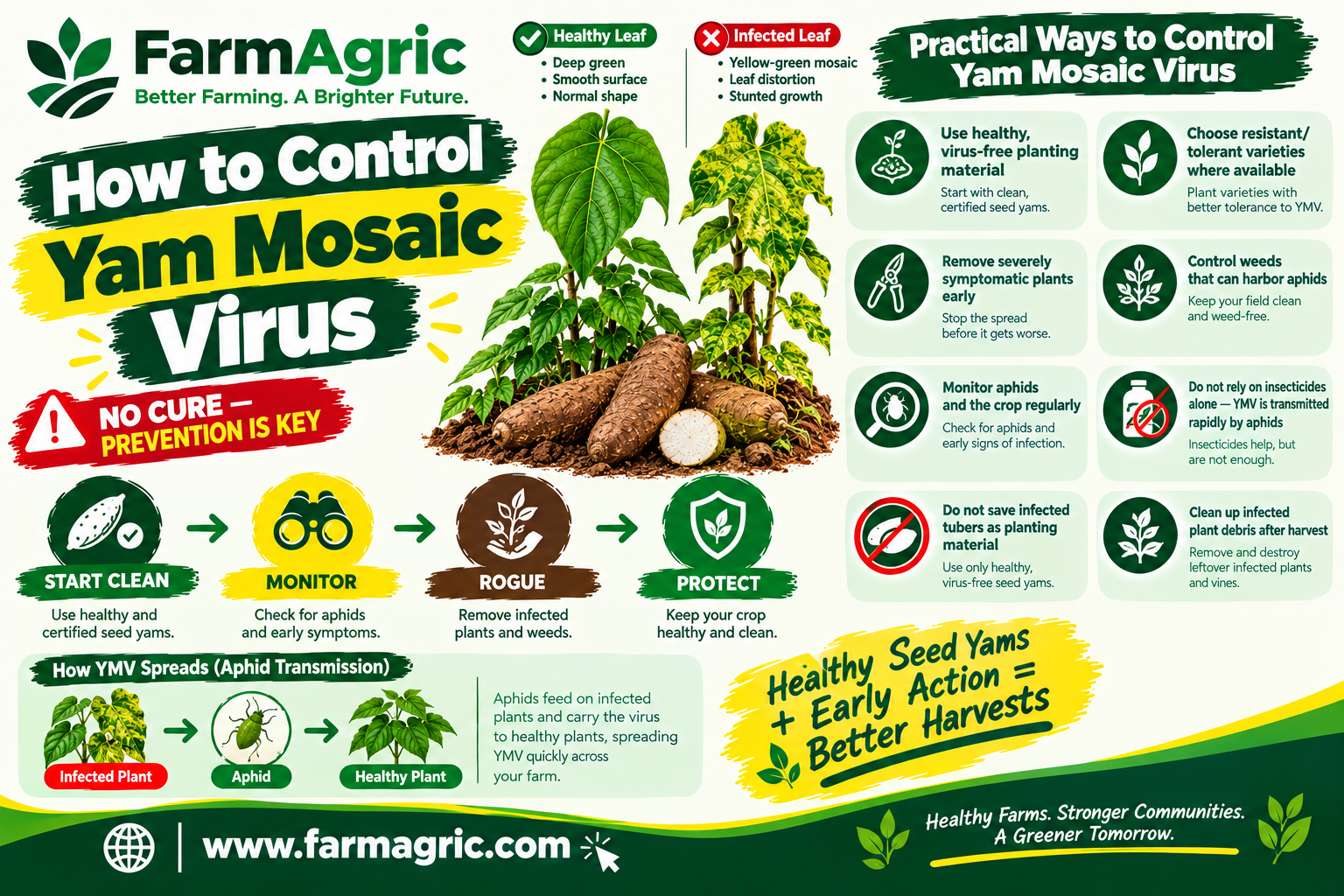
How to Control Yam Mosaic Virus
How to Control Yam Mosaic Virus
I once bought 500 seed yams from a trader because the price was good and the tubers looked big and clean. Six weeks after planting, the leaves in one corner of the field began to show pale green and yellow patches, like someone had smeared old paint on them. I told myself it was just nutrient shortage. By the time I accepted the truth, the sickness had moved along the rows. At harvest, the tubers from those plants were small and poor, and I made the worst mistake of all. I kept some of them for seed, and the next season the same sickness came back, stronger.
Here is the direct answer. There is no spray that cures yam mosaic virus once a plant is infected. You control it by planting clean, healthy seed yams (ideally from a trusted, virus-tested source), removing and destroying infected plants early, growing resistant or tolerant varieties where available, controlling aphids and weeds around the field, rotating crops, and never saving seed from plants that showed mosaic symptoms. Prevention at planting is worth far more than anything you do after the virus shows.
That is the short version. Here is the full picture from three decades of learning this one the hard way.
What Most Farmers Get Wrong
The biggest mistake is believing the virus comes only from the field. It rides inside the seed. Yam is planted from pieces of tuber, not true seed, so a sick plant produces a sick tuber, and a sick tuber produces a sick plant. Every season you replant your own sick seed, the virus travels with you. Many farmers carry the problem forward for years without knowing it.
The second mistake is mistaking mosaic for a nutrient problem. Pale patches, yellow streaks, and twisted leaves look a lot like hunger, so farmers pour on fertilizer. Fertilizer does not cure a virus. It only feeds a sick plant.
The third mistake is keeping infected plants “to see what happens.” A sick plant is a source. Aphids feed on it, then move to healthy plants and spread the virus. Leaving it in the field is like leaving a leaking bucket of disease in the middle of your crop.
The fourth mistake is saving seed from the best-looking tubers of an infected field. A virus-infected plant can still make a big tuber. Looks do not tell you whether it is clean. Symptoms may also be mild or hidden in some seasons and varieties, so a plant that seems fine may still carry the virus.
The fifth mistake is ignoring the weeds and the neighbors. Aphids move in from other fields and from wild plants. A clean field next to a badly infected one still faces pressure.
The sixth mistake is hoping a chemical will rescue the crop. Insecticides can reduce aphid numbers, but they do not cure infected plants, and they cannot fully stop the virus from being spread by aphids that only need to probe a leaf briefly. Chemical use also costs money and carries safety risks.
Know the Enemy
You fight a virus better when you understand how it behaves.
What it is. Yam mosaic virus is a plant virus that attacks yam. Viruses live inside plant cells, so you cannot wash, scrape, or spray them off.
How it spreads. There are two main routes. The first is through infected seed yams, because the virus is carried through vegetative propagation. The second is through aphids, which pick up the virus when they feed on a sick plant and carry it to healthy ones. Some farm tools, such as cutting knives, may also help move virus in plant sap, so cleanliness is a sensible habit.
What it does. It weakens the plant. The leaves make less food, the vine grows poorly, and the tuber comes out smaller and sometimes distorted. Losses vary with the variety, the plant’s age at infection, and whether other viruses are also present. Plants infected early usually suffer more.
What it does not do. It does not spread from the soil in the way many fungal diseases do, so rotation helps mostly by removing volunteer sick plants and breaking the cycle of reinfection, not by “clearing” the virus from the ground.
How to Recognize Yam Mosaic Virus
Symptoms differ by variety, plant age, weather, and other infections, so learn the range.
Mosaic pattern. Light green, yellow, or pale patches mixed with normal green on the leaf, giving a mottled look.
Vein clearing or vein banding. The veins look pale or have a pale band along them, or dark green bands next to the veins.
Leaf distortion. Leaves may be narrow, twisted, puckered, curled, or smaller than normal.
Stunted growth. Infected plants often grow slowly and look weaker than neighbors.
Shortened vines and fewer leaves. The canopy is thin, so the tuber gets less food.
Small, poor tubers. At harvest, infected plants often give smaller or misshapen tubers.
Mild or hidden symptoms. Some plants show few signs, especially in hot weather, or in tolerant varieties. These plants can still carry and spread the virus.
Do not confuse these with similar signs from nutrient shortage, herbicide drift, mites, or other diseases. If you are unsure, take a leaf sample or photo to your agricultural extension officer or a plant clinic. Proper identification saves you from fighting the wrong problem.
Step-by-Step: How I Control Yam Mosaic Virus
Step 1: Start with the cleanest seed you can get. This is the foundation. Where available, buy certified or virus-tested seed yams from reputable programs, research institutes, or seed multipliers, rather than random traders. Ask where the seed was grown and whether the mother plants were inspected. Some research programs produce clean planting material from tissue culture plantlets that are tested for virus, and then multiplied in protected, monitored conditions. Ask your national agricultural research institute or extension officer what is available in your area.
Step 2: Inspect seed before planting. Reject tubers from fields that showed mosaic. Reject tubers with rot, nematode damage, or heavy scarring. Remember that a good-looking tuber is not proof that it is virus-free, so the source matters more than the appearance.
Step 3: Use a seed multiplication plot. If you cannot buy clean seed every season, set aside a small, separate, well-managed plot for producing your own seed from the cleanest stock you have. Plant it away from older yam fields, keep it weed-free, monitor it closely, and remove sick plants at once. Harvest seed only from plants that stayed healthy throughout the season.
Step 4: Choose resistant or tolerant varieties. Plant breeders have developed and identified yam varieties that tolerate the virus better. Ask your research institute or extension service which varieties perform well in your region and meet your market’s needs. A tolerant variety may still carry the virus, but it can lose less yield.
Step 5: Walk the field early and often. In the first 8 to 10 weeks after emergence, I walk the field every week, looking at young leaves. Early detection is everything. A single sick plant caught in week 4 is a small problem. The same plant discovered in week 14 is a spreading one.
Step 6: Rogue infected plants. “Roguing” means removing sick plants. When I find a plant with clear mosaic symptoms, I mark it, then dig it out with its tuber and vine. I take it out of the field in a bag or basket so that leaves do not shake onto healthy plants, and I burn it or bury it deep, far from the field. I do not leave it on the field edge or throw it into a compost heap where seed pieces are stored. Rogue early in the season, and keep checking, because new cases may appear.
Step 7: Clean your tools. Wash or wipe your knife, hoe, and cutlass after working on a suspect plant. When cutting seed yams, clean the blade between tubers with a disinfectant such as a bleach solution or alcohol, following safe handling practice. I cannot give you an exact rate that suits every product, so follow the product label or ask your extension officer.
Step 8: Manage aphids sensibly. Aphids are small, soft-bodied insects, often found on the underside of young leaves and shoot tips. To reduce them, I keep the field and surroundings free of weeds that host aphids, avoid heavy nitrogen feeding that produces soft, lush growth they love, and encourage natural enemies such as ladybirds, lacewings, and small wasps. If aphid numbers are high and you decide to use an insecticide, choose only products registered for yam in your country, follow the label exactly, and ask your extension officer first. Because the virus can be passed on by quick feeding, spraying has limits, so use it as a support and not as your main defense.
Step 9: Control weeds in and around the field. Many weeds shelter aphids and other insects, and some may carry viruses. Keep the field clean, especially in the early weeks, and slash the bunds and surroundings. Remember to weed gently, so you do not wound the vines and tubers.
Step 10: Stake and space properly. Staked, well-spaced vines have better airflow and are easier to inspect. A tidy canopy also makes it easy to spot symptoms early, and plants that are healthy and vigorous tolerate infection better.
Step 11: Rotate crops and clear volunteers. After harvest, remove leftover tubers and vines, because they can regrow as volunteer plants and carry the virus into the next crop. Rotate with cereals or legumes to break the cycle and to help with other yam problems at the same time.
Step 12: Keep records. I write down the seed source, variety, field, planting date, and how many plants showed symptoms and when. After a season or two, the notebook shows which seed sources and varieties give the cleanest crops.
Tissue Culture and Clean Seed Systems
Because the virus travels in seed, the long-term answer to yam mosaic lies in clean seed systems. Research institutes use methods such as meristem culture, where a tiny growing tip is grown in a laboratory to produce healthy plantlets, which are then tested for virus. These are multiplied under protected conditions, including screen houses and aeroponic or small-sett techniques, and supplied as clean starter material. Farmers can then multiply that seed for a season or two before it is replaced.
I am not a laboratory scientist, and availability differs a lot between countries and regions. Ask your national agricultural research institute, extension office, or reputable seed program whether virus-tested yam planting material is available near you. Even buying a small amount of clean starter seed to build your own multiplication plot can change the health of your whole farm over a few seasons.
Warning Signs You Should Act On Immediately
Take action the same day if you see these.
Mosaic or mottling on young leaves in the first weeks. This often points to infection from the seed. Check neighbors and mark the plants.
A patch of stunted, mottled plants. This may mean a bad batch of seed.
New cases spreading along rows over several weeks. Aphids are moving the virus. Increase roguing and weed control.
Heavy aphid colonies on shoot tips. A high chance of fast spread.
Distorted, narrow, or twisted leaves. A common sign of virus stress.
Infected plants near your seed plot. Protect the seed plot with extra checks and remove sick plants nearby.
What To Do With Tubers from Infected Plants
Tubers from infected plants may still be edible, because yam mosaic virus does not harm humans. Quality may be lower, and the tubers may be smaller or misshapen, so sell or eat them, but do not keep them for seed. This is the rule that breaks the cycle on a farm. Mark infected fields and keep their tubers separate from your seed stock at harvest. Where possible, store seed from your cleanest plants in a separate barn section.
What I Would Do Differently If Starting Again Today
I would never again buy seed yams from an unknown source because the price was low. Cheap seed that carries a virus is the most expensive seed I have ever planted.
I would set up a small, protected seed plot from the first season, and treat it as the most valuable ground on the farm.
I would learn the symptoms by heart, and teach every worker to recognize them. Many eyes in the field catch problems earlier.
I would remove sick plants without hesitation, no matter how much I hoped they would recover.
I would ask my extension officer and research institute about resistant varieties and clean seed before every planting season, not after the damage.
And I would keep clear field records, so that I could trace any outbreak to a seed source, a field, or a variety.
Frequently Asked Questions
Can yam mosaic virus be cured?
No. Once a plant is infected, there is no spray or treatment that removes the virus. Control depends on prevention: clean seed, roguing, resistant varieties, aphid and weed management, and good field hygiene.
How does yam mosaic virus spread?
Mainly through infected seed yams, since yam is propagated from tuber pieces, and through aphids that move from sick plants to healthy ones. Contaminated tools may also help it spread.
Can I eat yams from plants with mosaic virus?
The virus does not harm people, so the tubers are generally safe to eat if they are otherwise healthy and not rotten. But do not use them as seed, because they will pass the virus on.
Can I use tubers from an infected field as seed?
You should not. Seed from infected plants carries the virus into the next crop. Always select seed from plants that stayed healthy, ideally from a dedicated clean seed plot or a trusted source.
Does spraying insecticide stop yam mosaic virus?
Not by itself. Insecticides may reduce aphid numbers, but they cannot cure infected plants, and aphids can transmit the virus quickly. Use them only as a support to other measures, and only with registered products and label directions.
Are there yam varieties that resist the virus?
Some varieties tolerate or resist it better than others. Ask your agricultural research institute or extension officer which varieties are recommended for your area and suit your market.
How early should I check for symptoms?
From the first weeks after emergence. Young leaves show symptoms most clearly, and early detection lets you remove infected plants before the virus spreads.
The Advice Worth Bookmarking
You cannot spray a virus out of a yam, so stop it where it begins. Plant clean seed, pull the first sick plant without mercy, and never plant a tuber you would not trust to father your next crop.