How to Stake Yam Vines the Right Way
How to Stake Yam Vines the Right Way
Early in my farming life, I staked half a field and left the other half to crawl. I told myself the cost of sticks and labor was not worth it for a “free-growing” crop. At harvest I dug both halves on the same day. The staked mounds gave me clean, heavy tubers. The ones left on the ground gave me smaller, patchy tubers, with more leaf disease. That one comparison paid for every stake I have bought since.
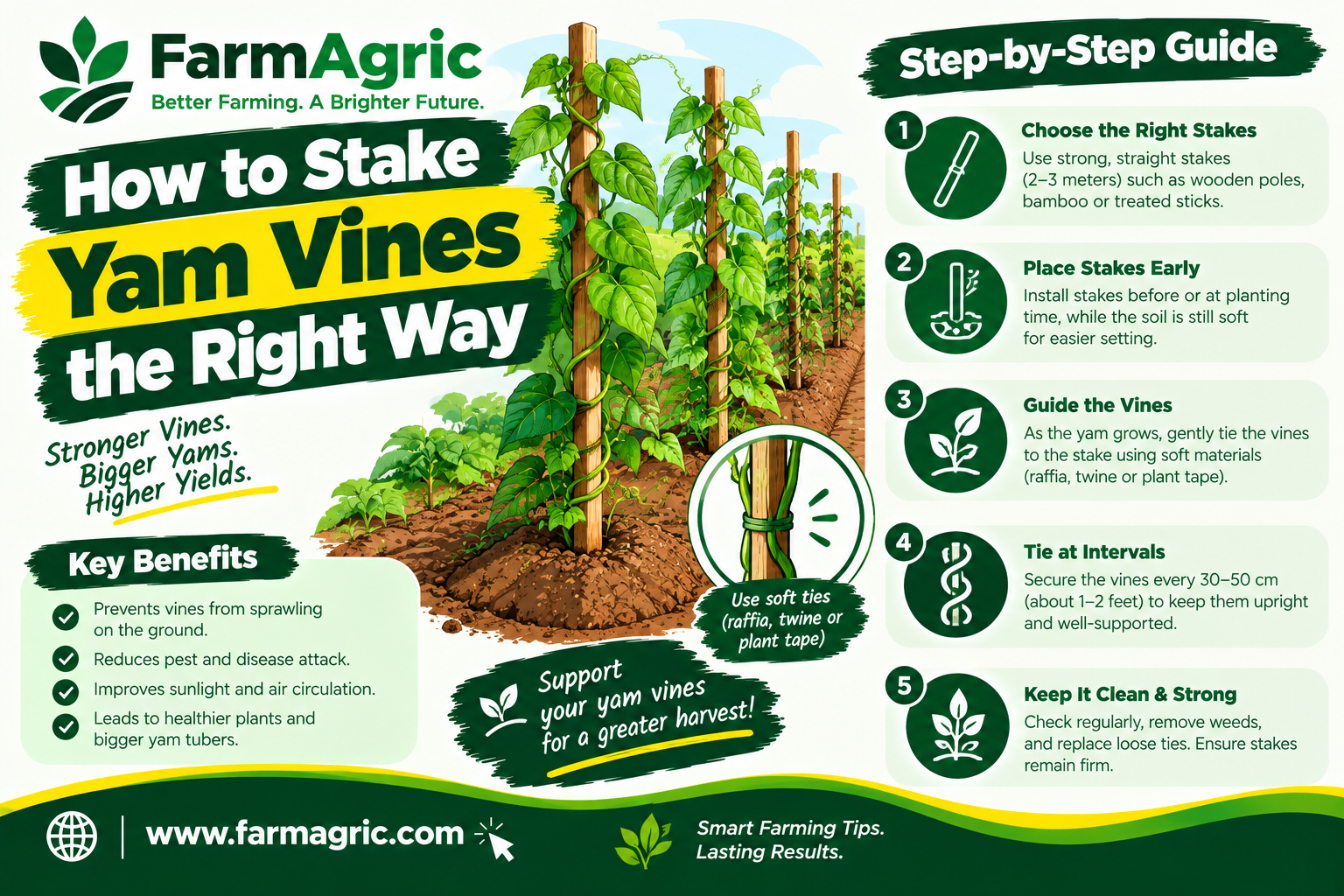
Here is the direct answer. To stake yam vines the right way, put a strong stake 2 to 3 meters tall about 10 to 15 centimeters from each mound, ideally at planting time or within the first 2 to 4 weeks after the shoot appears, then guide the young vine onto it with soft ties, keep one strong vine per stand, and check the ties and stakes every couple of weeks as the vine climbs. The goal is simple. Lift the leaves into the sunlight, keep them off the wet soil, and let air move through the plant.
That is the short version. Here is how I do it, with the mistakes I have already made so you do not have to.
What Most Farmers Get Wrong
The biggest mistake is staking late. A yam vine grows fast once the rains settle. By the time a farmer gets around to staking, the vine has already sprawled over the mound, tangled with its neighbors, and shaded its own leaves. Forcing it up a stake at that point breaks shoots and wastes the best growing weeks. Stake early, when the shoot is still a few centimeters to a hand’s length tall.
The second mistake is using short, weak stakes. A vine can climb well beyond 3 meters in a good season, and a heavy canopy catches wind. A thin, 1 meter stick bends or falls, and the vine falls with it. A fallen vine is a damaged vine.
The third mistake is driving the stake into the mound after planting, right next to the sett. A stake pushed in carelessly can pierce the seed yam, cut young roots, or wound the tuber later. Place the stake at planting, or well to the side of the mound, and push it in carefully.
The fourth mistake is tying too tight. Vines thicken as they grow. A wire or a hard cord that was snug in the first month will strangle the vine by the third month. Always tie loosely, with soft material, and leave room for growth.
The fifth mistake is staking with rotten or termite-prone wood. A stake that snaps in the middle of the season drops the whole canopy. Termites also carry trouble into the mound.
The sixth mistake is leaving too many vines on one stand. Several shoots from one sett compete for the same stake and the same food. The result is a tangle of thin vines and a modest tuber.
Why Staking Pays
Staking is not decoration. It works for several real reasons.
More light for the leaves. Yam makes its food in its leaves, and the tuber is where that food is stored. Leaves held up in open sun make more food than leaves lying in shade on the ground.
Better airflow. A staked canopy dries faster after rain and dew. That means less leaf spot, less anthracnose, and fewer other diseases that love wet, crowded foliage.
Cleaner leaves and vines. Vines off the soil do not pick up splashed spores and soil pests so easily.
Easier work. Weeding, feeding, scouting for beetles, and checking the mound are all easier with a tidy, upright crop. You can walk the rows without trampling vines.
Less vine damage. Sprawling vines get stepped on, bitten by animals, and tangled in weeds.
In my own fields, the staked plants consistently outperform the unstaked ones, and the difference shows most in tuber size and cleanliness. Results vary with variety, soil, and season, so I recommend running a small side-by-side test on your own land.
Choosing What to Stake With
You have several options, and the best choice depends on what you can get cheaply and how long it lasts.
Bamboo poles. Strong, straight, light, and long-lasting. Often my first choice where bamboo is available. Choose mature poles and dry them before use.
Hardwood sticks and poles. Durable and termite-resistant if you pick the right species. Ask local farmers which woods last longest in your area.
Live stakes. Some farmers use fast-growing tree or shrub cuttings, such as Gliricidia, which root and keep growing. They can last several seasons and may even add some nitrogen to the soil. Keep them pruned so they do not shade the yam too heavily.
Trellis or rope systems. For larger farms, farmers build a frame of poles with horizontal wires or ropes, and run strings down to each mound. This shares the load across the structure and saves on the number of tall stakes. It costs more to set up, but it can last many seasons.
Existing plants. Some farmers let yam climb on maize stalks or other tall crops. It is a low-cost approach, but a maize stalk is a weak support and the yam can compete with it, so I treat it as a compromise, not a replacement for a real stake.
Whatever you choose, inspect it before the season. Discard anything cracked, rotten, or eaten by termites.
Step-by-Step: How I Stake Yam Vines
Step 1: Decide on your system before planting. Choose between single stakes, a trellis, or live stakes, and gather the materials early. A farmer who waits until the vines are crawling is already behind.
Step 2: Cut stakes to the right length. I aim for about 2 to 3 meters above the soil surface. Add another 30 to 50 centimeters for the part that goes into the ground, so the stake stands firmly. Taller, strong stakes suit vigorous varieties and good soil. Shorter ones may be enough for weaker types, but I would rather have them too tall than too short.
Step 3: Prepare the stakes. Remove side branches and rough spurs that could wound the vine. Sharpen the lower end to a point so it goes in easily. Where termites are a problem, remove bark and let the stakes dry well, and ask your extension officer about safe, registered ways to protect them.
Step 4: Place the stake correctly. Set the stake about 10 to 15 centimeters from the planting point on the mound, and push it firmly into the ground, at a slight angle away from the sett if you are staking after planting. I try to place stakes at planting time, when I am already working in the mound and there is no sett to hurt. If I must stake later, I push gently and avoid the area where I know the seed yam lies.
Step 5: Make sure the stake is firm. Pull on it. A stake that wobbles now will fall in the first storm. Where the soil is loose, I tamp it down around the base, or I use a longer stake and set it deeper.
Step 6: Stake early. The best time is when the shoot is a few centimeters to a hand’s length tall, usually within the first 2 to 4 weeks after emergence. At this stage the vine is flexible, and you do not damage anything by guiding it.
Step 7: Guide the vine onto the stake. Yam vines naturally twine in a particular direction, depending on the species. Watch how your variety turns on its own and help it to wind the same way, rather than forcing it against its habit. Gently wrap the young vine around the stake a turn or two, and secure it with a soft tie.
Step 8: Tie loosely with soft material. Use strips of cloth, soft raffia, banana fiber, or soft twine. Make a loose figure-eight loop, with the stake in one circle and the vine in the other, so the vine has room to thicken and does not rub against the stake. Avoid wire, nylon thread, and anything that cuts.
Step 9: Keep one strong vine. If more than one shoot comes from the sett, I keep the strongest and remove the weaker ones early. That focuses the plant’s energy on one good vine and one good tuber.
Step 10: Train the vine as it grows. For the first few weeks, I check often. As the vine climbs, it usually holds on by itself, but I add a loose tie every 40 to 50 centimeters where it needs help, especially on smooth stakes. Move stray shoots back to the stake before they wander off into the neighbor’s row.
Step 11: Check ties and stakes regularly. Every 2 weeks, I walk the field to look for loosened ties, leaning stakes, and snapped vines. A quick fix in the morning saves a collapsed canopy after the next rain.
Step 12: Keep the base clean. Remove weeds around the stake, so they do not climb it and compete with the yam. Mulch around the mound to hold moisture, and keep the stake base from sinking into soggy ground.
Step 13: Handle the top carefully. When the vine reaches the top of the stake, let it hang loosely or guide it along a connecting line if you use a trellis. Do not force it down tightly, or you may break it.
Spacing and Row Layout
Staking changes how you think about spacing. Plants set too close shade each other even when staked. A typical spacing is around 1 meter between mounds, though your variety and local recommendation matter. Leave walking paths so that you can reach the stakes and ties without damaging vines.
On slopes, line the stakes along the contour. On flat, windy land, place rows to reduce wind catching the canopy, and use stronger stakes or add side supports.
Staking in Wind and Heavy Rain
Wind is the great enemy of a tall yam canopy. A few habits help.
Use thick, deep-set stakes, especially in open fields.
Tie the vine at several points, so wind does not whip it around the stake.
After a storm, walk the field the same day. Re-set leaning stakes, re-tie vines, and remove broken parts.
In a trellis system, brace the end posts well, because the whole frame depends on them.
What Staking Costs and Why It Still Pays
Yes, staking costs money and labor, and it is one of the bigger expenses in yam farming. But you can reduce the cost by planning ahead. Grow your own live stakes or bamboo clumps near the field. Reuse sturdy stakes for several seasons, storing them dry and upright between crops. Share harvesting and staking labor with neighbors, and cut stakes in the dry season when other farm work is lighter.
When I count what staking returns in larger, cleaner tubers and fewer disease losses, I would not skip it. That said, I tell farmers to test it first on a small plot and measure the difference on their own land.
Warning Signs Your Staking Is Not Working
Watch for these.
Vines lying on the ground or sprawling sideways. The stake is too short, too late, or the vine was never guided onto it.
Vines falling over after rain or wind. The stake is weak, too shallow, or poorly tied.
Thin, cut, or swollen marks on the vine at the tie point. The tie is too tight.
Several vines tangled on one stake. Too many shoots were left on the stand.
Leaves yellowing and spotting low on the plant. Poor airflow or wet leaves, often from vines trailing near the soil.
Termite trails on stakes. The stake is infested and about to fail.
Wilting after you drive in a late stake. You may have damaged the roots or the seed yam.
If you see these, fix them early. A quick re-tie or a replaced stake in week 6 beats a lost canopy in week 16.
What I Would Do Differently If Starting Again Today
I would put in every stake at planting time, when there is no sett to injure and no vine to chase. It costs the same labor and saves me a lot of trouble.
I would always choose the taller, stronger stake. Replacing a snapped short stake in the middle of the season has cost me more than buying the right ones at the start.
I would use soft ties from the first day and never use wire. I learned that from vines I had to cut free in the middle of the season.
I would grow a small patch of live stakes or bamboo near the farm, so I would not scramble for sticks each year.
I would keep one vine per stand without fail.
And I would take notes. Planting date, staking date, stake type, and harvest result for each block. After two seasons, I would know exactly which method gives the best return on my own land.
Frequently Asked Questions
When should I stake yam vines?
As early as possible, ideally at planting or within the first 2 to 4 weeks after the shoot appears. A young vine is easy to guide, and early staking prevents sprawling and damage.
How tall should yam stakes be?
Most farmers use stakes about 2 to 3 meters above the soil, with extra length underground for stability. Vigorous varieties may need the taller end of that range.
Do I really need to stake yam?
You can grow yam without staking, and some farmers do. In my experience and in many farmers’ experience, staked yam usually gives better light, less leaf disease, and larger, cleaner tubers. Test it on a small plot and compare results.
What is the best material for yam stakes?
Straight, strong, termite-resistant poles such as bamboo or durable hardwood work well. Live stakes can be a good long-term choice. Choose what lasts in your area and fits your budget.
How do I tie yam vines without hurting them?
Use soft material such as cloth strips, banana fiber, or soft twine, and tie in a loose figure-eight so the vine has room to thicken. Avoid wire and hard cord.
Can I stake after the vine has already sprawled?
Yes, but handle with great care. Lift the vine gently, avoid breaking shoots, and place the stake away from the sett. The sooner you do it, the better, because older vines are brittle and harder to train.
Should I remove extra vines from one mound?
Generally yes. Keeping the strongest vine and removing the weaker ones focuses the plant’s energy on one good tuber and makes staking easier.
The Advice Worth Bookmarking
A yam vine on the ground is feeding the soil. A yam vine in the sun is feeding the tuber. Put the stake in before the vine decides for itself, and you will harvest what you staked.