How to Control Nematodes in Plantain Farming
How to Control Nematodes in Plantain Farming
How to Control Nematodes in Plantain Farming: A Farmer’s Guide to Fighting an Enemy You Will Never Actually See
I spent nearly two full seasons blaming poor soil for a plantain stand that kept toppling in ordinary wind, producing undersized bunches, and generally underperforming compared to a field I had planted around the same time just a short distance away on what I assumed was simply better ground. It was only when an agricultural officer dug up a struggling plant at my request and sliced open the roots and the base of the corm that the real problem became visible, a root system riddled with dark, reddish-brown lesions and noticeably fewer healthy white roots than a plant that size should have had. Nematodes, microscopic worms living in the soil and inside the plant’s own root tissue, had been quietly undermining that entire field for longer than I had been looking in the wrong place for an explanation. That discovery changed how I think about plantain problems generally, because nematodes are a cause I now rule in or out early, specifically because they cause exactly the kind of symptoms, poor anchorage, small bunches, general weak growth, that are so easy to misattribute to almost anything else.
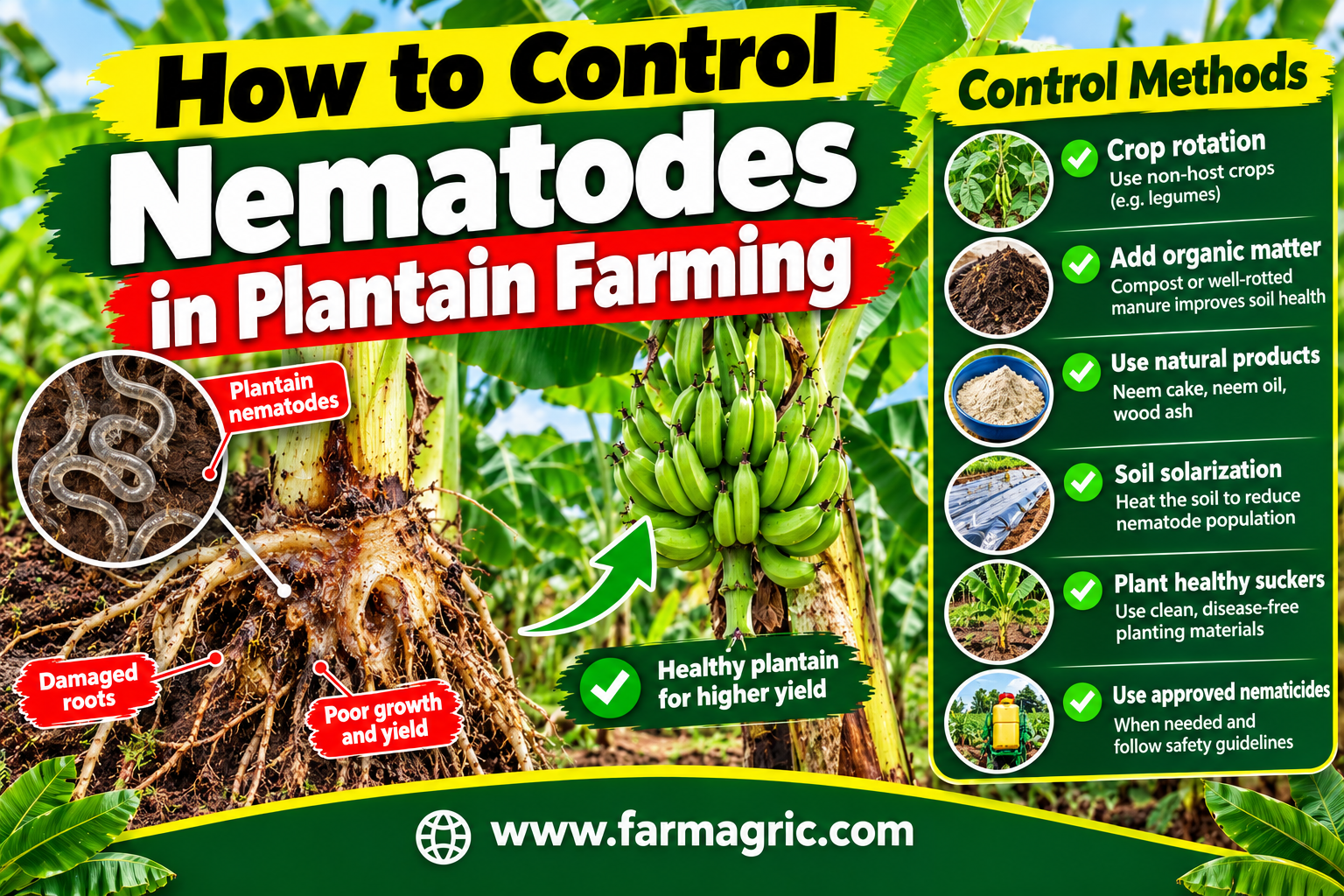
So let me answer you straight, because I know you are dealing with weak growth, poor anchorage, or disappointing bunch size and are starting to wonder whether something invisible is working against you below the soil. You control nematodes in plantain farming mainly by using clean, nematode-free planting material through hot water treatment or paring of suckers before planting, rotating plantain with non-host crops to break the nematode population’s continuous access to a food source, maintaining high organic matter in the soil which supports natural nematode-suppressing organisms, avoiding the movement of soil or planting material from infested fields into clean ones, and in severe cases using nematicides as a targeted, carefully managed tool rather than a routine, automatic treatment. Nematodes are not an insect you can scout for on a leaf or trap with a pheromone lure, they live entirely within the soil and the plant’s own root tissue, which means control depends almost entirely on prevention and on breaking their life cycle through management practices rather than on any kind of direct, visible intervention against a pest you will essentially never actually see.
Why Nematodes Are Such a Uniquely Difficult Problem to Diagnose and Manage
Plant-parasitic nematodes affecting plantain are microscopic roundworms living in the soil and feeding directly on root tissue, where they cause physical damage, introduce entry points for secondary infections, and directly interfere with the root system’s ability to take up water and nutrients effectively. Because these organisms are invisible without laboratory examination or, at minimum, cutting open roots and looking closely at the tissue itself, a farmer dealing with nematode damage typically sees only the downstream symptoms, weak growth, poor anchorage, reduced yield, increased susceptibility to toppling, without any obvious above-ground clue pointing specifically toward nematodes as the actual cause rather than nutrient deficiency, general poor soil, or any number of other possible explanations a farmer might reasonably consider first. This diagnostic difficulty is compounded by the fact that nematode damage often develops gradually over multiple growth cycles on the same perennial planting, making it easy to attribute a field’s declining performance over several years to simple soil exhaustion rather than to a specific, identifiable, and at least partially manageable pest working steadily beneath the surface the entire time.
What Most Farmers Get Wrong
The first mistake, the one behind my own two seasons of misdirected blame, is not considering nematodes as a possible cause at all when a plantain field underperforms in ways that could just as easily be attributed to soil fertility, water stress, or general poor management, missing an identifiable and at least partially manageable problem simply because it never occurred to investigate what was happening at the root level specifically.
The second mistake is using planting material, suckers taken for establishing new fields or replacing gaps in existing ones, without any consideration of whether the source plant or source field might already be carrying a nematode infestation, inadvertently spreading the problem into new, previously clean ground through exactly the planting material meant to establish a fresh, healthy stand.
The third mistake is planting continuous plantain on the same land for many years without any rotation or break, allowing nematode populations specific to that plot to build steadily across successive growing cycles, since a perennial crop grown continuously in the same soil provides an uninterrupted food source that a genuine break through rotation would otherwise disrupt.
The fourth mistake is neglecting soil organic matter and general soil health, not recognizing that healthier, more biologically active soil with good organic matter content tends to support a broader community of natural nematode predators and competitors that can help suppress problematic nematode populations, compared to depleted, biologically simplified soil where few natural checks on nematode numbers exist.
The fifth mistake is moving soil, tools, or planting material between fields without any consideration of nematode transfer risk, not recognizing that soil clinging to equipment, boots, or planting material itself can carry nematodes directly from an infested area into previously clean ground, spreading a problem that could otherwise have remained contained to its original location.
Step-by-Step Plan to Control Nematodes in Plantain Farming
Start by confirming whether nematodes are actually contributing to a struggling plantain field’s problems, digging up a representative plant from the affected area and examining the root system and corm base directly, looking for dark, reddish-brown or black lesions on roots, a noticeably reduced number of healthy white roots compared to what a plant of that size and age should have, and general root system decline that does not have an obvious alternative explanation such as visible pest tunneling or waterlogged, rotting tissue from a clearly different cause.
Where resources allow, send root and soil samples to a laboratory capable of nematode identification and counting, since this provides more definitive confirmation than visual inspection alone and can identify which specific nematode species are present, information that can be useful for understanding the severity of the problem and selecting the most appropriate management response.
Source planting material carefully for any new plantain establishment or for replacing gaps in existing fields, prioritizing suckers from fields with no known history of nematode problems, and where there is any uncertainty about the source material’s status, consider treating suckers before planting through paring, trimming away the outer corm tissue where nematodes tend to concentrate, or hot water treatment, submerging cleaned suckers in water held at a carefully controlled temperature for a specific duration that kills nematodes without damaging the planting material itself.
Avoid moving soil, used tools, or untreated planting material from a known or suspected infested field into clean, previously unaffected areas, cleaning equipment thoroughly between use in different fields where nematode status is uncertain or known to differ, and being particularly cautious about this kind of movement during land preparation or sucker harvesting activities that naturally involve significant soil disturbance and contact.
Rotate plantain with non-host crops where your land and planning allow for this kind of break, since continuous plantain cultivation on the same ground provides nematodes with an uninterrupted food source across multiple growth cycles, while a season or more of a genuinely non-host crop interrupts that continuous cycle and can meaningfully reduce nematode populations before plantain is reestablished on that same land.
Build and maintain soil organic matter through regular incorporation of compost, well-rotted manure, and crop residue, since biologically active, organic-matter-rich soil tends to support a broader community of nematode-suppressing organisms, including certain fungi and bacteria that naturally prey on or compete with plant-parasitic nematode populations, compared to depleted soil with little biological activity to provide this kind of natural check.
Consider specific cover crops or rotation crops known to have some suppressive effect on nematode populations where this information is available for your region and the specific nematode species present, since certain plants produce compounds in their roots that are directly toxic to nematodes or otherwise disrupt their reproduction, offering an additional tool beyond simple crop rotation alone.
Maintain overall plant vigor through proper nutrition and water management across your plantain planting, since vigorous, well-nourished plants generally tolerate a given level of nematode pressure somewhat better than stressed, poorly maintained plants, even though this does not address the underlying nematode population directly the way more targeted interventions do.
Reserve nematicide application for situations where nematode pressure has been confirmed as significant and other management approaches have not provided adequate control, following label instructions precisely for any product used, since nematicides are generally a more intensive, costly, and in some cases environmentally concerning tool compared to the preventive and cultural practices that form the foundation of good nematode management.
Monitor replanted or rotated fields over subsequent growth cycles for signs of improvement, digging occasional test plants to check root condition directly rather than relying purely on above-ground vigor as your only indicator, since root-level improvement following rotation or other management changes may take more than one growth cycle to become fully apparent in overall plant performance.
Keep records of which fields have shown nematode problems, what planting material and rotation history each field has had, and how different management changes have affected subsequent plantings, since this information, tracked over the multiple years relevant to a perennial crop like plantain, becomes genuinely valuable for making informed decisions about where and how to establish future plantings on your specific land.
Warning Signs to Watch For
A plantain field with noticeably weaker anchorage than expected, shown through increased toppling during ordinary wind that would not typically bring down a healthy, well-established planting, deserves investigation into root health specifically rather than being assumed to simply reflect inadequate propping or an unusually strong wind event. Smaller than expected bunch size across a field that has otherwise received reasonable fertilization and water management, without an obvious alternative explanation such as overcrowding or a confirmed nutrient deficiency, is worth checking against root condition as a possible underlying cause. Dark, reddish-brown or black lesions visible on roots when a plant is dug up and examined directly are a fairly clear visual indicator of likely nematode damage, distinct from the kind of damage a different soil pest or simple waterlogging would typically produce. A field showing a gradual, multi-year decline in overall vigor and productivity, where no clear single cause such as a specific disease outbreak or an obvious fertility problem has been identified, fits the pattern nematode damage often follows, building slowly and steadily rather than appearing as a sudden, dramatic event. And a new planting established from suckers sourced from a field with a known or suspected nematode history that begins showing similar symptoms within its own first couple of growth cycles suggests the problem was likely carried directly into the new field through that planting material.
What I’d Do Differently If Starting Again Today
If I were starting over, I would dig up and examine the roots of a struggling plant far earlier in any field underperforming for reasons I could not otherwise clearly explain, rather than spending nearly two full seasons attributing my own struggling field’s problems to simple poor soil before finally getting the direct, root-level answer that had been available the entire time. I would source planting material far more carefully, asking about the history of any field I was taking suckers from and treating that material through paring or hot water treatment whenever there was genuine uncertainty about its nematode status, rather than assuming all planting material was equally safe regardless of its origin. I would build genuine crop rotation into my plantain planning from the beginning, even though the perennial, multi-year nature of plantain makes this harder to fit into a farm’s overall planning than it would be for an annual crop, since I now understand how much continuous plantain cultivation on the same ground was likely contributing to the specific problem I eventually uncovered. And I would invest more consistently in building soil organic matter across all my plantain fields, understanding now how much that broader soil health investment contributes to natural nematode suppression in a way that works quietly in the background rather than requiring the kind of direct, confirmed diagnosis that finally alerted me to the problem in that first struggling field.
Frequently Asked Questions About Controlling Nematodes in Plantain Farming
How can I tell if nematodes are affecting my plantain without a laboratory test? Dig up a struggling plant and examine the roots directly, looking for dark, reddish-brown or black lesions and a noticeably reduced number of healthy white roots compared to what a plant of that size should normally have, since this kind of visible root damage, combined with symptoms like poor anchorage and reduced bunch size that lack another obvious explanation, is a reasonably strong practical indicator even without formal laboratory confirmation.
Can nematodes really be spread through plantain suckers used as planting material? Yes, suckers taken from an infested field can carry nematodes directly into new planting ground, which is why sourcing planting material from fields with no known nematode history, or treating suckers through paring or hot water treatment before planting, is one of the most important preventive steps available against introducing this problem into previously clean land.
Does crop rotation really help control nematodes in a perennial crop like plantain? Yes, even though plantain’s multi-year productive life makes rotation logistically more complex than with an annual crop, rotating affected land to a genuinely non-host crop for a season or more before reestablishing plantain interrupts the continuous food source that allows nematode populations to build steadily across successive plantain growth cycles on the same ground.
Is it worth building soil organic matter specifically for nematode control, or is that just general good practice? Both, since organic-matter-rich, biologically active soil genuinely supports a broader community of natural nematode predators and competitors that help suppress problematic nematode populations, meaning this generally beneficial soil health practice also provides a specific, meaningful contribution toward nematode management rather than being purely a general recommendation unrelated to this particular problem.
When should I consider using a nematicide for plantain nematode control? Nematicide use is generally best reserved for situations where nematode pressure has been confirmed as significant, ideally through direct root examination or laboratory testing, and where preventive and cultural practices like clean planting material and rotation have not provided adequate control on their own, given the greater cost and management intensity nematicides typically involve compared to these foundational practices.
If there is one thing I want you to remember from all this, it is that the enemy working against your plantain field might be one you will never actually see with your own eyes, so when a field underperforms in ways that do not add up to any obvious explanation, dig up a plant, slice open the roots, and look closely before you spend two seasons the way I did, blaming soil that may have been telling you the truth about nematodes the entire time, if only I had thought to look closely enough to actually hear it.