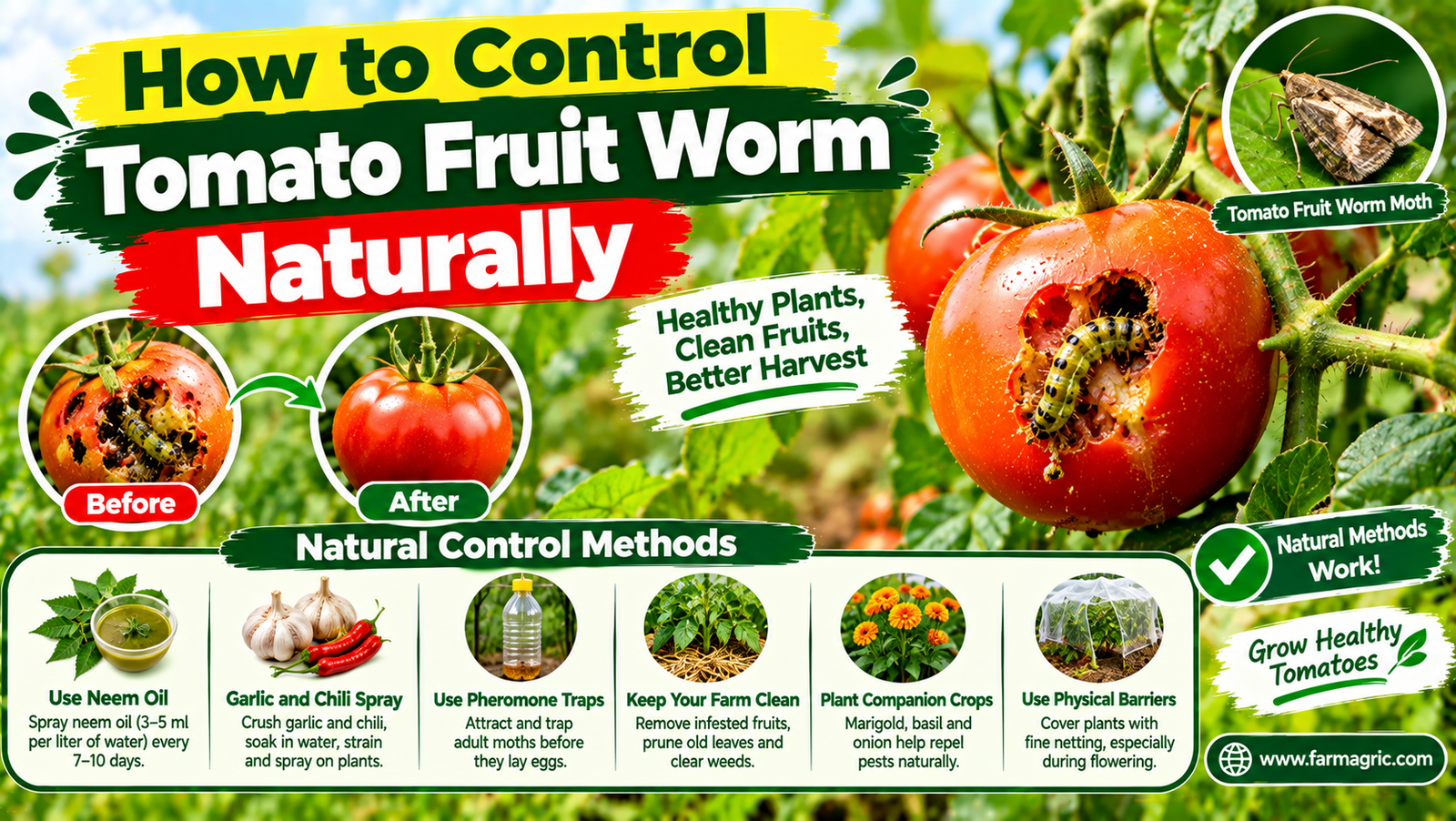
How to Control Tomato Fruit Worm Naturally
How to Control Tomato Fruit Worm Naturally: A Farmer’s Guide to Beating This Pest Without Chemical Spray
I remember reaching into a tomato plant to pick what looked like a perfectly ripe fruit, only to find a neat, round hole near the stem end with a soft, mushy interior that told me I was too late before I had even turned it over completely. When I split that fruit open, I found a plump, striped caterpillar curled comfortably inside, having eaten its way through most of the flesh while the outside still looked reasonably presentable from a short distance. That was my introduction to tomato fruit worm, and what struck me most that season was how many fruit I lost to a pest I rarely actually saw crawling on the plant itself, since it spends nearly all of its damaging life hidden inside the very fruit it is destroying. Fifteen years later, I control this pest almost entirely without chemical spray, and the methods that work are ones that catch the insect at the stages before it ever tunnels into a fruit and disappears from view.
So let me answer you straight, because I know you have found that same telltale hole in a fruit you were looking forward to picking. You control tomato fruit worm naturally by scouting regularly for eggs and young caterpillars before they bore into fruit, hand-picking and destroying both whenever you find them, encouraging natural predators like parasitic wasps and birds by avoiding broad-spectrum insecticide, using pheromone or light traps to catch adult moths before they lay eggs, planting trap crops like sweet corn nearby to draw egg-laying moths away from your tomatoes, and removing and destroying damaged fruit promptly so any caterpillar already inside cannot complete its life cycle and produce the next generation of moths. This pest, like several others that tunnel into the parts of a plant we cannot easily see, rewards a farmer who focuses control efforts on the stages that happen out in the open, the egg and the newly hatched caterpillar, rather than trying to reach a worm that has already disappeared into the fruit itself.
Why Tomato Fruit Worm Is So Hard to Catch Once It Is Inside
The adult moth lays individual eggs, usually on leaves near developing flower clusters or on the fruit itself once it begins to form, and the young caterpillar that hatches feeds briefly on the surface before boring into the nearest available fruit, where it then spends the majority of its damaging life protected from view and largely protected from any spray applied to the plant’s exterior. By the time a farmer notices the entry hole or the visible external damage, the caterpillar inside has usually already consumed a significant portion of that fruit’s interior and is well on its way toward completing its development. This life cycle is almost identical in structure to how fall armyworm operates in maize, hiding deep in the whorl where sprays cannot reach effectively, and it means that natural control methods focused on the egg and early larval stages, before boring begins, genuinely have an advantage over reactive spraying aimed at a caterpillar that has already found its hiding place.
What Most Farmers Get Wrong
The first mistake, the one that caught me off guard with that first hollowed fruit, is not scouting closely enough for eggs and very young caterpillars before damage becomes visible, since a quick glance at the outside of developing fruit tells you almost nothing about what might already be happening at the egg or newly hatched stage nearby.
The second mistake is waiting until visible fruit damage appears before taking any action at all, by which point the caterpillar responsible for that particular hole has usually already done most of the damage it is going to do and is close to completing its development regardless of what you do next.
The third mistake is relying heavily on broad-spectrum insecticide, which does little to reach a caterpillar already tunneled inside a fruit and simultaneously kills off the parasitic wasps and other natural predators that provide meaningful, ongoing control of this pest for free when their populations are allowed to build undisturbed.
The fourth mistake is leaving damaged, worm-infested fruit on the plant or dropped on the ground nearby rather than removing and destroying it promptly, allowing the caterpillar inside to complete its development, emerge as an adult moth, and lay the next generation of eggs right back into the same planting.
The fifth mistake is planting tomatoes without any awareness of nearby trap crop options or moth activity patterns, missing the opportunity to draw egg-laying moths toward a more attractive alternative planting rather than concentrating all their egg-laying directly onto the tomato crop itself.
Step-by-Step Natural Control Plan for Tomato Fruit Worm
Start by scouting your plants at least twice a week, checking the undersides of leaves near flower clusters and developing fruit, along with the surface of young fruit itself, for the small, round, pale eggs the adult moth lays individually rather than in clusters. Catching eggs before they hatch, and simply crushing them between your fingers, prevents that particular caterpillar from ever reaching the fruit at all.
Look closely for very young caterpillars as well, small and pale before they develop their more recognizable striped pattern, often found feeding briefly on leaves or the surface of a fruit before boring in. Hand-pick and destroy any you find at this stage, since this brief window before boring begins is your best opportunity to stop that specific caterpillar without any damage having occurred yet.
Set up pheromone traps specifically designed for tomato fruit worm moths where available, since these traps use a scent that mimics the female moth to attract and catch adult males, both reducing the mating and egg-laying that follows and giving you a useful early warning of how much moth activity is present in your area at any given time.
Consider light traps as an additional tool, particularly effective when run during the evening hours when adult moths are most active, catching a portion of the adult population before they have the chance to lay eggs across your planting.
Plant a trap crop such as sweet corn nearby, since egg-laying moths for this pest often prefer corn silk as an egg-laying site over tomato fruit when given the choice, effectively drawing a portion of the moth population and its eggs away from your main tomato crop and onto a sacrificial planting you can monitor and manage separately.
Encourage natural predators by avoiding unnecessary broad-spectrum insecticide use throughout the season, since parasitic wasps that lay their own eggs inside fruit worm eggs or young caterpillars, along with various predatory insects and birds, provide substantial ongoing control when left undisturbed to build their populations naturally over time.
Maintain some flowering plants or less disturbed vegetation near field margins to support the adult stage of parasitic wasps and other beneficial insects, similar to the habitat management principle that helps with several other pests across different crops.
Remove and destroy any fruit already showing entry holes or other signs of damage as soon as you find them, taking them completely out of the growing area rather than leaving them on the plant or dropping them nearby, since the caterpillar inside a damaged fruit will otherwise continue developing toward becoming a breeding adult regardless of whether you have picked that fruit or not.
Inspect fruit regularly through the ripening period specifically, since fruit becomes an attractive egg-laying and boring site as it develops, meaning your scouting frequency should increase somewhat as your plants move from flowering into active fruit development and ripening.
Rotate your planting location for tomatoes and related crops where practical, since fruit worm pupae can survive in the soil between seasons, and continuous planting of susceptible crops in the same location allows this carryover population to persist and build rather than being interrupted by a season of something the pest does not use as a host.
Manage crop residue after harvest by clearing old plant material rather than leaving it standing or lying in the field, since this reduces the overwintering or carryover population available to affect your next planting in the same area.
Keep a simple record of when you first notice moth activity, eggs, or damage each season, since this timing often follows a fairly consistent pattern year to year in a given location, letting you anticipate and increase scouting frequency proactively as that window approaches in future seasons rather than only reacting once damage has already appeared.
Warning Signs to Watch For
A small, round entry hole near the stem end of a developing or ripening fruit, often with a small amount of visible frass just outside it, is the clearest sign that a caterpillar has already bored in and is feeding inside, and any fruit showing this sign should be removed and destroyed promptly rather than left in place. Small, pale, individually laid eggs on the undersides of leaves near flower clusters or on the surface of young fruit, rather than in clusters, signal that egg-laying is actively underway and that scouting and hand-picking should be a priority over the following days. Young caterpillars feeding openly on leaf surfaces or on the outside of fruit before any boring has occurred represent your best remaining opportunity to remove that particular insect before it disappears from view and becomes far harder to address. A noticeable increase in moth catches in a pheromone trap, where one is in use, signals rising local moth pressure and is worth treating as a cue to scout more intensively over the following one to two weeks as those moths lay their eggs. And fruit that looks externally intact but feels unusually soft or hollow in one area when gently pressed may already have hidden internal damage from a caterpillar that entered through a very small, easily missed opening, making this worth checking by hand on fruit you are about to harvest from a planting known to have some level of pest pressure.
What I’d Do Differently If Starting Again Today
If I were starting over, I would build a twice-weekly scouting habit specifically focused on eggs and young caterpillars from the very first season, rather than only noticing this pest once it had already announced itself through a hollowed, ruined fruit the way it did for me that first time. I would set up pheromone traps as a standard early-season practice rather than something I only adopted after years of dealing with heavier pressure than necessary, since the early warning they provide has consistently helped me scout more intensively at exactly the right moments in the seasons since I started using them. I would plant a small trap crop of sweet corn near my tomatoes as routine practice rather than an occasional experiment, given how clearly it has drawn egg-laying pressure away from my main crop in the seasons where I have used it consistently. And I would protect my natural predator populations far more deliberately from the beginning, understanding now how much free, ongoing control I was undermining in my earlier years of reaching for broad-spectrum options out of habit rather than genuine necessity.
Frequently Asked Questions About Natural Tomato Fruit Worm Control
Can I still eat tomatoes that had fruit worm damage if I cut away the affected part? Yes, cutting away the damaged portion, along with the tunnel the caterpillar created, leaves the remaining fruit generally safe to eat, though badly damaged fruit with significant internal decay following the initial worm damage is better discarded entirely.
Why don’t I ever see the caterpillar on my tomato plants before finding damaged fruit? Tomato fruit worm caterpillars bore into fruit shortly after hatching and spend nearly all of their feeding period hidden inside, which is exactly why scouting specifically for eggs and very young caterpillars before boring occurs is so much more effective than looking for the caterpillar itself once damage has become visible.
Does planting sweet corn near tomatoes really help reduce fruit worm damage? Yes, adult moths often prefer laying eggs on corn silk over tomato fruit when both are available, so a trap crop of sweet corn planted nearby can genuinely draw a meaningful portion of egg-laying activity away from the tomato planting itself.
Are pheromone traps effective against tomato fruit worm without any other control methods? Pheromone traps work best as one part of a broader approach, since they catch adult male moths and provide useful early warning of population pressure, but combining them with regular scouting, hand-picking of eggs and young caterpillars, and predator protection gives significantly better overall control than relying on traps alone.
Why shouldn’t I just use insecticide against tomato fruit worm since natural methods take more effort? Insecticide struggles to reach caterpillars already tunneled inside fruit, meaning much of its effect falls on the more vulnerable but also more beneficial insects like parasitic wasps that would otherwise provide free, ongoing control, so relying heavily on chemical treatment can undermine long-term management even when it offers some short-term reduction in visible adult moths or exposed young caterpillars.
If there is one thing I want you to remember from all this, it is that tomato fruit worm wins the moment it disappears inside a fruit, so beat it before that happens, at the egg you crush between your fingers, the young caterpillar you catch feeding out in the open, and the trap that pulls the adult moth away from your planting before she ever lays the eggs that would have become the next hole in the next fruit you were looking forward to picking.