How to Control Weeds in Rice Without Killing the Crop
How to Control Weeds in Rice Farming Without Killing the Crop: A Farmer’s Guide to Safe, Effective Control
I ruined a section of my own paddy once with a herbicide I applied at the wrong growth stage, close enough to transplanting that the young rice seedlings hadn’t fully recovered from transplant shock yet. Within four days those seedlings had gone from pale green stress to a yellowed, curled mess that never fully caught up with the rest of the field for the whole season. I’d read the label, I’d used the right chemical for the weeds I had, but I hadn’t respected the timing, and rice, I learned that season, is a lot less forgiving of herbicide mistakes than maize ever was. Weeds are one of the most costly problems in rice farming, often costing more yield than pests or disease combined if left unmanaged, but the fix has to be precise, because the same water that helps weeds establish also means chemical or physical mistakes spread and concentrate differently than they do in a dry field.
So let me answer you straight, because I know you’re standing over a weedy paddy right now trying to figure out how to clean it up without setting your rice back in the process. You control weeds in rice without harming the crop by combining proper water management to suppress weed germination, timely hand weeding or mechanical weeding during the critical early weeks, and if using herbicide, matching the product and timing precisely to your rice’s growth stage and method of establishment, since transplanted and direct-seeded rice have very different tolerance windows. Weed control in rice isn’t really about finding one silver bullet method, it’s about layering water management, timing, and selective intervention so that the rice always has the advantage over whatever weeds are trying to establish alongside it.
Why Rice and Weeds Compete So Differently Than Other Crops
Standing water is actually one of rice’s biggest natural advantages against weeds, since most weed species can’t germinate or survive in flooded conditions the way rice itself can. This is part of why water management sits at the center of weed control in rice in a way it simply doesn’t for a dry-land crop like maize. But that advantage only holds if the water is managed correctly and consistently, because gaps in flooding, poor land leveling that leaves dry patches, or periods where fields are drained for other reasons all create windows where weeds establish and then have to be dealt with through other means. Direct-seeded rice faces heavier weed pressure than transplanted rice specifically because transplanted seedlings already have a size and root advantage over weeds germinating from seed at the same time, while direct-seeded rice starts the competition from scratch alongside the weeds.
What Most Farmers Get Wrong
The first mistake, the one that cost me that damaged section of paddy, is applying herbicide without properly accounting for crop growth stage and establishment method. Rice is significantly more sensitive to herbicide timing than many farmers realize, and the safe window for one product can be completely different from another, or completely different between transplanted and direct-seeded systems.
The second mistake is neglecting water depth and consistency as a primary weed control tool, treating it purely as an irrigation question rather than recognizing its central role in suppressing weed germination. A field with inconsistent water depth, too shallow in places, dry patches elsewhere, is inviting weeds into exactly those gaps.
The third mistake is delaying the first weeding pass too long. The first three to four weeks after transplanting or direct seeding are the most critical window for weed competition, and weeds allowed to establish heavily during this period cause yield damage that later weeding, even if thorough, can’t fully undo.
The fourth mistake is using a herbicide meant for one weed type, broadleaf weeds for example, when the actual problem is a grass weed or a sedge, which require different products entirely. Misidentifying the weed spectrum in the field leads to spraying that looks like it did nothing, when really it was simply the wrong tool for that particular weed.
The fifth mistake is over-relying on herbicide alone without any water management or hand weeding as backup, leaving no fallback if the chemical application has poor results due to weather, timing, or weed resistance, which is becoming an increasing issue with certain herbicide classes used repeatedly in the same fields over many seasons.
Step-by-Step Weed Control Plan for Rice
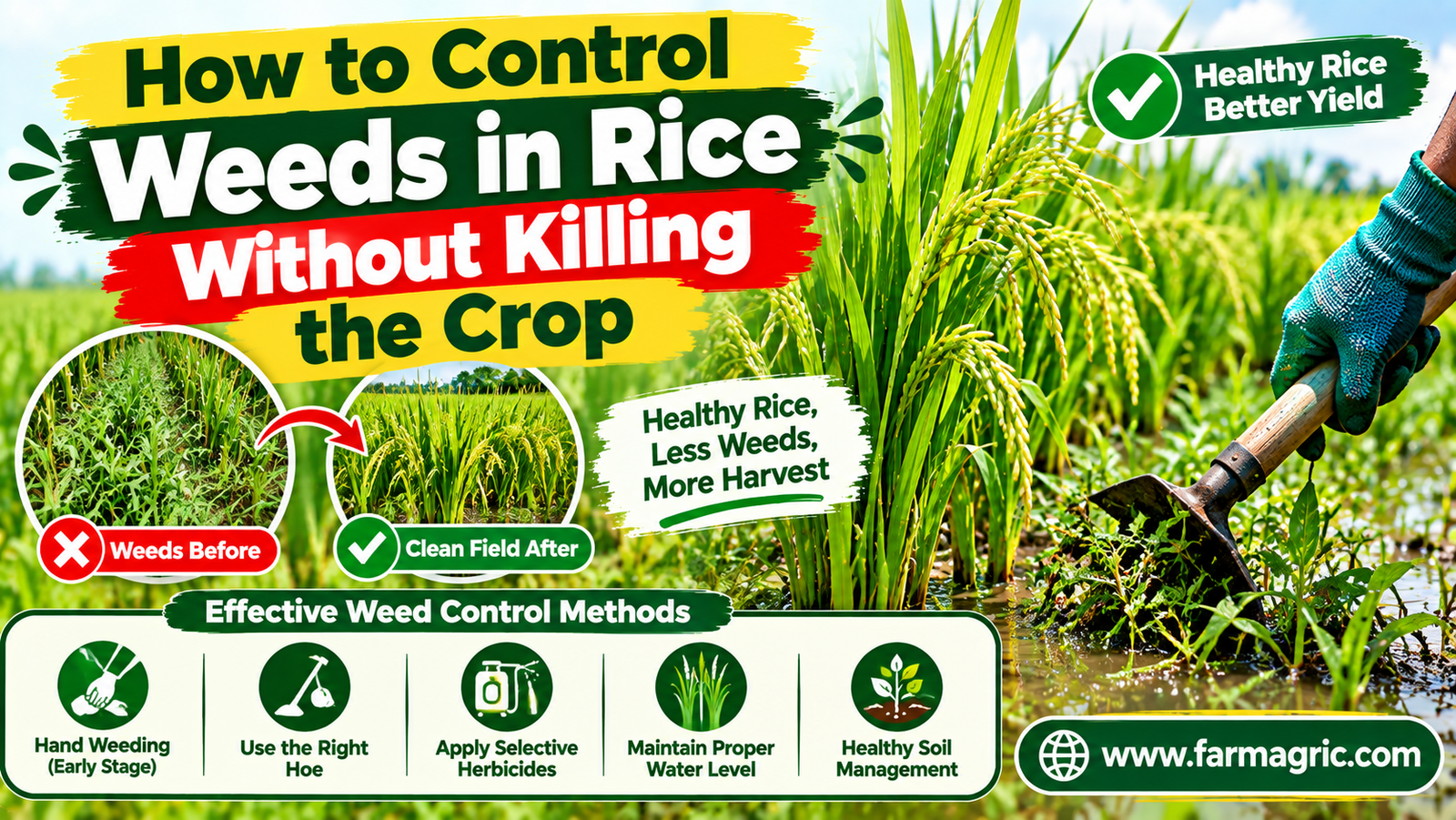
1. Prepare and level your land thoroughly before planting. Good land leveling ensures water covers the field evenly at the depth you intend, without dry patches or overly deep pockets, both of which create uneven weed pressure across the paddy. This single step, often rushed or skipped, has an outsized effect on how much weed pressure you’ll be managing all season.
2. Establish and maintain consistent flood depth as your first line of defense. For transplanted rice, maintaining a flood depth of around five to ten centimeters starting shortly after transplanting suppresses the germination of most weed species effectively. Avoid letting fields dry out unintentionally during the early weeks, since even short gaps in flooding open a window for weeds to establish.
3. Identify your dominant weed types before choosing any treatment. Walk the field and note whether you’re dealing primarily with grasses, broadleaf weeds, sedges, or a mix of all three, since this determines both which herbicide would actually be effective and how urgently hand weeding is needed if you’re avoiding chemicals entirely.
4. Hand weed or mechanically weed during the critical first three to four weeks. This is the single most important active intervention window in the whole season. For transplanted rice, a first weeding pass around fourteen to twenty-one days after transplanting, followed by a second pass two to three weeks later if needed, handles most weed pressure effectively without any chemical involvement at all.
5. Use a rotary weeder or simple mechanical tool between rows if hand labor is limited. In transplanted rice planted in reasonably straight rows, a simple push weeder moved between rows can cover ground far faster than hand pulling while still avoiding herbicide entirely, disturbing the topsoil enough to uproot small weeds while leaving established rice largely undisturbed.
6. If using herbicide, match the product to your establishment method and growth stage precisely. For transplanted rice, most selective herbicides are applied a few days after transplanting once seedlings have recovered from transplant shock, generally not immediately upon transplanting when the crop is at its most vulnerable. For direct-seeded rice, pre-emergence herbicides applied shortly after seeding, before both rice and weeds emerge, work differently than post-emergence products and require completely different timing logic.
7. Always read and follow the specific product label for crop stage restrictions. Herbicide labels specify safe application windows precisely because rice sensitivity genuinely varies this much by product, and deviating from that window, even by what seems like a small margin, is exactly what damaged my own field years ago.
8. Drain and reflood strategically around herbicide application if the label calls for it. Certain herbicides require a specific water depth or a brief drain-down period for proper activation or crop safety, and skipping this step because it feels like unnecessary extra work is a common reason farmers see poor herbicide performance or unexpected crop stress.
9. Rotate herbicide modes of action across seasons if using chemical control regularly. Repeated use of the same herbicide class in the same field encourages resistant weed populations to build up over time, so alternating between different modes of action, combined with the physical and water management methods above, keeps any single method from being relied on so heavily that it eventually fails.
10. Keep field bunds and margins clean of weeds too. Weeds seeding along bunds and field edges act as a constant source of reinfestation into the paddy itself, so a clean field interior can still face heavy pressure if the borders are left to grow wild season after season.
Warning Signs to Watch For
Yellowing, curling, or unusually stunted rice seedlings appearing within days of a herbicide application is a clear sign of crop injury rather than normal transplant stress, and it usually means the product, rate, or timing wasn’t matched correctly to the crop’s actual growth stage. Weeds visibly taller than the surrounding rice within the first three weeks after planting signal that the critical early control window is being lost, and delaying action further will compound the yield loss significantly. Patches of dry or shallow water within an otherwise flooded field are worth investigating immediately, since these gaps are where weeds most commonly gain their first foothold before spreading into better-flooded areas. And weeds that seem to survive a herbicide application that worked well in previous seasons can indicate developing resistance, worth addressing by rotating to a different mode of action rather than simply increasing the rate of the same product.
What I’d Do Differently If Starting Again Today
If I were starting over in rice, I’d invest more time and care into proper land leveling from my very first season, since I now understand how much of my later weed pressure traced back to uneven flooding caused by land I hadn’t leveled carefully enough at the start. I’d read herbicide labels far more carefully for crop stage restrictions before that costly mistake taught me the hard way, and I’d build in a buffer of extra caution around timing rather than applying right at the edge of what the label technically allowed. I’d also lean more heavily on the first three to four week hand or mechanical weeding window as my primary defense rather than treating it as a backup to herbicide, since that critical period matters more than almost anything else I do all season for keeping weeds from ever gaining the upper hand. And I’d keep my field bunds cleaner from the start, understanding now how much of my recurring weed pressure was quietly reseeding itself from borders I’d been neglecting for years.
Frequently Asked Questions About Weed Control in Rice
Can I use the same herbicide for transplanted and direct-seeded rice?
Not always, since the safe application timing and sometimes the product itself differs significantly between the two establishment methods, with direct-seeded rice generally requiring careful pre-emergence timing that doesn’t apply the same way to transplanted seedlings.
How soon after transplanting can I apply herbicide safely?
Most selective herbicides for transplanted rice are applied a few days after transplanting, once seedlings have recovered from transplant shock, rather than immediately, though the exact safe window varies by specific product, so always check the label rather than assuming a standard timing applies universally.
Does flooding really help control weeds in rice, or is that overstated?
It genuinely helps significantly, since standing water at the right depth suppresses the germination of most weed species that aren’t adapted to flooded conditions, making consistent water management one of the most effective and lowest-cost weed control tools available in rice specifically.
Is hand weeding still worth doing if I already use herbicide?
Yes, using both together as a layered approach catches weeds that survive or escape herbicide treatment, and it provides a fallback if weather, timing, or developing resistance reduces the herbicide’s effectiveness in a given season.
Why did my herbicide application damage my rice crop instead of just killing weeds?
This usually happens from applying the wrong product for the crop’s growth stage, applying too soon after transplanting before seedlings have recovered from shock, or using an incorrect rate, all of which point back to needing to follow label instructions for crop stage restrictions precisely rather than approximately.
If there’s one thing I want you to remember from all this, it’s that water is your first and best weapon against weeds in rice, so get your flooding right before you ever reach for a sprayer, and let timing, not just the product you choose, decide whether your weed control helps your crop or quietly damages it right alongside the weeds.