How to Control Cabbage Worms Without Chemicals
The first mistake, the one that had me chewing through chemical spray for several seasons before I reconsidered, is not recognizing how visible and interceptable the adult butterfly stage actually is, jumping straight to spraying caterpillars after damage has already appeared rather than watching for and responding to adult butterfly activity in the days beforehand.
The second mistake is scouting only the tops of leaves where damage is most obvious, without checking leaf undersides closely enough for the caterpillars themselves, which despite their effective camouflage are usually findable with a careful, deliberate search rather than a quick glance across the bed.
The third mistake is skipping physical barriers like row covers entirely, assuming that because other control methods exist, the extra effort of covering young plants is unnecessary, when in reality a properly installed row cover can prevent the problem from ever starting at all rather than requiring ongoing management once butterflies have already had the chance to lay eggs.
The fourth mistake is relying on broad-spectrum insecticide even occasionally, not realizing that even infrequent use can meaningfully set back the parasitic wasp and predatory insect populations that would otherwise provide substantial, ongoing natural control of cabbage worm populations across the season.
The fifth mistake is planting cabbage as a large, uniform block with no companion planting or diversity nearby, missing the modest but genuine benefit that certain strong-smelling companion plants can offer in making it somewhat harder for egg-laying butterflies to locate and settle on your cabbage specifically.
Step-by-Step Natural Control Plan for Cabbage Worms
Begin by watching for adult white butterflies flying around your cabbage bed during the day, since their presence, even before any caterpillar damage is visible, signals that eggs are likely being laid and that closer attention to your plants over the following week is warranted.
Scout your plants at least twice a week, checking both the tops and undersides of leaves carefully, looking for small, pale yellow, bullet-shaped eggs laid singly on the leaf surface, along with the pale green, velvety caterpillars themselves, which despite their effective camouflage against cabbage leaf color can usually be found with a careful, deliberate search rather than a casual glance.
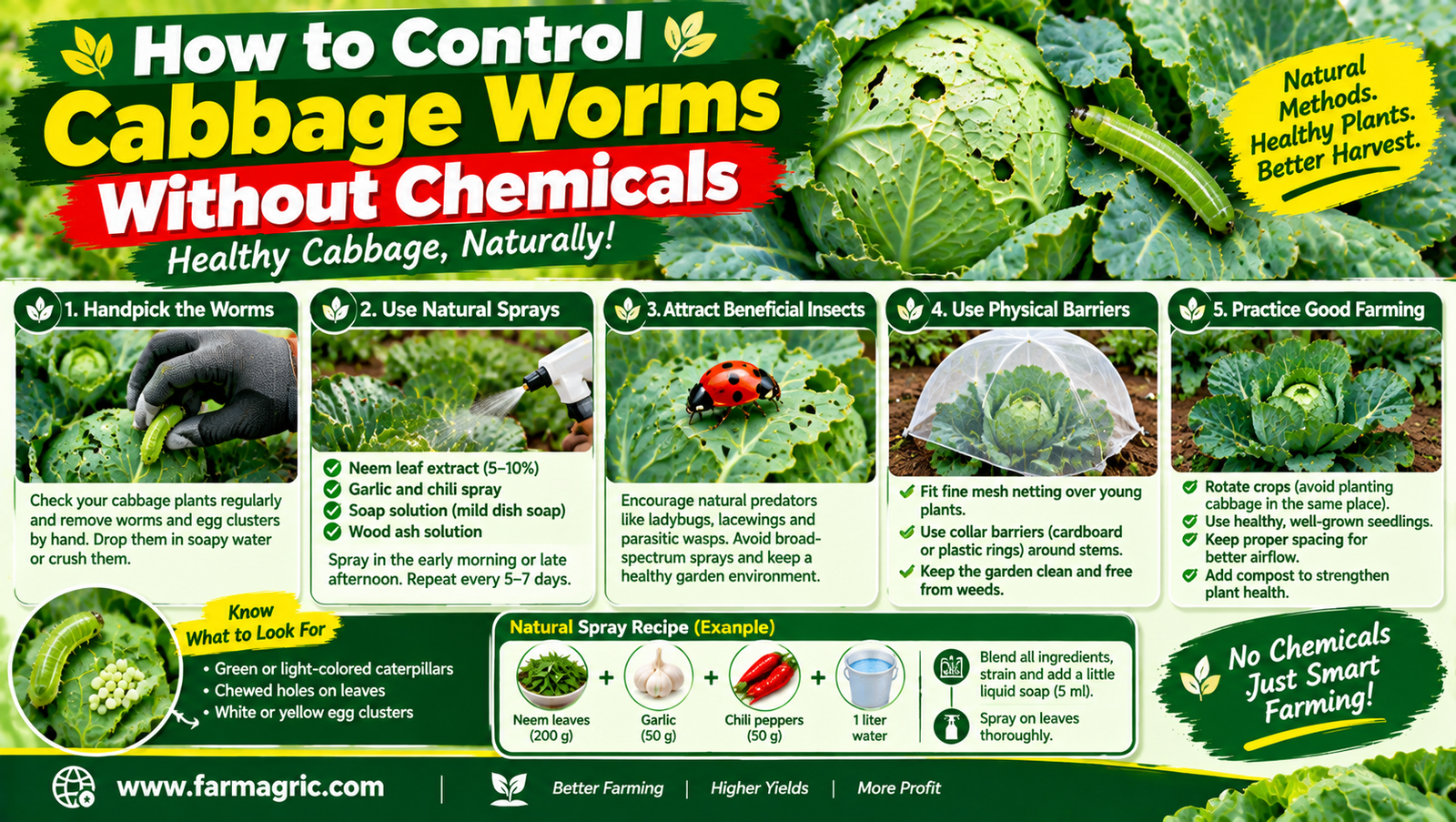
Hand-pick and destroy both eggs and caterpillars whenever you find them during scouting, a genuinely practical and effective method for most home gardens and small to medium farm plots, since each egg or caterpillar removed at this stage represents damage that will never happen and, in the case of caterpillars found before they mature, a butterfly that will never go on to lay further eggs.
Cover young cabbage transplants with floating row covers immediately after planting, securing the edges thoroughly against the soil so adult butterflies cannot find a way underneath to lay eggs directly on the plants, and keep this cover in place through the period when plants are most vulnerable, removing it later in the season if needed for pollination of other nearby crops or once plants have grown large and resilient enough to tolerate some feeding pressure without significant harm.
Apply a biological spray based on Bacillus thuringiensis where scouting reveals caterpillar pressure building beyond what hand-picking alone is managing effectively, applying according to label instructions and ideally in the early morning or evening when caterpillars are most actively feeding, and reapplying as directed since this biological control breaks down relatively quickly in sunlight.
Encourage natural predator and parasite populations by avoiding broad-spectrum pesticide use throughout the season, since several parasitic wasp species specifically target cabbage worm eggs and caterpillars, and various birds and predatory insects also contribute meaningful control when their populations are allowed to build and operate without being disrupted by indiscriminate spraying.
Plant strong-smelling companion plants such as thyme, dill, sage, or rosemary interspersed among or around your cabbage planting, since these aromatic plants can help mask the scent cues egg-laying butterflies use to locate suitable cabbage plants, modestly reducing the rate at which your crop gets found and targeted compared to a large, uniform block of cabbage with no companion diversity nearby.
Maintain some flowering plants or less disturbed vegetation near your cabbage bed to support the adult stage of parasitic wasps specifically, since these beneficial insects need nectar sources to sustain themselves between the times they are actively parasitizing cabbage worm eggs and larvae in your planting.
Remove severely damaged outer leaves promptly where caterpillar feeding has been heavy, both to reduce the immediate food source available to any remaining caterpillars on that particular plant and to improve your ability to spot further activity on the cleaner growth that remains.
Rotate your cabbage and related brassica plantings to different areas of your land where your space allows, since this can help reduce the buildup of cabbage worm pressure specific to a plot that has hosted susceptible crops repeatedly, though this pest’s flying adult stage makes rotation somewhat less decisive on its own compared to pests with more limited mobility.
Clear and destroy crop residue after harvest rather than leaving old cabbage and brassica plant material in the field, since pupae can sometimes survive on this residue, carrying pressure forward into whatever susceptible crop follows in that same location.
Keep a simple record of when you first notice adult butterfly activity and caterpillar damage each season, since this timing often follows a reasonably consistent pattern year to year in a given location, letting you anticipate and prepare row covers or increased scouting proactively as that window approaches in future seasons.
Warning Signs to Watch For
Small, pale yellow, bullet-shaped eggs laid individually on either the top or underside of cabbage leaves represent the earliest possible warning sign, and catching these before they hatch through regular, careful scouting offers your best opportunity to prevent any feeding damage from occurring at all. Ragged, irregular holes chewed through leaves, sometimes leaving only the leaf veins intact in badly affected areas, indicate caterpillars have already been feeding for some time and are worth tracing back to find and remove the responsible insects promptly. Pale green, velvety caterpillars found on close inspection of leaf undersides, often remaining remarkably still and well camouflaged against the leaf color when disturbed, confirm active feeding and should prompt immediate hand-picking or treatment. Dark green or black droppings, small and pellet-like, scattered on leaves beneath where feeding has been occurring are a secondary sign worth checking, since they often indicate a caterpillar is still present somewhere nearby on that same plant even if it has not been spotted directly yet. And damage concentrated specifically on the developing inner leaves near the center of a cabbage plant as it approaches heading deserves particular urgency, since feeding at this specific location can directly affect the quality and marketability of the head itself rather than remaining limited to outer leaves that matter less to the final harvest.
What I’d Do Differently If Starting Again Today
If I were starting over, I would install row covers on every young cabbage planting as standard practice from the very beginning, rather than only adopting this physical barrier method after years of relying on spray, since I now understand how much more effective it is to prevent the egg-laying from ever happening at all compared to managing the caterpillars that result once butterflies have had free access to my plants. I would watch for adult butterfly activity deliberately rather than only noticing the pest once visible leaf damage forced my attention, understanding now how much useful warning that slow, conspicuous adult stage actually provides if I simply paid attention to it. I would turn to Bt as my go-to treatment for any pressure that hand-picking alone could not manage, rather than continuing with the chemical spray that first made me uneasy feeding my own family cabbage grown with it. And I would plant my aromatic companion herbs around every cabbage bed as routine practice, given how much that small addition seems to have helped reduce the rate at which butterflies settle on my plants in the seasons since I started doing it consistently.
Frequently Asked Questions About Controlling Cabbage Worms Without Chemicals
What is the easiest way to spot cabbage worms before they cause serious damage? Watching for the slow-flying white adult butterflies around your cabbage bed during the day, and then scouting leaf undersides carefully for small, pale yellow eggs within the following week, gives you the earliest possible warning, well before any caterpillar feeding damage becomes visible on the plant itself.
Is Bacillus thuringiensis safe to use on cabbage I plan to eat soon? Yes, Bt is generally considered safe with a short or no withholding period compared to many chemical insecticides, since it targets caterpillars through a specific biological mechanism and breaks down relatively quickly in the environment, though it is always worth checking the specific product label for guidance relevant to your situation.
Do floating row covers really stop cabbage worms from being a problem at all? Yes, a properly installed row cover with edges secured against the soil physically prevents adult butterflies from reaching the plants to lay eggs in the first place, making it one of the most effective preventive tools available, provided it stays in place and properly sealed through the period when plants are most vulnerable.
Can companion planting alone keep cabbage worms away from my crop? Companion planting with strong-smelling herbs like thyme, dill, or sage offers a modest, genuine benefit by making it somewhat harder for butterflies to locate your cabbage through scent, but it works best as one part of a broader layered approach including scouting, hand-picking, and row covers rather than as a complete standalone solution.
Why are cabbage worms easier to control without chemicals compared to some other pests? The adult stage is a slow, highly visible daytime butterfly rather than a fast-moving or nocturnal moth, and the caterpillars themselves feed in a relatively exposed way compared to pests that bore into stems or hide deep within plant structures, both of which make direct scouting, hand-picking, and physical barriers like row covers genuinely practical and effective against this particular pest.
If there is one thing I want you to remember from all this, it is that the slow white butterfly drifting lazily over your cabbage bed is handing you a warning days before her caterpillars ever take a single bite, so watch for her, cover your young plants before she ever lands, and let the small wasps and the biological spray do the rest, because the lacy, hole-riddled leaf that first taught me about this pest never needed to happen at all once I learned to see the problem coming before it arrived.