How to Space Groundnut Seeds for Better Yield
How to Space Groundnut Seeds for Better Yield
I once planted a field of groundnuts so wide that I could walk between the plants without touching a leaf. I told myself each plant would have all the room it needed and would reward me for it. Instead, the weeds moved into the gaps, the rosette aphids landed on the exposed plants, and the harvest was thin. The next season I planted the same variety much closer, on the same kind of soil, and nearly doubled what I picked from the same area. Spacing did that, and it cost me nothing.
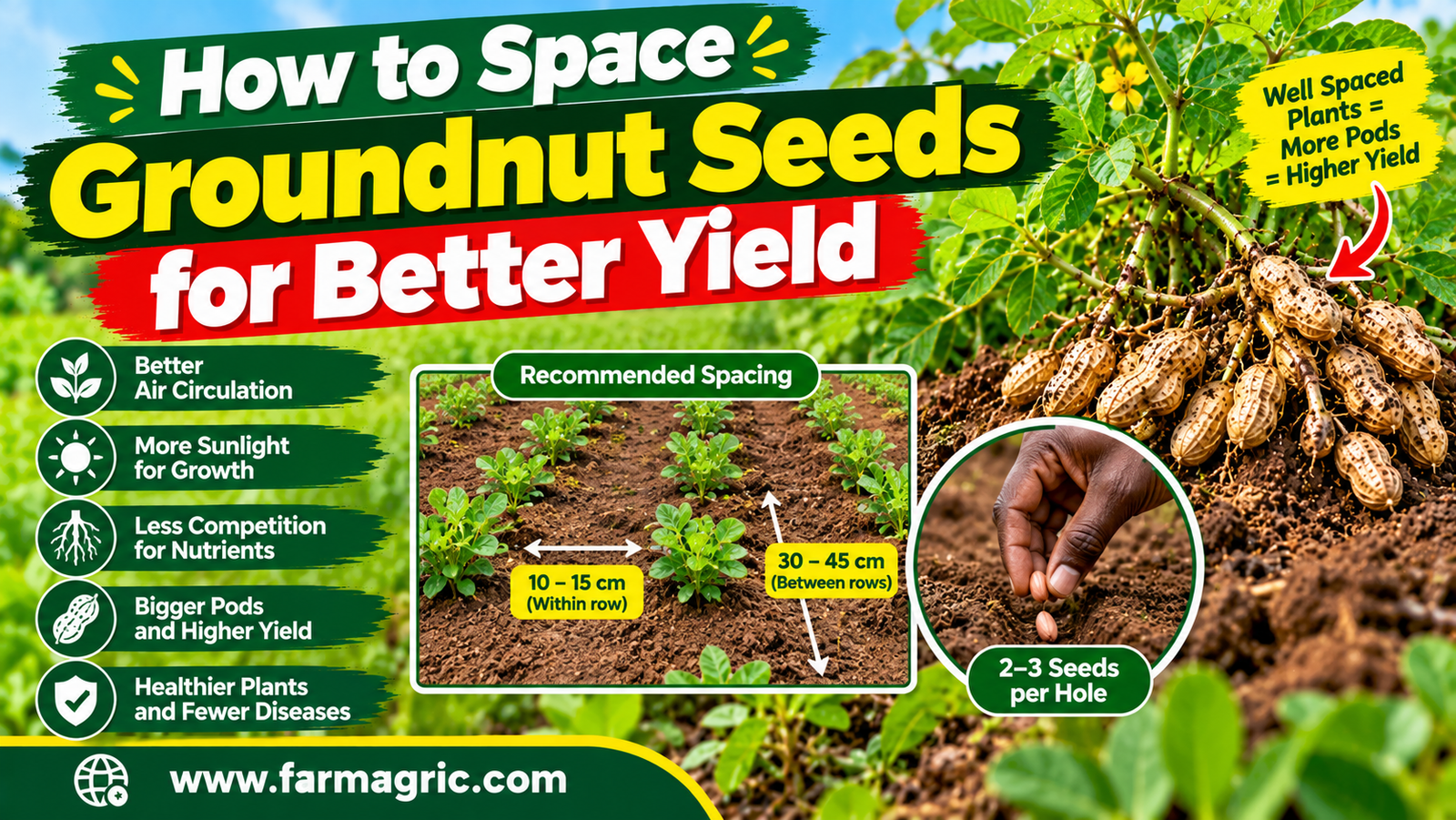
Here is the plain answer. For most groundnut types, a good starting point is about 45 to 50 centimeters between rows and 10 to 20 centimeters between plants within the row, with one or two seeds per hole. That gives roughly 100,000 to 220,000 plants per hectare for common bunch and semi-erect types. Spreading types usually need more room, around 60 centimeters between rows. The right figure depends on your variety, your soil, and your rainfall, so treat these numbers as a range to start from and confirm with your local extension office or seed supplier.
The short version of what I do is this. I plant on a ridge or flat well-prepared bed, use a close but not crowded spacing, keep it uniform, plant at the first dependable rains, fill any gaps within the first week, and keep the field weed free. The rest of this article explains why spacing matters, how to choose it, and the mistakes that cost farmers yield.
What Most Farmers Get Wrong
The first mistake is planting too wide. Farmers believe fewer plants means bigger plants and bigger yields. Groundnut does not work that way. A thin stand wastes land and light, lets weeds take over the bare soil, and exposes plants to aphids that carry rosette. The yield per plant may rise a little, but the yield per hectare falls.
The second mistake is planting too thick. Crowded plants compete for light, water, and calcium, grow tall and weak, and stay damp, which invites leaf spot and other diseases. Pod filling suffers and many pegs never develop into full pods.
The third mistake is uneven spacing. Seed thrown in by hand, holes at random distances, and gaps in the row all lead to some plants being squeezed and others being isolated. An even stand yields better and is easier to weed and harvest.
The fourth mistake is using the same spacing for every variety. A spreading type that runs along the ground needs room to branch and peg, while an upright bunch type can be planted tighter. Using one spacing for everything means one of them is wrong.
The fifth mistake is planting too deep or too shallow. Even perfect spacing fails if the seed does not emerge. Seeds buried too deep struggle to come up, and seeds too shallow dry out or get eaten.
The sixth mistake is never filling gaps. A missing plant is a missing yield, and late replanting rarely catches up.
Why Spacing Matters
Spacing controls how much light, water, and nutrients each plant gets, and how quickly the canopy closes. A canopy that closes at the right time shades out weeds, keeps the soil cooler and moister, and makes it harder for aphids to land. A canopy that never closes, or that closes too early and too tightly, causes trouble in the opposite direction.
Groundnut is also unusual because the pods form underground from pegs that grow down from the flowers. Each plant needs enough open soil near its base for pegs to enter. Too much crowding means pegs cannot reach the ground, and pod numbers drop.
Recommended Spacing by Type
Bunch or erect types are upright, mature earlier, and are usually planted closer. A common recommendation is about 45 to 50 centimeters between rows and 10 to 15 centimeters between plants.
Semi-erect or semi-spreading types, which many farmers grow, usually do well at about 50 centimeters between rows and 15 to 20 centimeters between plants.
Spreading or runner types need more room because the branches run along the ground. Around 60 centimeters between rows and 15 to 20 centimeters in the row is typical.
These are general figures. Recommendations differ between countries and even between research institutes, so check the guidance for your specific variety. The seed packet, the extension office, and the research institute are the best sources.
Seeds Per Hole
One seed per hole at close spacing gives the best use of seed and avoids competition within the hole. Two seeds per hole is a common practice at the wider end of the range because it protects against a seed failing to come up, and the two plants grow together as one stand. If you use two seeds, widen the in-row distance a little, for example 20 centimeters instead of 10, so the pair is not crowded.
Use your seed quality as a guide. Good, fresh, certified seed with high germination can go at one per hole. Older or doubtful seed needs two, and a germination test is worth doing first.
Seed Rate and Cost
Close spacing uses more seed, and groundnut seed is not cheap. As a rough guide, a hectare planted at the closer spacings above can take around 80 to 120 kilograms of shelled seed, depending on seed size and spacing. Large-seeded varieties need more. Work out your seed need before the season, and budget for it, because running short at planting time leads to wide gaps that you will regret.
If seed is expensive, do not stretch it by spacing too wide on the whole farm. A better approach is to plant a smaller area at the right spacing, which will often give you more total harvest than a bigger area planted thinly.
Preparing the Land and Planting Method
Good spacing begins with good land preparation. Clear the field, loosen the soil to a fine tilth so pegs can penetrate, and remove stones and heavy clods. Ridges or raised beds help drainage in heavy soils and make it easier to keep rows straight. On light, sandy soils, flat planting is common and works well.
Mark your rows with a string or a marker so they run straight, and use a stick, hoe handle, or a measured rope to mark the distance between holes. It feels slow at first, but it is faster than weeding a messy field for the rest of the season. Plant at a depth of about 3 to 5 centimeters, deeper in dry sandy soil and shallower in heavy wet soil. Cover the seed lightly and firm the soil gently.
Plant at the first dependable rains, and when the soil is moist enough for germination. A uniform start gives a uniform crop. Where there is a risk of rosette in your area, planting early and keeping the stand dense are two of the best protections you have.
Fill Gaps Early
Check the field about seven days after planting. Where seeds have not come up, replace them straight away with fresh seeds, using the same spacing. Replants done within the first week catch up with their neighbors. Anything later than about two weeks becomes a weak plant under shade and rarely gives a worthwhile yield.
Keep a small amount of seed in reserve for this job, and do not forget to treat the replacement seeds in the same way as the original lot.
Weeding and Spacing Together
Close spacing reduces weeds, but you still need to weed early. Weed at about two to three weeks after emergence and again at five to six weeks, and finish before the pegs start entering the soil, since late hoeing can damage them. A uniform stand makes this much easier, because the rows are straight and you know where to work.
Earth up lightly at the first weeding if it is your practice, but avoid disturbing the soil around the plants once flowering and pegging begin.
Spacing and Soil Fertility
Rich soils grow bigger plants, so they may need slightly wider spacing within the recommended range to avoid crowding. Poor soils grow smaller plants, and a closer spacing can help them cover the ground. Whatever your soil, give the crop calcium, since pods take up calcium directly from the soil. Gypsum at flowering, at the rate advised locally, improves pod filling and reduces empty pods. Do not overload the soil with nitrogen, because groundnut fixes its own, and too much produces leaves instead of pods.
Step-by-Step Practical Plan
If I were giving you a plan for the next season, it would run like this.
Find out the recommended spacing for your specific variety from your extension office or seed supplier.
Prepare a fine, clean seedbed and mark your rows with string.
Mark your in-row distance with a measuring stick so every hole is even.
Use certified seed with good germination and calculate the seed you need before planting day.
Plant at the first dependable rains, at 3 to 5 centimeters deep, one or two seeds per hole.
Check the field after one week and fill every gap with fresh seed.
Weed at two to three weeks and again at five to six weeks, and finish before pegging.
Apply gypsum at flowering if recommended in your area.
Note your spacing, seed rate, and final yield so next season you can adjust.
Warning Signs to Watch For
Learn to read your stand. Large bare patches between plants mean the spacing is too wide or the seed failed. Tall, thin, leggy plants with few flowers suggest crowding. A canopy that has not closed by flowering is too open. Plants with many flowers but empty pods point to a calcium shortage or pegs that could not reach the soil. Lots of yellow, stunted plants scattered around a wide stand can signal rosette, which thrives in open fields.
If you see any of these, act that week, not next month.
What I Would Do Differently If Starting Again Today
If I were starting fresh, I would stop guessing and mark every row. I would pick one recommended spacing for my variety and stick to it for the whole farm, and I would keep a record of the yield so I could test a closer or wider spacing on a small plot the following season. I would buy enough seed before planting, so I never had to stretch it. I would also fill gaps the first week without fail, and weed on time.
And I would stop believing that wider is better. Most of my low yields in the early years came from empty ground, not from bad seed or bad weather.
FAQ
What is the best spacing for groundnut?
For most bunch and semi-erect types, about 45 to 50 centimeters between rows and 10 to 20 centimeters between plants is a good starting range. Spreading types need more space between rows. Check the recommendation for your variety.
How many groundnut seeds should I plant per hole?
One or two. One seed per hole works with good seed at close spacing. Two seeds per hole is a safer choice with doubtful seed, and the in-row distance should be a little wider.
How deep should I plant groundnut seeds?
About 3 to 5 centimeters. Go a little deeper in dry, sandy soil and a little shallower in heavy or wet soil.
How much groundnut seed do I need per hectare?
Roughly 80 to 120 kilograms of shelled seed, depending on seed size and spacing. Large-seeded varieties need more. Confirm with your seed supplier.
Does close spacing reduce groundnut rosette?
Yes. A dense, even stand discourages aphids from landing and shades out weeds, which helps reduce rosette. It works best together with early planting and resistant varieties.
The Advice Worth Bookmarking
Empty ground does not rest, it grows weeds. Plant your groundnuts close enough to cover the soil and far enough apart to let every peg reach it.