How to Improve Poor Soil for Cassava Farming
How to Improve Poor Soil for Cassava Farming: A Farmer’s Guide to Building Ground That Can Actually Feed the Crop
I inherited a plot from my father that everyone in the family called the tired land, a section that had grown cassava and little else for as long as anyone could remember, season after season, with nothing ever put back into it. My first harvest there was embarrassing, roots so small and few that I genuinely considered abandoning the plot altogether and looking for land elsewhere to rent. Instead I spent three seasons rebuilding that soil before I planted cassava on it again seriously, and when I finally did, the difference was not subtle. The same plot that had once given me a basin and a half of thin roots gave me full sacks of thick, heavy ones, and the only thing that had changed was what I had put into that ground in the years between. That experience taught me something I now tell anyone who complains about poor soil, that cassava has a reputation for tolerating bad ground, and it does tolerate it, but tolerating poor soil and thriving in it are two very different outcomes, and the gap between them is almost entirely something a farmer can close.
So let me answer you straight, because I know you are standing on land that looks tired, sandy, hard, or simply worn out, and you are wondering whether cassava can even be worth planting there. You improve poor soil for cassava farming by adding organic matter through manure, compost, and crop residue to rebuild structure and fertility, correcting soil pH where it has drifted too acidic through liming, breaking up compacted layers through deep tillage or ridging, rotating with legumes to restore nitrogen naturally, and applying fertilizer thoughtfully based on what the specific soil is actually lacking rather than guessing. Cassava is often praised as a crop that grows where nothing else will, but the truth I learned on that tired family plot is that cassava simply survives in poor soil rather than performing well in it, and the farmer willing to invest a season or two in genuinely improving the ground will see a difference in root size and total yield that no amount of cassava’s natural toughness alone can deliver.
Why Poor Soil Limits Cassava More Than Farmers Expect
Cassava has a genuine ability to produce something even on soil too poor for many other crops, since its root system can extract nutrients from depths and in conditions that would leave maize or vegetables struggling badly. This reputation, though, has led many farmers to treat cassava as a crop that needs no real soil investment at all, and that assumption costs real yield. Poor soil, whether it is depleted of organic matter, compacted from years of use, too acidic, or simply low in the specific nutrients cassava needs for root bulking, still limits how large and how numerous the storage roots can grow, even if the plant survives and produces something. The difference between a plant that merely survives on tired ground and one that thrives on properly managed ground shows up exactly where it matters most at harvest, in the size and weight of the roots you actually dig up.
What Most Farmers Get Wrong
The first mistake, the one my own family made for years on that tired plot before I finally broke the pattern, is assuming cassava’s toughness means the soil does not need attention at all, planting it season after season on the same depleted ground purely because it was the one crop that would still produce something there. This turns a genuinely resilient crop into an excuse for neglecting the soil entirely, and the yield penalty for that neglect compounds year after year.
The second mistake is ignoring soil pH, particularly in areas where soil has become acidic over time through repeated cropping without correction. Cassava tolerates a wider pH range than many crops, but strongly acidic soil still locks up phosphorus and other nutrients the plant needs, and farmers who never test or correct pH are often fighting a chemistry problem they do not even know exists.
The third mistake is treating compaction as irrelevant to cassava specifically, since farmers know it matters for root vegetables generally but somehow assume cassava’s toughness extends to pushing through hard ground without consequence. Compacted soil restricts root bulking in cassava just as directly as it does in any other root crop, regardless of how well the plant otherwise survives above ground.
The fourth mistake is relying entirely on chemical fertilizer without ever rebuilding organic matter, applying nutrients to soil that has lost the structure and biological life needed to hold and cycle those nutrients efficiently. Fertilizer poured onto poor, structureless soil often washes away or fails to reach the roots effectively, while the same fertilizer applied to soil with decent organic matter content works far better.
The fifth mistake is continuous cassava cropping on the same land without any rotation or rest, which depletes specific nutrients cassava draws on heavily, particularly potassium, and allows pest and disease pressure specific to cassava to build up in the soil over successive seasons without ever being broken.
Step-by-Step Plan to Improve Poor Soil for Cassava
Start by getting a basic understanding of what is actually wrong with your soil, whether through a formal soil test if one is available to you, or through simple observation and local knowledge if it is not. Land that has grown thin, pale crops for years, that crusts hard after rain, that shows visible erosion, or that has a known history of continuous cropping without any input all point toward different specific problems worth addressing differently.
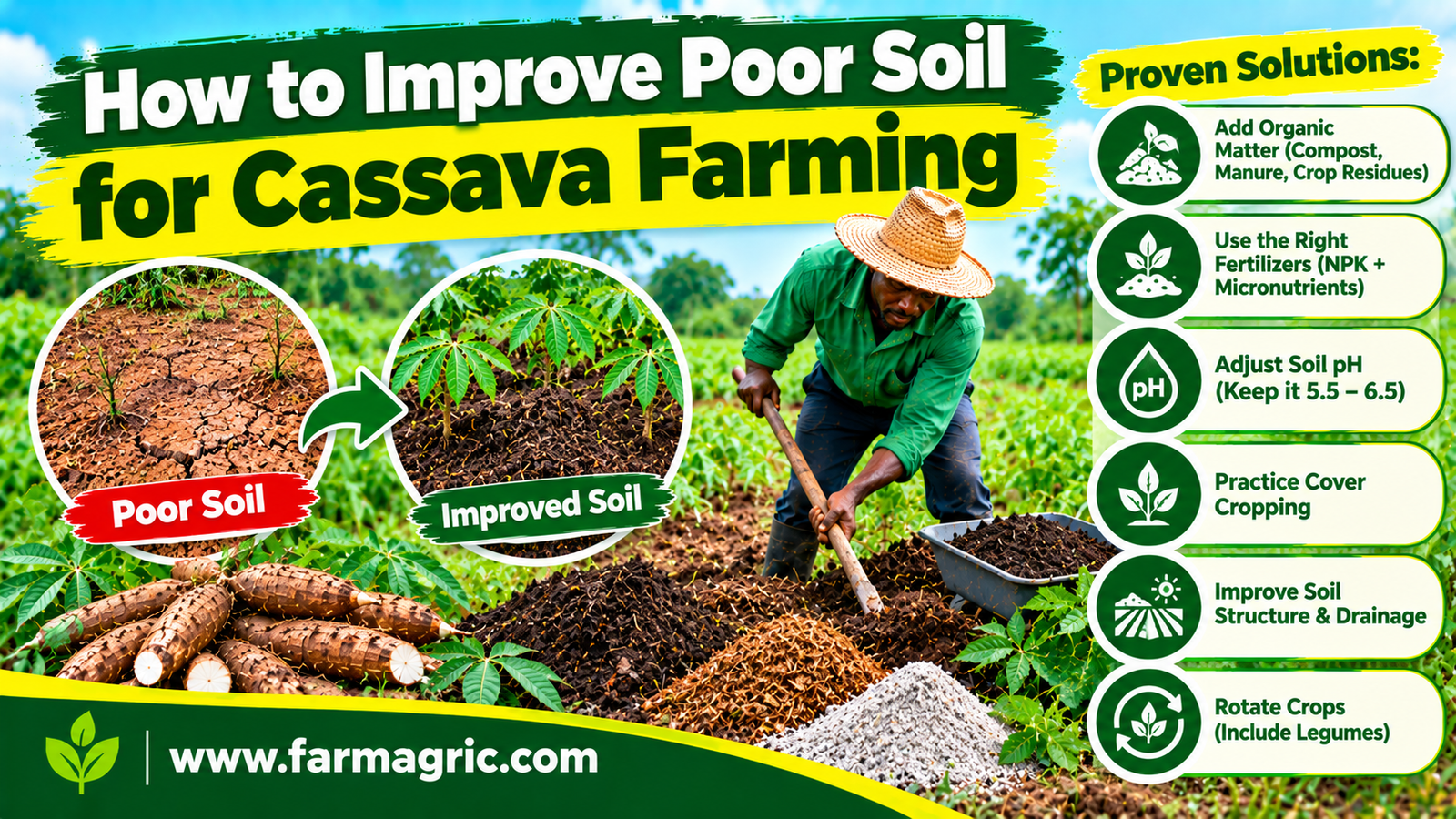
Add organic matter as your foundation, regardless of what else the soil needs. Well-rotted manure, compost, and crop residue worked into the soil before planting rebuild the structure, water-holding capacity, and biological life that poor soil has lost, and this single practice underpins almost everything else you do afterward, since fertilizer and other corrections work far more effectively in soil with reasonable organic matter content than in structureless, depleted ground.
Where you have access to manure, apply it generously and work it into the soil at least a few weeks before planting, allowing it time to begin breaking down rather than planting immediately into fresh, undecomposed material. Compost from crop residue, kitchen waste, and other organic material serves the same purpose where manure is limited, and even a modest, consistent composting practice over a few seasons visibly changes how the soil feels and behaves.
Test or estimate your soil pH, and correct it with agricultural lime if it has drifted significantly acidic. Cassava tolerates a wider range than many crops, generally performing reasonably well down to a pH around five, but soil that has fallen well below this range benefits noticeably from lime application, since correcting pH unlocks phosphorus and other nutrients that were previously present in the soil but unavailable to the plant.
Break up compacted layers through deep ploughing or thorough hand digging before planting, particularly on land that has been worked repeatedly with shallow tillage or that has seen heavy foot or equipment traffic over the years. Planting on ridges or mounds, in addition to helping with drainage as covered in managing root rot, also gives cassava roots a deeper, looser volume of soil to expand into on land where compaction has been a persistent problem.
Rotate cassava with legumes wherever your land and planning allow it. Cowpea, groundnut, soybean, or another suitable legume planted for a season between cassava crops adds nitrogen back to the soil naturally through the relationship these plants have with soil bacteria, while also breaking the continuous buildup of cassava-specific pests and diseases that comes from planting the same crop repeatedly on the same ground.
Apply fertilizer based on what your soil actually needs rather than a generic blanket recommendation. On soil that has been depleted of potassium specifically, which is common on land that has grown cassava repeatedly without replenishment, prioritize potassium sources such as muriate of potash or wood ash alongside a balanced nitrogen and phosphorus program, since potassium plays a particularly direct role in cassava root bulking.
Use mulch between rows or ridges where organic material is available, since a mulch layer protects the soil surface from erosion and crusting, helps retain moisture, and gradually breaks down to add further organic matter over time, effectively working as a slow, ongoing soil improvement measure throughout the growing season rather than a one-time input applied only before planting.
Give genuinely depleted land a season or two of dedicated recovery before returning to intensive cassava production, if your circumstances allow it. Planting a cover crop, a legume rotation, or simply allowing a fallow period with careful weed management gives severely tired soil time to rebuild organic matter and biological activity in a way that trying to push a full cassava crop through immediately often cannot achieve nearly as effectively.
Keep track of what you have applied and where, particularly on land you know has a history of poor performance, so that your soil improvement effort builds consistently over successive seasons rather than starting from scratch with each new planting because you have lost track of what was already done.
Be patient with the process, since soil that has been depleted over many years rarely transforms in a single season no matter how much organic matter or lime is applied at once. The improvement I saw on that tired family plot came from three seasons of consistent effort, not one large input applied before a single planting, and expecting a dramatic transformation immediately often leads farmers to give up on soil improvement before it has had the chance to actually work.
Warning Signs Your Soil Needs Improvement Before Planting Cassava
Soil that crusts hard on the surface after rain and takes visibly longer than surrounding areas to absorb water points toward poor structure and low organic matter, conditions that will limit root bulking even if the cassava plant itself survives reasonably well above ground. Pale, stunted, or slow-growing cassava across an entire field, rather than in isolated patches, often reflects an underlying soil fertility problem rather than a variety or management issue specific to that season. Visible erosion, exposed subsoil, or gullies forming after heavy rain indicate soil that has lost much of its protective structure and organic matter, and planting directly into this kind of land without first addressing the underlying problem typically produces disappointing results regardless of other management decisions. A long history of continuous cassava or other exhausting crops on the same plot without any rotation, manure, or rest is itself a warning sign worth taking seriously, even before any visible symptom appears in the crop, since depletion often builds gradually over years before it becomes dramatically obvious in a single season’s harvest. And test roots that come out consistently small and thin across several different plants in different parts of a field, despite reasonable spacing and healthy-looking planting material, point toward a soil fertility limitation rather than a problem with variety, spacing, or pest pressure specifically.
What I’d Do Differently If Starting Again Today
If I were starting over on that tired family plot, I would begin the soil improvement process the very first season I recognized the land was underperforming, rather than continuing to plant cassava into the same depleted ground for years simply because it was the one crop still willing to produce something there. I would commit to a legume rotation far earlier, understanding now how much nitrogen and general soil health that simple practice restores compared to continuous cassava cropping alone. I would build a consistent composting and manure routine from the beginning rather than treating organic matter as an occasional addition, since I now know how much every other input, fertilizer especially, depends on decent soil structure to actually work as intended. And I would test or at least estimate my soil pH far earlier in my farming life, since I now understand how many years I may have spent fighting a chemistry problem I never even knew was quietly limiting everything else I was trying to do for that land.
Frequently Asked Questions About Improving Poor Soil for Cassava
Can cassava really grow well on poor soil without any improvement at all? Cassava can survive and produce something on poor soil better than many other crops, but surviving and thriving are different outcomes, and root size and total yield on truly poor, unimproved soil are consistently lower than what the same crop would produce on properly managed ground.
How long does it take to improve depleted soil for cassava farming? Meaningful improvement often takes two to three seasons of consistent effort through organic matter addition, pH correction, and rotation, rather than a single large input before one planting, since soil that has been depleted over many years typically needs sustained rebuilding rather than a one-time fix.
Does cassava need fertilizer even though it tolerates poor soil? Yes, fertilizer, particularly potassium, makes a real difference to root size and total yield even on soil cassava can technically survive in without it, and fertilizer generally works far more effectively when applied to soil that also has reasonable organic matter content and structure.
Is crop rotation really necessary for cassava, or can it be grown continuously on the same land? Continuous cassava cropping without rotation gradually depletes specific nutrients, particularly potassium, and allows cassava-specific pests and diseases to build up in the soil, so rotating with a legume or another suitable crop every season or two meaningfully protects both soil fertility and long-term yield.
What is the fastest way to improve poor soil before planting cassava? Adding well-rotted manure or compost, correcting soil pH with lime if it is significantly acidic, and breaking up any compacted layers through deep tillage or ridging before planting together give the quickest meaningful improvement, though full recovery of severely depleted land still benefits from sustained effort over more than one season.
If there is one thing I want you to remember from all this, it is that cassava’s toughness is not permission to neglect the soil, it is simply what allows the crop to survive while you take the time to actually improve the ground beneath it, and the farmer who spends a season or two rebuilding tired soil before planting seriously again will dig roots that make that patience worth every bit of the wait.