How to Support Plantain Plants to Stop Them Falling Over
How to Support Plantain Plants to Stop Them Falling Over: A Farmer’s Guide to Keeping a Bearing Mat Standing Through to Harvest
I lost a mat loaded with one of the best bunches I had grown that season to a wind that was not even particularly strong, nothing like a storm, just a stiff afternoon breeze that should never have been enough to bring down a healthy plant. I found it the next morning leaning badly, roots half torn from the soil on one side, the bunch itself bruised and scraped along the ground where the stem had come to rest. That loss, so close to harvest, taught me that a plantain plant carrying a mature bunch is carrying a genuine structural burden, often fifteen to twenty-five kilograms or more hanging well above its own center of gravity, and that this is exactly the point in the plant’s life when it is most vulnerable to toppling, not some abstract risk but a very real one that a stiff breeze, a heavy rain-soaked canopy, or simple top-heaviness can trigger with very little warning.
So let me answer you straight, because I know you have either already lost a bunch to a fallen plant or you are looking at a heavily bunching mat right now and worrying about exactly that happening. You support plantain plants to stop them falling over mainly by propping mature, bunching stems with sturdy forked poles positioned to brace the plant against the direction it is most likely to lean, mounding soil around the base of the plant to improve root anchorage, managing sucker numbers so the root system is not weakened by overcrowding, choosing planting sites with some wind protection where possible, and propping proactively as soon as a bunch begins forming rather than waiting until a plant is already visibly leaning. A plantain stem is a soft, fibrous pseudostem rather than true wood, and it simply was never built to carry the weight of a full bunch indefinitely on its own once that bunch reaches real size, which is exactly why physical support at the right time is not an optional extra but a genuinely necessary part of bringing a heavy-bearing mat safely through to harvest.
Why Plantain Is So Vulnerable to Toppling Right When It Matters Most
The plantain pseudostem is built from tightly rolled, overlapping leaf sheaths rather than true woody tissue, giving the plant real flexibility and fast growth but relatively limited rigid strength compared to a hardwood tree trunk of similar height. This structure works perfectly well through most of the plant’s life, but once a mat flowers and begins developing a bunch, that bunch can add a substantial, concentrated weight well above the plant’s center of gravity, at precisely the point along the stem where it has the least structural support from the ground. A plant in this condition is carrying a load it was not purely built to bear on its own, and the combination of a top-heavy bunch, a relatively soft and flexible stem, and a root system that may already be somewhat compromised by overcrowding or shallow soil conditions creates a genuine structural vulnerability that is highest during exactly the weeks when the farmer has the most to lose from a fall.
What Most Farmers Get Wrong
The first mistake, the one that cost me that bunch to an ordinary afternoon breeze, is waiting to prop a plant until it is already visibly leaning, treating support as a reactive fix for a problem that has already started rather than a proactive step taken as soon as a bunch begins developing real size and weight.
The second mistake is using inadequate or poorly positioned props, a single thin stick leaned casually against the stem rather than a sturdy, properly forked pole planted firmly into the ground and positioned specifically to brace against the direction the plant is most likely to lean given the weight of its particular bunch.
The third mistake is neglecting root anchorage as part of the support strategy, focusing entirely on external props while ignoring how directly soil mounding around the base and a well-managed, uncrowded root system contribute to a plant’s ability to resist toppling in the first place.
The fourth mistake is allowing excessive sucker crowding around a bearing mother plant, not recognizing that too many competing suckers can weaken the root development of the specific stem that is actually carrying the bunch, reducing its anchorage at precisely the stage when strong rooting matters most.
The fifth mistake is ignoring site selection and windbreak considerations entirely when establishing a new planting, placing plantain in a consistently exposed, wind-prone location without any natural or planted windbreak, and then relying entirely on individual plant propping to compensate for a site-level vulnerability that could have been reduced from the very beginning.
Step-by-Step Guide to Supporting Plantain Plants Against Falling
Begin monitoring each mat closely once flowering occurs and a bunch begins forming, recognizing this as the point when the plant’s vulnerability to toppling starts increasing meaningfully, rather than waiting until the bunch has reached full size and maximum weight before taking any supportive action.
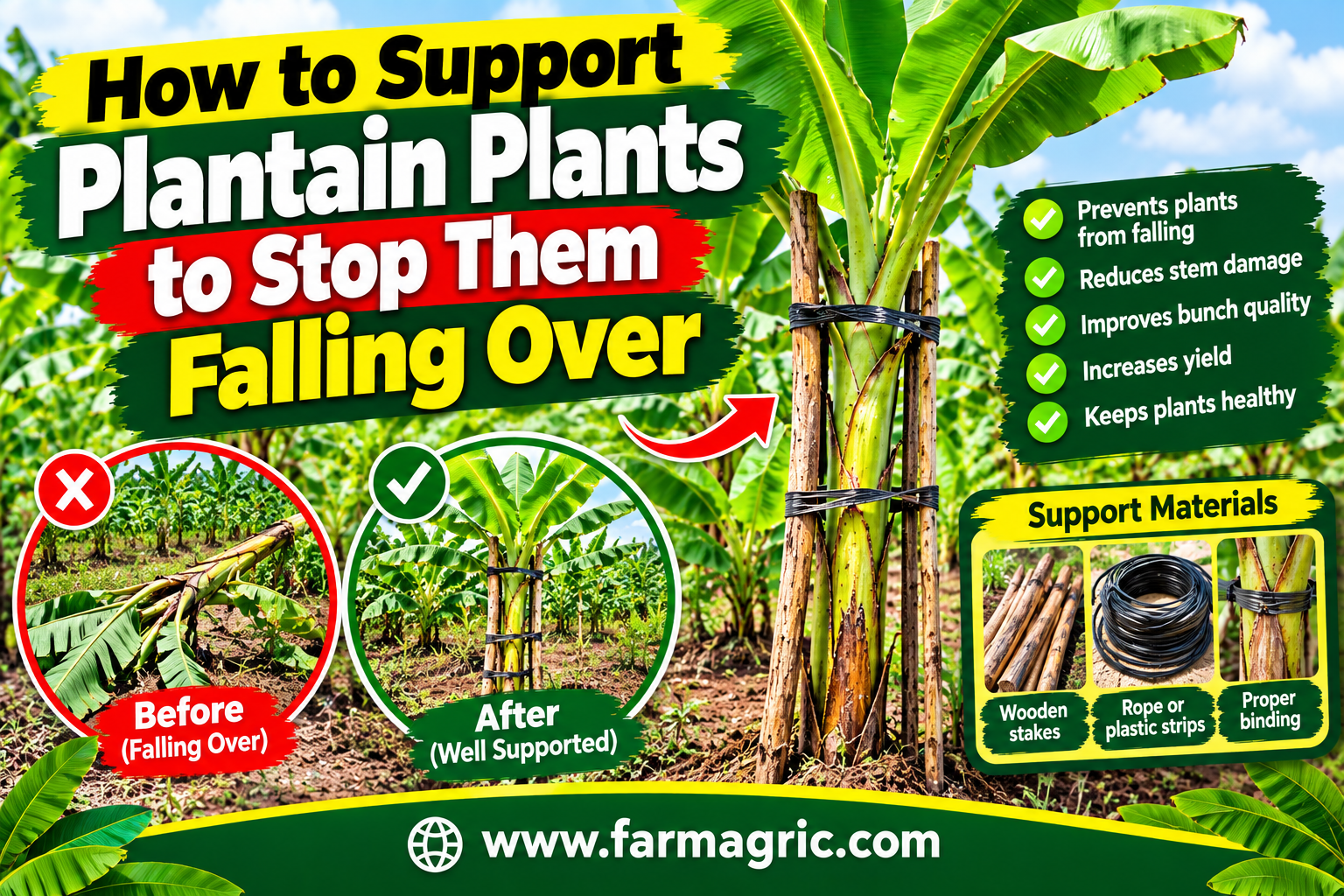
Select sturdy, forked poles for propping, ideally hardwood branches with a natural fork near the top that can cradle the pseudostem securely, cut to a length appropriate for reaching from firm ground contact up to a supportive point along the stem below the bunch, since a prop that is too short or poorly positioned provides far less genuine structural support than one properly sized and placed for the specific plant.
Position the prop on the side of the plant opposite to the direction the bunch is leaning or is most likely to lean, typically the side the bunch itself is hanging toward or the direction of your area’s prevailing wind, driving the base of the pole firmly into the soil at an angle that allows the fork to brace solidly against the pseudostem rather than simply resting against it loosely.
Drive the base of each prop deep enough into the soil to resist being pushed over itself under the plant’s weight and wind load, since a prop that is only lightly set into the ground can fail right alongside the plant it was meant to support, particularly during the same wind event that creates the greatest risk to the plantain itself.
Check and adjust propping regularly as the bunch continues to develop and gain weight over the following weeks, since a prop positioned correctly for a smaller, lighter bunch may need repositioning or reinforcement as that bunch matures further and the plant’s lean or weight distribution shifts accordingly.
Mound soil around the base of bearing mats, building up a modest earth mound several centimeters high around the stem base, since this additional soil volume helps stabilize and anchor the root system more effectively than a flat, unmounded planting surface, giving the plant genuinely improved resistance to toppling from below in addition to whatever external propping is providing from the side.
Manage sucker numbers on each mat deliberately, maintaining the recommended three to four stems at staggered maturity as covered in proper plantain spacing and sucker management, since an overcrowded mat with too many competing root systems can result in weaker overall anchorage for the specific stem that is actually carrying a bunch and needs the most root support at that particular time.
Consider planting a windbreak, whether a line of taller trees, a dense hedge, or another suitable barrier, along the side of your plantain field most exposed to prevailing winds, particularly in areas known for regular strong wind events, since reducing wind force at the field level provides a broader, longer-term benefit that complements individual plant propping rather than replacing the need for it entirely.
Harvest bunches promptly once they reach appropriate maturity rather than leaving them on the plant longer than necessary, since every additional week a full, heavy bunch remains on a stem is additional time that stem is carrying its maximum structural burden and additional time it remains vulnerable to a wind event or simple top-heavy collapse.
Inspect propped plants after any significant wind or heavy rain event, checking that props remain firmly positioned and have not shifted or loosened in a way that reduces their effectiveness, and making prompt adjustments where needed rather than assuming a prop set up weeks earlier is still providing the same level of support without any verification.
Remove and reposition props as needed when harvesting from a propped plant, since the sudden removal of a bunch’s weight changes the plant’s balance considerably, and the stem itself, having already been weakened somewhat by the stress of carrying that bunch, may still benefit from support during the plant’s remaining life or until the mother stem is eventually cut back to make way for the next sucker in succession.
Train new workers or family members helping with field management on proper propping technique specifically, since inconsistent or careless propping across a large planting, with some mats properly supported and others left with inadequate or poorly positioned props, undermines the overall effectiveness of what should be a consistent, planting-wide practice during the bearing season.
Warning Signs a Plantain Plant Needs Immediate Support
A pseudostem that has begun leaning noticeably from vertical, even slightly, once a bunch has started developing real size, is worth propping immediately rather than waiting to see whether the lean worsens on its own, since a plant that has already begun leaning is demonstrably past the point where its own structure is fully managing the bunch’s weight unassisted. Visible cracking or splitting in the outer leaf sheaths of the pseudostem, particularly near the point where the bunch stalk emerges, signals real structural stress and calls for prompt, sturdy propping to prevent that damage from progressing to a full break or collapse. Soil that appears disturbed, cracked, or slightly heaved on one side of the base of a bearing plant, even before the stem itself shows an obvious lean, can indicate the root system is already beginning to shift under the plant’s growing top-heavy load. A forecast calling for strong winds or heavy rain arriving while mats in your planting are carrying maturing or mature bunches should prompt an immediate check of all propping across the field rather than waiting to discover problems after the weather event has already passed. And any mat where sucker crowding has clearly limited root development around the specific bearing stem, identifiable by a notably loose or wobbly feel when the stem is gently pushed compared to well-managed neighboring mats, deserves both root-level correction through sucker thinning and more vigilant propping in the meantime.
What I’d Do Differently If Starting Again Today
If I were starting over, I would begin propping every mat as soon as a bunch started developing noticeable size rather than waiting for visible leaning the way I did right up until that ordinary afternoon breeze cost me a bunch I had been looking forward to harvesting for weeks. I would invest in properly sized, sturdy forked poles as standard equipment for the bearing season rather than grabbing whatever thin stick happened to be nearby when I finally did get around to propping a plant. I would mound soil around the base of every bearing mat as routine practice, understanding now how much that additional root anchorage contributes alongside external propping rather than treating propping alone as a complete solution. I would manage sucker numbers more strictly specifically around mats approaching their bearing stage, recognizing now how directly root crowding at that particular time undermines the very anchorage a heavily loaded stem most needs. And I would think seriously about windbreak planting along my most exposed field edges far earlier in my farming life, rather than relying entirely on individual plant propping to compensate for a site-level wind exposure I could have reduced from the very beginning.
Frequently Asked Questions About Supporting Plantain Plants
When should I start propping a plantain plant to prevent it from falling over? Begin propping as soon as a bunch starts developing noticeable size and weight, generally shortly after flowering, rather than waiting until the plant shows visible leaning, since proactive support before any lean develops is considerably more effective than reactive propping applied only after a problem has already begun.
What is the best material to use for propping plantain plants? A sturdy hardwood pole with a natural fork near the top works well, since the fork cradles the pseudostem securely, and the pole should be long and strong enough to reach firmly into the ground while providing genuine support at a point along the stem below the bunch rather than simply leaning loosely against the plant.
Does mounding soil around plantain plants really help prevent them from falling over? Yes, building up a modest mound of soil around the base of a bearing mat helps stabilize and anchor the root system more effectively than a flat planting surface, providing additional resistance to toppling from below that works alongside, rather than instead of, external propping from the side.
Can too many suckers on a plantain mat increase the risk of the plant falling over? Yes, an overcrowded mat with too many competing suckers can result in weaker root development for the specific stem that is carrying a bunch, since that stem’s root system is sharing limited soil space and resources with multiple other competing suckers rather than having full access to support its own anchorage needs.
Why do plantain plants fall over more easily than other similarly tall crops? The plantain pseudostem is built from layered leaf sheaths rather than true woody tissue, giving it flexibility and fast growth but relatively limited rigid structural strength, and once a mature bunch adds substantial weight well above the plant’s center of gravity, this combination creates a genuine vulnerability to toppling that a true hardwood tree of similar height would not experience to the same degree.
If there is one thing I want you to remember from all this, it is that a plantain plant carrying a mature bunch is carrying more weight than its soft, fibrous stem was ever built to manage alone indefinitely, so prop it before it leans, mound the soil that anchors its roots, and keep its neighbors thinned enough that its own root system can do its share of the work, because the bunch I lost to an ordinary breeze was never really beaten by the wind, it was beaten by a support system I had not yet bothered to put in place.