How to Space Plantain Suckers for Better Yield
How to Space Plantain Suckers for Better Yield: A Farmer’s Guide to Giving Every Mat Room to Actually Bear
I once planted a plantain field the way I had seen done on a neighboring farm that looked impressively full within its first year, suckers going into the ground close enough together that I calculated I was fitting noticeably more mats per acre than the spacing charts I had been handed by an extension officer actually recommended. I remember feeling clever about it at the time, certain I had found a way to get more plantain from the same piece of land than anyone following the standard advice. By the second and third years, once the mats had matured enough to really compete with each other, that field was giving me smaller bunches, more unproductive suckers crowding each mat, and noticeably more lodging during windy weather than a more conservatively spaced field I planted around the same time on a different part of my land. The math I had done on paper, more mats per acre, never showed up in the harvest, because every one of those extra mats was pulling resources away from its neighbors rather than adding a clean, independent contribution to the total.
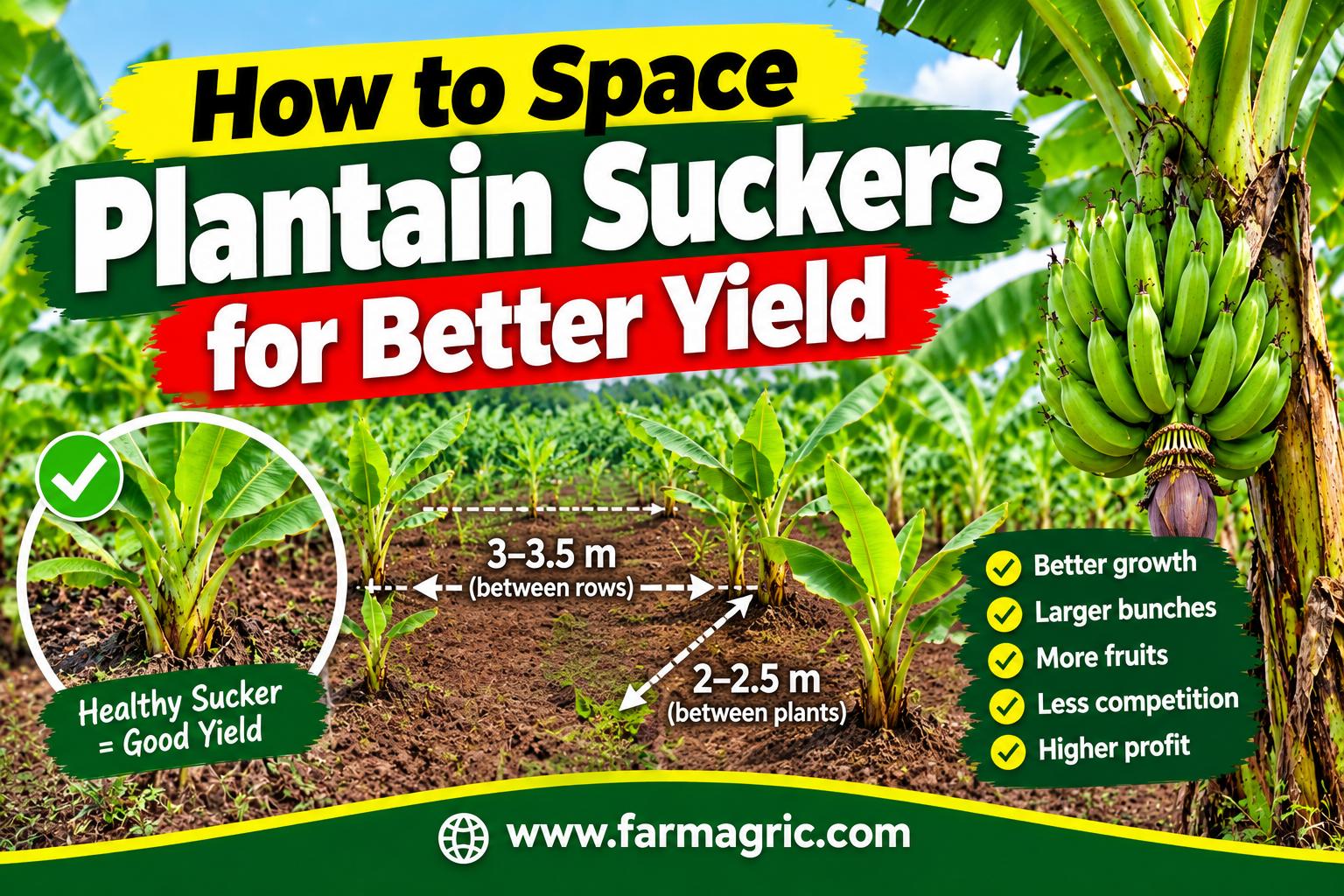
So let me answer you straight, because I know you are deciding right now how close together to put your plantain suckers and whether tighter spacing really does mean more total yield. Plantain suckers should generally be spaced about two to three meters apart in each direction, which works out to roughly four hundred fifty to seven hundred mats per acre depending on your exact spacing and soil fertility, with wider spacing favored on richer soil where mats will grow larger and spread more vigorously, and somewhat closer spacing reasonable on poorer soil where individual mat size will naturally stay more modest. Proper spacing gives each mat enough root volume in the soil, enough direct sunlight for its broad leaves, and enough physical room to support healthy sucker development and eventual bunch production without constant competition from its closest neighbors, and getting this wrong in the direction of too tight very reliably costs more in reduced bunch size and quality than it gains in simple mat count per unit of land.
Why Plantain Spacing Has Such a Large Effect on Long-Term Yield
Plantain is a large, long-lived perennial crop that occupies its growing space for years rather than months, with each mat continuing to produce new suckers and new bunches across multiple growth cycles on the same patch of ground. This means the consequences of spacing decisions made at planting compound over time in a way that is considerably more significant than with an annual crop harvested and replanted within a single season. A mat planted too close to its neighbors does not simply experience mild competition during one growing cycle, it experiences ongoing, worsening competition for light, water, and soil nutrients across every subsequent cycle of sucker development and bunch production for as long as that planting remains in the ground, with the mats’ root systems and canopies growing ever more intertwined and competitive as the planting matures rather than the competition staying fixed at whatever level existed when the suckers were first planted.
What Most Farmers Get Wrong
The first mistake, the one that cost me noticeably smaller bunches on that overly ambitious field, is calculating potential yield based on mat count alone, assuming that fitting more mats into the same area through tighter spacing automatically translates into proportionally more total harvest, without accounting for how directly crowding reduces the productivity of each individual mat as the planting matures.
The second mistake is applying one spacing standard regardless of soil fertility, using the same distance between suckers on rich, well-drained soil capable of supporting large, vigorous mats as on poorer, less fertile ground where individual plant size and vigor will naturally stay more limited throughout the planting’s life.
The third mistake is not accounting for how plantain spacing needs change over time as a planting matures, treating the initial spacing of young suckers as a fixed, permanent arrangement without recognizing that sucker management within each mat, covered in managing mats that fail to fruit, interacts directly with how much total space the whole planting actually needs as individual mats grow larger and more established over successive years.
The fourth mistake is ignoring windbreak and lodging risk when deciding on spacing, not recognizing that overly crowded plantings can actually increase lodging risk during storms rather than reducing it, since crowded mats competing for light often grow taller and more spindly in their pseudostems while also developing weaker, more restricted root systems than properly spaced mats would.
The fifth mistake is planting without any consideration for future access through the field for harvesting, weeding, and sucker management, cramming mats close enough together that simply moving through the mature planting to tend individual mats or carry out heavy bunches at harvest becomes genuinely difficult, adding ongoing labor cost and inefficiency that a slightly wider initial spacing would have avoided entirely.
Step-by-Step Guide to Spacing Plantain Suckers Properly
Assess your soil fertility honestly before finalizing your spacing plan, since this single factor should meaningfully influence where within the general two to three meter range you decide to plant. Richer soil with good organic matter content and reliable moisture availability can support the wider end of that range, around three meters in each direction, allowing mats to grow to their full potential size without unnecessary competition, while poorer, less fertile soil may reasonably use spacing toward the closer end of the range, since individual mat vigor and size will naturally stay more modest regardless of spacing in genuinely limited soil.
Consider your local climate and typical wind exposure when finalizing spacing, since areas with regular strong winds benefit from the somewhat reduced lodging risk that properly spaced, well-rooted mats provide compared to crowded plantings where competition has pushed individual stems taller and thinner than they would otherwise grow.
Measure your spacing using a marked rope, measuring stick, or another consistent physical guide when laying out your planting pattern, rather than estimating distances by eye, since consistent, accurate spacing from the very start avoids the patchwork of crowded and underused areas that inconsistent, by-eye planting tends to produce across a large field.
Plant suckers with adequate depth and proper orientation according to standard practice for your specific planting material, ensuring good initial root-to-soil contact and appropriate covering, since even correctly spaced suckers need proper planting technique to establish the strong root system that spacing is ultimately meant to give them room to develop.
Plan your row orientation with both sunlight access and future field access in mind, since rows oriented to minimize excessive shading between adjacent rows, combined with maintaining clear pathways for movement through the field, support both plant productivity and the practical labor efficiency of managing a mature plantain planting over its multi-year life.
Leave adequate space for sucker development within each mat as the planting matures, recognizing that the overall spacing between mats needs to accommodate not just the original planted sucker but the ongoing presence of a managed, staggered set of three to four stems per mat as described in addressing mats that fail to fruit, rather than planning spacing as if each mat would remain a single, isolated stem indefinitely.
Avoid the temptation to interplant additional plantain suckers into the open spaces between properly spaced young mats simply because that space looks underused during the planting’s early years, since mats that appear small and isolated in their first year will grow substantially larger over subsequent years, and space that looks wasted early on is typically fully utilized by mature canopy and root systems well before the planting reaches its full productive potential.
Consider intercropping compatible, shorter-term crops in the genuinely open space between young plantain mats during their first year or two, rather than adding more plantain into that space, since a well-chosen companion crop can generate useful additional income or food production from that temporarily available ground without creating the long-term competition problem that additional plantain suckers planted too close together would create for years to come.
Monitor mat development over the following one to two years after planting, watching for early signs that your chosen spacing may have been too tight, such as canopies from neighboring mats beginning to heavily overlap and shade each other well before mats have reached full maturity, which provides useful, concrete information for any future plantain plantings even if the current spacing is now difficult to meaningfully correct.
Maintain consistent sucker management within each mat as the planting matures, since proper within-mat sucker thinning works together with proper between-mat spacing to determine how much total competition exists across the whole planting, and neglecting one while managing the other only partially addresses the overall resource competition affecting your eventual bunch yields.
Keep simple records of the spacing used, the soil conditions, and the resulting bunch size and overall yield across different plantings or different sections of your land where spacing may have varied, since this record, built over a few planting cycles given how long plantain remains productive, often reveals a clear and specific relationship relevant to your particular land and conditions.
Warning Signs Your Plantain Spacing Needs Adjustment
Canopies from neighboring mats overlapping and shading each other significantly well before the planting has reached full maturity is an early visual sign that spacing was likely too tight for the soil conditions and mat vigor involved, and this competition for light typically shows up over time as smaller bunch size and reduced overall mat productivity compared to what the same soil could have supported with more generous spacing. Noticeably taller, thinner, more spindly pseudostems compared to what is typical for the variety, particularly paired with increased lodging during wind events, suggest that crowding has pushed individual plants into a weaker growth pattern as they compete for available light rather than developing the sturdier structure that properly spaced plants typically achieve. Bunches that come in smaller or less well-filled than expected for the variety, in a planting that otherwise received reasonable water and nutrition, often trace back to spacing as a limiting factor once other more obvious causes have been ruled out. Difficulty moving through a mature planting to carry out harvested bunches or to carry out routine sucker management and weeding points toward a spacing decision that prioritized mat count over the practical, ongoing labor efficiency of actually working the field over its multi-year productive life. And a pattern across different sections of your land or different plantings, visible once you begin keeping records, where more generous spacing consistently correlates with larger average bunch size, confirms the general relationship in a way worth taking seriously for any future plantain establishment.
What I’d Do Differently If Starting Again Today
If I were starting over, I would resist the temptation to calculate potential yield based purely on mat count per acre the way I did when I first laid out that overly ambitious field, understanding now how completely that calculation ignored the compounding competition that tighter spacing creates across years of a perennial planting rather than just one growing season. I would match my spacing decision honestly to my actual soil fertility from the very beginning, using the wider end of the recommended range on my better ground rather than applying one standard distance everywhere regardless of how much each specific section of land could actually support. I would think seriously about intercropping compatible short-term crops into the genuinely open space between young mats during their first year or two, rather than ever being tempted to fill that space with additional plantain suckers that would only create long-term competition problems for the life of the planting. And I would keep far better records from the start, given how long a plantain planting remains productive and how much useful, specific information about my own land’s ideal spacing I could have accumulated years earlier than I actually did by simply writing down what I planted and what it eventually produced.
Frequently Asked Questions About Spacing Plantain Suckers
What is the best spacing for plantain suckers to get good yield? Most plantings perform well with spacing of about two to three meters between mats in each direction, with richer, more fertile soil generally supporting the wider end of that range to allow mats to reach their full potential size, and poorer soil reasonably using spacing toward the closer end since individual mat vigor will naturally stay more limited regardless.
Does planting plantain suckers closer together really reduce bunch size? Yes, tighter spacing creates ongoing competition for light, water, and soil nutrients that compounds over the multiple years a plantain planting remains productive, typically resulting in smaller individual bunch size and often a lower total harvest weight overall compared to a more generously spaced planting on the same land.
Should plantain spacing be different depending on soil fertility? Yes, richer soil capable of supporting large, vigorous mats generally benefits from spacing toward the wider end of the typical range, while poorer, less fertile soil can reasonably use somewhat closer spacing, since individual mat size and vigor will naturally stay more modest on that ground regardless of how much room is provided.
Can I intercrop something in the space between young plantain mats? Yes, planting a compatible, shorter-term crop in the open space between young mats during their first year or two can make good use of temporarily available ground without creating the long-term competition problem that would come from planting additional plantain suckers too close together in that same space.
Why does plantain spacing matter more than spacing for a crop like maize or beans? Plantain is a long-lived perennial that occupies the same ground for multiple years and growth cycles, so the competition created by overly tight spacing compounds and worsens over time rather than being limited to a single growing season the way spacing effects are for an annual crop that is replanted fresh each year.
If there is one thing I want you to remember from all this, it is that every extra mat you squeeze into a plantain field is a decision you will live with for years, not just one season, so space generously enough for the soil you actually have, resist the appeal of a mat count that looks impressive on paper, and let your eventual bunches, not your initial planting density, be the number that actually tells you whether your spacing decision was the right one.