
Newcastle Disease Symptoms in Chickens Nigeria: Complete Prevention Guide for Nigerian Farmers
As a chicken farmer in Oyi Local Government Area, Anambra State, I’ve watched too many fellow farmers lose their entire flocks to Newcastle disease.
After 8 years in poultry farming and training hundreds of farmers across the Southeast, I can tell you this: Newcastle disease symptoms in chickens are something every Nigerian farmer must recognize early.
The first time I encountered Newcastle disease was in 2017. My neighbor, Papa Chukwu, lost 400 birds in just one week. He called me crying, saying his chickens were “acting drunk” and dying faster than he could bury them.
That experience taught me the hard truth about this disease – it spreads like wildfire through Nigerian poultry farms.
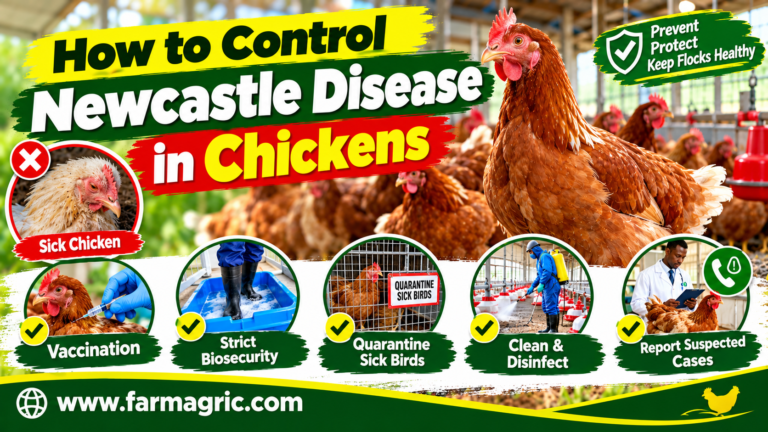
Newcastle disease symptoms in chickens include sudden death, respiratory distress, greenish diarrhea, and neurological signs.
Newcastle disease is a contagious disease of birds and is the greatest constraint to the development of rural poultry production in Nigeria and most developing countries. This disease has cost Nigerian farmers billions of naira annually.
In this guide, I’ll share everything I’ve learned about recognizing, preventing, and managing Newcastle disease in Nigerian chicken farms.
These are real strategies that work in our climate, with our local breeds, and within our budget constraints.
Vaccination costs vary by location and farm size, but here are current Nigerian market estimates:
Vaccine costs (2024 prices):
- LaSota vaccine (1000 doses): ₦3,000-5,000
- Killed vaccine (500 doses): ₦8,000-12,000
- Combination vaccines: ₦10,000-15,000 per 1000 doses
Additional costs:
- Cold storage/ice: ₦500-1,000 per vaccination
- Veterinary consultation: ₦5,000-10,000
- Transportation: ₦1,000-3,000
- Equipment (syringes, etc.): ₦1,000-2,000
Cost per bird (annual):
- Small farms (50-200 birds): ₦50-80 per bird
- Medium farms (500-2000 birds): ₦30-50 per bird
- Large farms (5000+ birds): ₦20-35 per bird
Cost-saving strategies:
- Join farmer cooperatives for bulk purchasing
- Share veterinary consultation costs
- Proper vaccine storage to prevent waste
- Government-subsidized programs where available
Can wild birds spread Newcastle disease to my chickens in Nigeria?
Yes, wild birds are major carriers of Newcastle disease virus in Nigeria. Common carriers include:
- Pigeons and doves (very common in urban/suburban farms)
- Weaver birds (seasonal movements spread virus)
- Egrets and herons (from rice fields and water bodies)
- Migratory birds (introduce new virus strains)
High-risk situations:
- Wild birds roosting above chicken coops
- Shared water sources with wild birds
- Open feeding areas accessible to wild birds
- Farms near rice fields, rivers, or wetlands
Effective wild bird control:
- Complete netting of chicken runs
- Remove water sources that attract wild birds
- Don’t plant fruit trees near chicken houses
- Use covered feeders and waterers
- Install bird deterrents (scarecrows, reflective tape)
In my Oyi farm, I invested ₦50,000 in complete netting in 2019. I haven’t had a Newcastle disease outbreak since, while my unneted neighbors have had three major outbreaks.
References:
- MSD Veterinary Manual – Newcastle Disease in Poultry: https://www.msdvetmanual.com/poultry/newcastle-disease-and-other-paramyxovirus-infections/newcastle-disease-in-poultry
- PMC – Prevalence of Newcastle Disease Antibodies in Nigeria: https://pmc.ncbi.nlm.nih.gov/articles/PMC4897135/
- Poultry Hub Nigeria – Newcastle Disease Prevention: https://www.poultryhub.org/all-about-poultry/health-management/disease/newcastle-disease
Pius Emeka is a certified poultry farmer and trainer based in Oyi Local Government Area, Anambra State, with 8 years of experience in chicken farming and disease management. He has trained over 500 farmers across Southeast Nigeria in modern poultry management practices.