How to Improve Pollination in Watermelon Farms
How to Improve Pollination in Watermelon Farms
One season I had vines as thick as a carpet, hundreds of yellow flowers every morning, and almost no fruit. The few melons that did set were lopsided, fat at the stem end and pinched at the tip. I blamed the seed, then the soil, then the weather. It took a neighbor watching my field at seven in the morning to point out the obvious: there was not a single bee on my flowers. I had sprayed the whole field two days earlier, in the middle of the morning, with the flowers wide open. I had killed my own pollinators, and the vines were full of flowers that nobody was visiting.
Here is the plain answer. Watermelon has separate male and female flowers on the same vine, and each flower opens for only one morning. A bee has to carry pollen from a male flower to the female flower during that short window, and it has to do it several times, because a female flower needs a lot of pollen grains to grow a full, well-shaped fruit. To improve pollination, you bring bees to the field, protect them from sprays, plant so that male and female flowers overlap, keep the vines healthy and not overfed with nitrogen, and hand pollinate where bees are scarce or the weather is against you.
The short version of what I do is this. I put honeybee hives near the field before flowering starts, I never spray while the flowers are open, I plant flowering strips along the field edge for the bees, I keep nitrogen moderate so the vines make female flowers on time, I plant a pollinizer variety if I grow seedless types, and on bad mornings I go down the rows by hand with a male flower and do the job myself. The rest of this article explains how pollination works in watermelon, what most farmers get wrong, and how to put each step into practice.
What Most Farmers Get Wrong
The first mistake is assuming the flowers will take care of themselves. Many farmers see a field full of yellow flowers and think pollination is guaranteed. A flower is not a pollinated flower. Without bees visiting at the right hours, you get flowers and no fruit.
The second mistake is spraying at the wrong time. Insecticides sprayed in the morning or during the day kill bees directly or leave residue on the flowers that harms them for hours. Many farmers spray whenever they have time, with no thought for the bloom period.
The third mistake is not having any bees nearby. Fields cleared right to the edge, with no hedges, wild flowers, or hives within reach, may have very few pollinators. Bees will not travel far if there is nothing to feed them on the way.
The fourth mistake is overfeeding nitrogen. Heavy nitrogen pushes vine growth and a long run of male flowers, and it delays or reduces female flowers. The field looks lush and flowering, but the flowers that matter are few.
The fifth mistake is ignoring the weather. Rain, cold mornings, heavy cloud, and extreme heat all cut down bee activity and damage pollen. A good field can have a poor set simply because the first week of flowering was wet.
The sixth mistake is not understanding seedless varieties. Seedless watermelons produce little or no viable pollen of their own, so they need a regular seeded variety planted nearby to supply it. Farmers who plant seedless types alone get flowers and no fruit.
The seventh mistake is leaving misshapen fruit on the vine. Poorly pollinated fruit is lopsided and small, and it takes energy from better fruit. Many farmers keep everything out of reluctance to throw it away.
How Watermelon Pollination Works
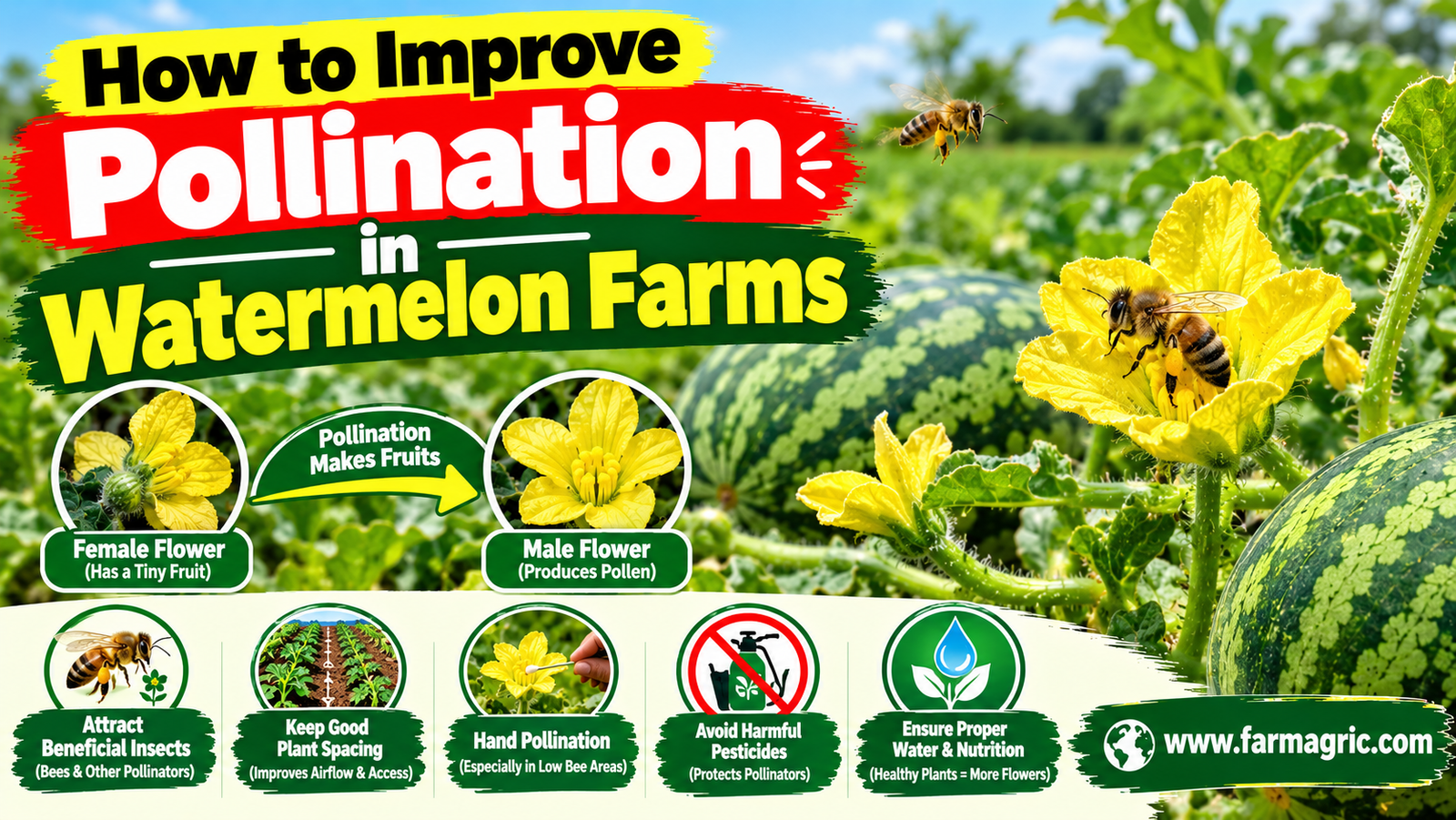
Each watermelon vine carries male flowers and female flowers. The male flowers come first, in large numbers, and the female flowers come a little later. You can tell a female flower easily, because it has a tiny swelling behind the petals that looks like a miniature watermelon. The male flower has only a thin stalk.
Each flower opens early in the morning, often around sunrise to mid-morning, and closes by around midday. After that it is finished, and a female flower that was not pollinated will drop off, and the little swelling behind it shrivels and falls. Pollen is at its best in the early part of the morning, and its life is short, especially in heat.
For a female flower to make a full, evenly shaped fruit, it needs many pollen grains spread across the stigma, and that normally means a bee has to visit it several times. A flower visited once or twice often makes a small, lopsided, or hollow fruit, or aborts altogether. That is why the number of bee visits matters as much as the number of flowers.
Bring Bees to the Field
Honeybees are the most dependable pollinators for a commercial watermelon field. A common recommendation is roughly one to three strong hives per hectare, though the right number depends on the size of the field, the variety, and the other flowers competing for the bees’ attention. Ask your extension office or a local beekeeper for the figure that suits your area.
Place the hives near the field before the first female flowers open, not after. Bees need a few days to get used to the area. Put them in a sheltered spot, facing the morning sun, with a source of clean water close by. Spread several smaller groups of hives around a large field instead of putting all of them in one corner, because bees work hardest on the flowers closest to the hive.
Rent hives from a local beekeeper if you do not keep bees yourself. It is one of the best investments in a watermelon farm. A good beekeeper will also tell you when to move the hives out of the way before you spray.
Support Wild and Native Pollinators
Honeybees are not the only helpers. Wild bees, stingless bees, bumblebees, and other insects visit watermelon flowers, and in many places they do a great deal of the work. You can help them without spending much.
Leave strips of flowering plants and hedges along the field edge, and let useful wild flowers grow on the margins. Plant a few rows of flowers that bloom before and after the watermelon so the bees stay in the area. Provide a shallow dish of clean water with stones in it so bees can drink without drowning. Avoid clearing every bit of bush around the field, since many wild bees nest in bare ground, dead wood, and hollow stems.
A field surrounded by diverse flowering plants usually has more pollinators visiting, and a steadier set of fruit, than a bare, spotless one.
Protect Pollinators From Sprays
This is the cheapest improvement you can make. Do not spray insecticides while the flowers are open. If you must spray during the flowering period, do it in the late evening, after the bees have returned to their hives and the flowers have closed, and choose products with the lowest risk to bees. Read the label, because many list bee warnings and give guidance on timing.
Never spray flowering weeds in or near the field, since bees visit them too. Tell your neighbors about your hives, and ask them to avoid spraying at flowering time when the wind could carry drift across. Move or cover hives, as your beekeeper advises, if a spray cannot be avoided.
Scout your field for pests before flowering and deal with them early, so you do not face a crisis in the middle of the bloom. A field that is clean and healthy at the start rarely needs emergency spraying during pollination.
Plant the Right Pollinizers for Seedless Types
If you grow seedless watermelons, you must plant a seeded pollinizer variety in the same field. The seedless plants make flowers, but their pollen cannot do the job, so the seeded plants supply it, and the bees carry it across.
A common arrangement is one pollinizer plant for every two to three seedless plants, or one row of pollinizers to every two or three rows of seedless, so that bees moving along the rows always meet pollen. Choose a pollinizer that flowers at the same time as the seedless variety, and ask your seed company which pollinizer they recommend. Some varieties are bred just for this role, with the seed color or rind pattern making it easy to tell the pollinizer fruit apart at harvest, so you do not mix them up.
Plant the pollinizers on the same day as the seedless plants where possible, and do not let them be shaded or crowded out. Fewer pollinizers than recommended means lower fruit set on the seedless crop.
Time Planting and Feeding for Flower Overlap
For good pollination you need male and female flowers open together. Healthy vines will normally do this on their own, but a few things upset the balance.
Too much nitrogen is the biggest. Keep your early feeding balanced, with moderate nitrogen, and cut it back once the vines begin flowering. Shift toward potassium and phosphorus to support flowering and fruit set. A soil test is the cheapest way to avoid guessing.
Water stress and heat also reduce female flowers. Keep the soil steadily moist with mulch and drip irrigation, and in the hottest weeks consider light shade netting for young plantings. Plant so that the main flowering period falls in warm, dry, sunny weather and not in the heaviest part of the rains or the coldest nights. Counting backward from the expected flowering date, as I do for other crops, helps you pick the planting window.
Aim to get fruit from the first few female flowers on each vine, and do not worry about the earliest flowers on very young plants. Fruit that sets at the second or third node, on a vine that is already well branched, tends to be better formed.
Hand Pollination: When and How
Hand pollination is slow, but it works, and on small farms, new plantings, or during wet and cold weather it can save a crop. It also helps with seedless types and in greenhouses or tunnels where bees cannot reach.
Go to the field early, as soon as the flowers open, usually in the first hours after sunrise. Pick a freshly opened male flower with a good, yellow, powdery center. Remove the petals gently so the pollen-bearing part is exposed. Touch it lightly against the center of an open female flower, rolling it slightly so pollen is spread across all the lobes of the stigma. One male flower can pollinate several females, as long as it still has visible pollen.
Pollinate only flowers that are fully open and fresh, and finish by mid-morning, before the heat dries the pollen. Mark each hand-pollinated flower with a bit of cloth or a colored string tied loosely to the vine, so you know the date and can follow its progress. Do it every morning during the flowering window. Use a soft brush instead of a male flower if you prefer, but a fresh flower works best.
If you use hand pollination as a back-up, treat it as a way to fill the gaps, not to replace bees where bees are available.
Weather and Microclimate
You cannot control the weather, but you can soften its effects. Windbreaks of tall crops or hedges, planted well to the side so they do not shade the vines, reduce wind that discourages bees and dries pollen. Good drainage and raised beds keep roots healthy through wet spells. Shade netting in extreme heat protects pollen and flowers.
Bees fly less in cool, wet, windy, or very hot weather. If the first week of flowering is wet, be ready to hand pollinate a few vines from each part of the field so you do not lose all the early fruit. If the whole flowering period is poor, remember that the vines will keep producing flowers, and a later set may do better.
Manage Fruit After Setting
Once fruits are set, thin them. Keep two or three well-shaped fruits per vine for large types, and remove those that are misshapen, small, or damaged, since poorly pollinated fruit will not catch up and wastes the plant’s energy. Keep the vines healthy and the leaves intact, because the sugar and size of the fruit depend on them.
Keep notes. Record the dates of first flowering, the weather, the hive numbers, any sprays, and the fruit set per vine. After a season or two you will see which factors matter most on your own land.
Step-by-Step Practical Plan
If I were planning your next crop, it would run like this.
Plan your planting date so that flowering falls in warm, dry, sunny weather.
Prepare well-drained soil with compost, and feed balanced nutrition early, with moderate nitrogen.
Arrange hives with a local beekeeper to arrive a few days before the first female flowers open, and place them in several spots around the field.
Plant flowering strips and keep hedges and wild flowers at the margins, with a clean water dish near the hives.
If you grow seedless types, plant the recommended pollinizer variety in the right ratio and on the same day.
Cut back nitrogen once the vines begin flowering, and keep soil moisture steady with mulch and drip irrigation.
Scout pests before flowering, and avoid spraying while flowers are open. Spray only in the late evening, with low-risk products, if you must.
Check the flowers early each morning for bee activity, and hand pollinate on cold, wet, or low-bee days.
Mark pollinated flowers, and thin fruits to two or three per vine once they are growing.
Record flowering dates, weather, hives, and fruit set so you can improve next season.
Warning Signs to Watch For
Learn to read the field. Few or no bees on the flowers during the morning hours is the clearest warning. Female flowers dropping off with the small swelling behind them turning yellow and shriveling mean they were not pollinated. Small, lopsided, or pinched fruit shows poor or partial pollination. Very lush vines with lots of male flowers and few female ones suggest too much nitrogen. A sudden spray in or near the field during bloom will show up as fewer bees the next morning. A long cold or wet spell during flowering means you need to hand pollinate.
If you see any of these, act that week, not next month.
What I Would Do Differently If Starting Again Today
If I were starting fresh, I would arrange my hives before I ordered my seed. I would walk the field at seven every morning during flowering, counting bees and checking flowers, because that single habit would have saved me three poor seasons. I would write a spray rule on a board at the farm gate that says nothing goes on during bloom except in the evening, and I would tell every worker. I would plant a flowering strip along the field edge on the first day. And I would take the time to hand pollinate a few test vines each season, so I knew exactly what a well-pollinated fruit should look like.
I would also stop treating bees as a bonus. On a watermelon farm, they are one of your workers, and you cannot pay them to work if you have already poisoned them.
FAQ
Why are my watermelon flowers falling off without making fruit?
Female flowers drop when they are not pollinated, or when the plant is under stress from heat, water problems, or heavy nitrogen. Male flowers also drop naturally, since they only last one morning. Check whether the female flowers, the ones with the tiny fruit behind them, are being visited by bees.
How many bees do I need for a watermelon field?
A common recommendation is about one to three strong honeybee hives per hectare, placed near the field before flowering. The right number depends on your field and the other flowers around, so ask a local beekeeper or your extension office.
What time of day should I hand pollinate watermelon?
Early in the morning, as soon as the flowers open, and ideally before mid-morning. Pollen is freshest then, and the flowers close later in the day.
Do seedless watermelons need a pollinizer?
Yes. Seedless varieties do not produce viable pollen, so a seeded pollinizer variety must be planted nearby, in the ratio recommended by the seed company, so bees can carry its pollen to the seedless flowers.
Why are my watermelons misshapen?
The usual cause is poor or incomplete pollination, where only part of the stigma receives pollen, so only part of the fruit develops fully. Improve bee numbers, avoid spraying at bloom, and hand pollinate in poor weather. Water stress and nutrient problems can also play a part.
The Advice Worth Bookmarking
A watermelon flower gets one morning and a few bee visits. Make sure the bees are there, the sprays are not, and the pollen has somewhere to land.