How to Control Cassava Mosaic Disease
How to Control Cassava Mosaic Disease: A Farmer’s Guide to Protecting Your Crop From a Disease You Cannot Cure
I remember walking a friend’s cassava field with him one morning and stopping at a plant that looked wrong in a way I couldn’t immediately name. The leaves were smaller than the rest, twisted at the edges, and patched with light green and dark green in a blotchy pattern that looked almost like a map. He told me it had always looked like that, that it was just how that particular stem grew. It wasn’t. That was cassava mosaic disease, and by the time we walked the rest of his field we found it scattered through nearly a third of his plants, many of which he had unknowingly used as a source for planting material the previous season. That morning taught me something that has shaped how I grow cassava ever since: this disease spreads through the very cuttings farmers use to plant their next crop, which means the mistake is often made months before the symptoms ever show up.
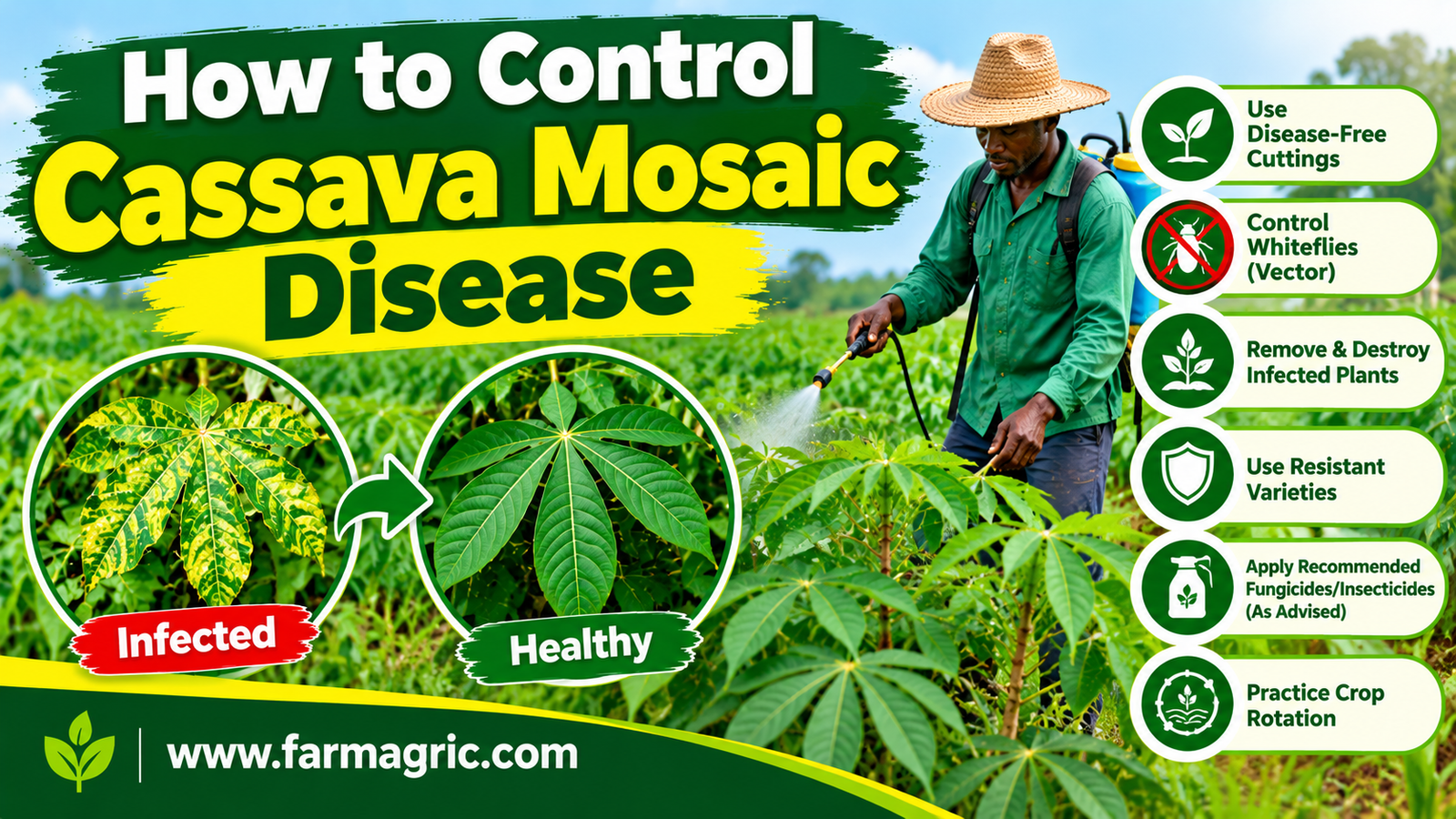
So let me answer you straight, because I know you are looking at mottled, twisted leaves right now and wondering what you can spray to fix it. Cassava mosaic disease has no chemical cure once a plant is infected, since it is caused by a virus that spreads mainly through infected cuttings and through a small insect called the whitefly, and the only real way to control it is prevention, using certified virus-free planting material, planting resistant or tolerant varieties, removing and destroying infected plants early, and managing whitefly populations so they cannot keep spreading the virus from plant to plant. This is one of those cassava problems where the fight is won or lost before you ever put a cutting in the ground, not afterward with a chemical you reach for once the leaves already look wrong.
What Cassava Mosaic Disease Actually Is
Cassava mosaic disease is caused by a group of related viruses that infect the plant systemically, meaning the virus spreads through the whole plant once it takes hold and stays there for the plant’s entire life. It moves between plants in two main ways. The first and by far the most damaging in most fields is through infected cuttings, since a farmer who takes stems from an infected plant to use as seed for the next season is planting the virus directly into a fresh field along with the cutting itself. The second way is through the whitefly, a small, pale insect that feeds on the sap of infected plants and carries the virus to healthy plants as it moves through the field. Once a cassava plant is infected, there is no treatment that removes the virus, and the plant will show reduced vigor and reduced root yield for its entire life, which is exactly why this disease has to be managed by keeping it out of the field in the first place rather than by treating it once it has already arrived.
What Most Farmers Get Wrong
The first mistake, and it was the mistake my friend was making without knowing it, is using cuttings from your own field year after year without ever checking whether those parent plants are healthy. Farmers save money and effort by reusing planting material, but if even a portion of the source plants carry the virus, that infection gets planted straight into the next season’s crop along with everything else.
The second mistake is not recognizing the symptoms early because they can be mistaken for nutrient deficiency, drought stress, or simply a plant’s natural variation. The mottled, blotchy yellow and green pattern on the leaves, combined with leaf twisting, curling, and a smaller overall leaf size, is distinctive once you know to look for it, but it is easy to walk past if you have never learned to recognize it specifically.
The third mistake is ignoring the whitefly as a factor in spreading the disease, focusing entirely on planting material while leaving the insect that carries the virus between plants completely unmanaged. Even a field planted with clean cuttings can become infected over the season if whitefly populations are high and there is a nearby source of the virus for them to pick up.
The fourth mistake is leaving infected plants standing in the field because they still produce some roots and it feels wasteful to remove them. Every infected plant left standing is a continuing source of virus that whiteflies can pick up and spread to the healthy plants around it, so tolerating a few infected plants for the sake of their partial yield often costs far more in yield loss across the rest of the field over time.
The fifth mistake is planting a susceptible variety in an area with a known history of the disease simply because that variety is what has always been grown locally, without seeking out resistant or tolerant alternatives that could dramatically reduce the risk from the very first season.
Step-by-Step Plan to Control Cassava Mosaic Disease
Start by sourcing certified, virus-free planting material from a trusted supplier, research station, or extension program rather than defaulting to whatever cuttings happen to be available nearby. This single decision does more to prevent the disease from ever entering your field than any other single step, since it stops the most common route of infection before planting even begins.
Where certified material is not available and you must use your own or a neighbor’s stock, inspect the source plants carefully before cutting. Walk the parent field and look specifically for the mottled, blotchy leaf pattern and leaf distortion described above, and take cuttings only from plants that show no sign of infection, ideally from the center of a healthy stand rather than the edges, where infection pressure from whiteflies moving in from outside the field tends to be highest.
Choose a resistant or tolerant variety wherever your area has a history of mosaic disease pressure. Plant breeders have developed cassava varieties with meaningful resistance to this disease, and in high-risk areas this single choice can mean the difference between a field that stays largely clean and one that becomes heavily infected regardless of how carefully you manage everything else.
Scout your field regularly, starting from the first month after planting and continuing throughout the season, looking specifically for the mottled, twisted leaf symptoms on young growth. Catching an infected plant early, before it has been standing long enough to become a major source of virus for the whiteflies around it, makes a real difference to how far the disease spreads through the rest of the field.
Remove and destroy infected plants as soon as you find them. Dig out the whole plant, roots included, and take it out of the field entirely rather than leaving it in a pile nearby, since a source of the virus does not need to be alive and rooted to still act as a whitefly feeding site for a period after removal.
Manage whitefly populations to slow the spread of the disease between plants. Avoid broad-spectrum insecticide use that would also wipe out the natural predators, such as ladybird beetles and various parasitic wasps, that help keep whitefly numbers down on their own. Where whitefly pressure is genuinely high, a targeted insecticide applied specifically for this pest, following label instructions, can reduce transmission, though it works best as one part of a broader control approach rather than a stand-alone fix.
Keep field margins reasonably managed rather than letting dense, unmanaged vegetation grow right up to the edge of the cassava, since certain weeds and volunteer plants can serve as an alternative host for whiteflies and sometimes for the virus itself, giving both a place to persist between cassava seasons.
Avoid planting new cassava immediately next to an old, heavily infected field still standing nearby, since whiteflies move readily between neighboring plots, and a young, healthy planting next to a mature infected field faces significant pressure from day one.
Practice a degree of isolation for any multiplication or nursery plots intended purely for producing clean planting material for future seasons, keeping them as far as practical from known infected fields, and inspecting them even more rigorously than a normal production field, since the entire purpose of that plot is to supply disease-free cuttings going forward.
Rotate away from cassava on a badly infected plot for at least one season where the option exists, planting maize, a legume, or another non-host crop instead, which helps reduce local virus and whitefly pressure before cassava is planted there again.
Keep simple records of which sections of your land have shown infection in past seasons, since this history helps you decide where to prioritize resistant varieties, more frequent scouting, or a season of rotation, rather than treating every part of your land as equally at risk.
Warning Signs to Watch For
The clearest and earliest sign is a blotchy, mottled pattern of light green and dark green on the leaves, often described as looking like a map or a patchwork, appearing on young leaves near the growing tip of the plant. Alongside this, watch for leaves that are visibly smaller than normal, twisted, curled, or puckered rather than lying flat, since this distortion often accompanies the color pattern and helps distinguish the disease from a simple nutrient issue. Stunted overall growth, with the plant noticeably shorter and less vigorous than healthy neighbors of the same age, is common in more severely affected plants, particularly those infected very early in their life. High numbers of small, pale whiteflies visible on the undersides of leaves, especially rising up in a small cloud when a plant is disturbed, signal active transmission risk even before any symptoms appear on a particular plant, and this warrants closer attention to the whole surrounding area. And a pattern of infection concentrated near field edges, particularly edges closest to an older or already infected field, points toward whiteflies moving in from that neighboring source, which tells you where your control efforts need the most attention.
What I’d Do Differently If Starting Again Today
If I were starting over, I would source certified planting material from the very first season instead of assuming that cuttings from a healthy-looking local field were automatically safe, since I now understand how easily this particular disease hides in plants that otherwise look reasonably normal from a short walk through the field. I would learn to recognize the mottled leaf pattern properly from day one, the way I eventually learned it standing in my friend’s field that morning, rather than only becoming familiar with it after seeing an advanced, unmistakable case. I would scout specifically for this disease on a regular schedule rather than folding it into a general walk-through where it is easy to miss early on. I would remove infected plants the moment I found them instead of ever being tempted to leave a few standing for their partial yield, since I now see clearly how much a single untreated source plant can cost the rest of the field over a season. And I would pay far more attention to whitefly pressure and to what was growing in neighboring fields, rather than treating my own plot as an isolated concern separate from what my neighbors were managing, or not managing, right next door.
Frequently Asked Questions About Cassava Mosaic Disease
Can cassava mosaic disease be cured once a plant is infected? No, there is no treatment that removes the virus from an infected plant, since it spreads through the plant’s tissue permanently and stays for the rest of its life, which is why prevention through clean planting material and early removal of infected plants is the only real management strategy available.
How is cassava mosaic disease actually spread between plants? It spreads mainly through infected cuttings used as planting material, and to a lesser but still meaningful degree through the whitefly, a small insect that feeds on infected plants and carries the virus to healthy ones as it moves through the field.
How can I tell if a cassava plant is infected with mosaic disease? Look for a blotchy, mottled pattern of light and dark green on the leaves, along with leaves that are smaller than normal, twisted, or curled, particularly on young growth near the tip of the plant, and compare against healthy neighboring plants for contrast.
Are there cassava varieties resistant to mosaic disease? Yes, plant breeders have developed varieties with meaningful resistance or tolerance to this disease, and choosing these in areas with a known history of mosaic pressure is one of the most effective single steps a farmer can take to protect yield.
Should I remove infected cassava plants or leave them to grow since they still produce some roots? Removing infected plants as soon as you find them is generally the better choice, since they act as a continuing source of virus that whiteflies can spread to the healthy plants around them, and the yield loss they cause across the rest of the field over time usually outweighs the partial harvest they would have given if left standing.
If there is one thing I want you to remember from all this, it is that cassava mosaic disease is planted long before it is ever seen, hidden inside a cutting that looked perfectly ordinary at the time, so put your effort into clean planting material and early scouting rather than searching for a cure that simply does not exist once those mottled leaves appear.