How to Space Cowpea for Better Yield
How to Space Cowpea for Better Yield
For my first few seasons I believed that more plants meant more beans. I sowed cowpea so thick that the seedlings looked like a green carpet, and I was proud of it for about five weeks. Then the plants stretched toward the light, the stems went thin and leggy, the lower leaves yellowed, and the flowers that did come were up at the top, far fewer than they should have been. My neighbour had planted the same variety in neat, wider rows. His field looked thinner at first. At harvest, his sacks were fuller than mine.
That season taught me that spacing is not a detail. It decides how much light every plant gets, how fast the field dries after rain, how easily you can weed and scout, and how many pods each plant can carry. After thirty years I have settled on a way of choosing spacing that works, and I want to share it.
The short answer
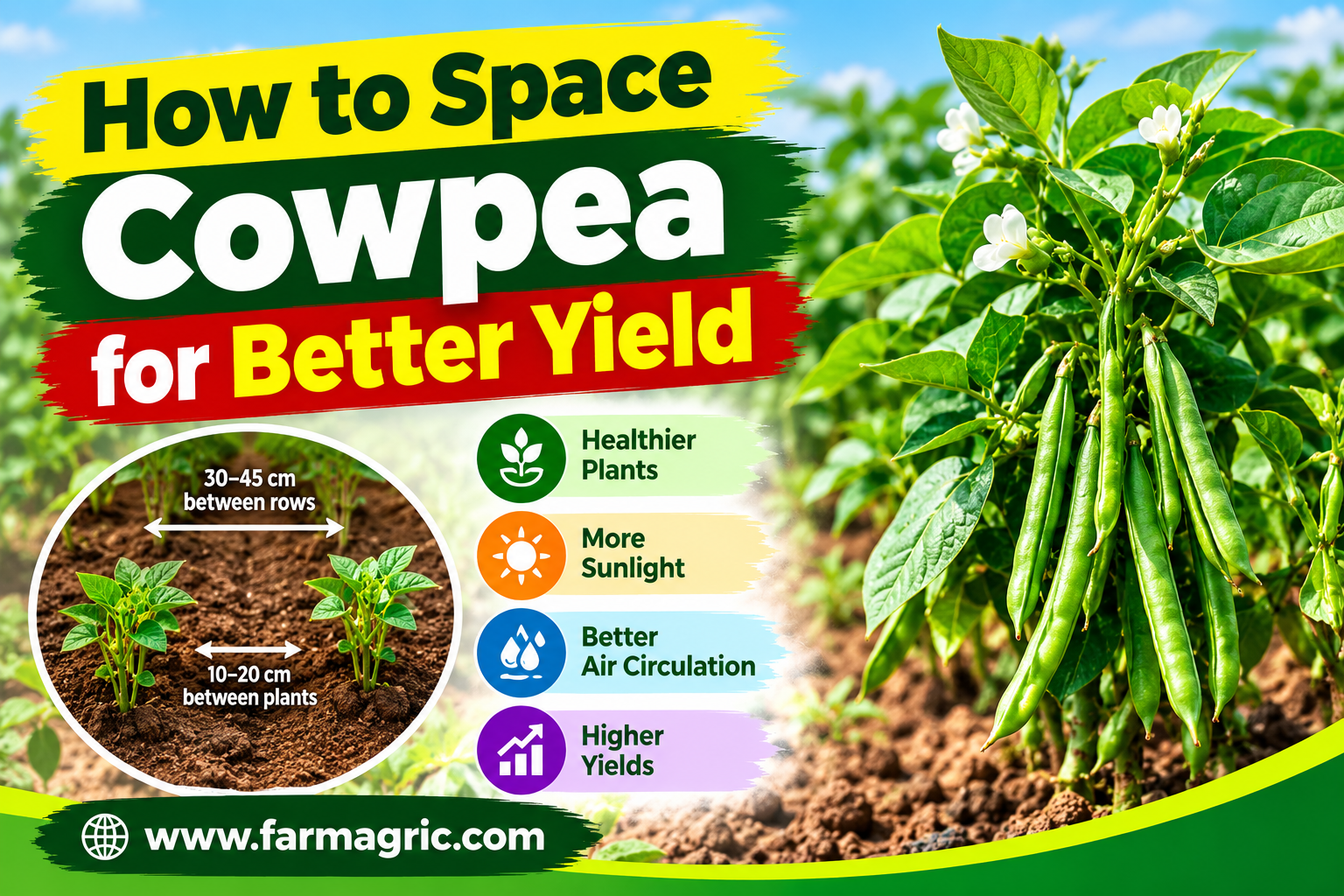
For most erect and semi erect improved cowpea varieties, plant in rows about 50 to 75 centimetres apart, with about 10 to 20 centimetres between plants in the row, giving roughly 60,000 to 100,000 plants per hectare, which is about 25,000 to 40,000 plants per acre. Spreading and late varieties need more room, often 75 to 100 centimetres between rows and 20 to 30 centimetres or more between plants. There is no single perfect number, because the best spacing depends on your variety, your soil fertility and your rainfall. As a rule, give erect early types a closer spacing, give spreading types a wider one, and always check the recommendation for the variety you bought.
What most farmers get wrong
I made every one of these mistakes myself, so please take this as a friend talking.
They plant too thick because they fear a poor stand. A thick field feels safe, like insurance against the birds, ants and drought. But crowded plants compete for light, water and nutrients, grow tall and weak, and drop their flowers.
They use one spacing for every variety. A short bushy variety and a vigorous spreading one are not the same plant. Treating them alike wastes yield either by crowding the spreader or by leaving the bush type with too much empty ground.
They ignore soil fertility. On rich soil, plants grow big and need more room. On poor soil, they stay small and can tolerate closer spacing. Farmers who copy a neighbour’s spacing without thinking about their own soil often get it wrong.
They sow carelessly by broadcasting or scattering seed. The result is clumps and gaps. Clumps compete and rot, gaps waste land and let weeds in.
They never count the stand. Many farmers have no idea how many plants they actually have per acre, so they cannot tell whether a poor harvest came from the spacing or from something else.
Why spacing matters so much
It helps to understand what spacing really controls, because once you see it, the choices make sense.
Light is the first thing. A cowpea flower needs sun to form and set a pod. In a crowded field, the upper leaves shade everything below, and the middle and lower parts of the plant produce few flowers. Wider spacing lets light reach deeper into the canopy.
Air is the second. A dense canopy holds humidity, keeps the leaves wet for longer after rain or dew, and invites fungal and bacterial leaf diseases. It also gives pests a sheltered, damp home. Good airflow dries the plants quickly and keeps both problems down.
Water and nutrients are the third. Every plant draws on the same patch of soil. Too many plants means each gets less, and a dry spell hits harder because the soil moisture runs out faster. Fewer plants with deeper roots usually handle a dry spell better.
Management is the fourth. Wider rows let you walk through the field, scout for pests, weed easily and spray properly with the product reaching the flowers and not just the top leaves. In a tangled thick stand, you cannot reach the flower buds where the thrips and pod borers hide.
Cowpea also has a useful habit. If the plant has room, it branches and fills the space, producing more pods per plant. That is why a somewhat thinner stand often yields as much as, or more than, a very thick one. But there is a limit. Too few plants leave bare ground, let weeds take over, and waste the field’s potential. The goal is the balance between the two.
How to choose the right spacing for your field
Four things decide the best spacing for you: your variety type, your soil, your rainfall and your planting method.
For your variety, read the seed packet or ask the seed seller whether the plant is erect, semi erect or spreading. Erect and early types, which grow upright and compact, take close spacing. Semi erect and medium types need a little more. Spreading, trailing and late types, which grow long vines, need wide spacing, or they smother themselves and each other.
For your soil, rich, deep and fertile soils grow bigger plants and need wider spacing. Poor, shallow or sandy soils grow smaller plants and can handle a somewhat closer stand, though very poor soil may simply give low yield at any spacing.
For rainfall, in drier areas, wider spacing helps each plant find enough water, so I lean toward fewer plants per acre. In wetter areas, closer spacing is possible, but airflow and disease then become the limiting factor, so I do not push it.
For planting method, if you plant by hand in rows with a line or a measured stick, you can hold a tight, even spacing. If you sow with a planter, you can follow the machine’s settings. If you mix cowpea with a cereal, the spacing changes, and I explain that below.
Recommended spacing ranges
Please treat these numbers as starting points and always check the recommendation for your specific variety and region.
For erect or early improved varieties, I plant rows 50 to 60 centimetres apart, with plants 10 to 15 centimetres apart in the row, one or two plants per stand. This gives a high plant population and works well on moderately fertile soil with reliable rain.
For semi erect and medium maturing varieties, I plant rows about 60 to 75 centimetres apart, with plants 15 to 20 centimetres apart. This is the spacing I use most often.
For spreading, trailing or late varieties, I plant rows 75 to 100 centimetres apart, with plants 20 to 30 centimetres apart, sometimes more on rich soil. These plants run and fill the space, so they do not need many stands.
To work out how many plants you will have, multiply it out. An acre is about 4,047 square metres. If you plant with rows at 75 centimetres and plants at 20 centimetres, with one plant per stand, each plant takes up 0.15 square metres, which comes to roughly 27,000 plants per acre. With rows at 60 centimetres and plants at 15 centimetres, each plant takes 0.09 square metres, which is about 45,000 plants per acre. Doing this sum before you plant lets you check that you are in a sensible range.
As for seed, many erect improved types need roughly 8 to 10 kilograms of seed per acre, though this depends on seed size, spacing and germination. Spreading types need less. Weigh your seed against your plan, and buy a little extra to fill gaps.
Step by step: how I space and plant my cowpea
Step 1: Know your variety
Before anything else, find out whether your variety is erect, semi erect or spreading, and note its recommended spacing. If the seed seller cannot tell you, ask the extension office. Write the number down, and plan your field around it.
Step 2: Measure out your rows
Do not plant by eye. Use a long string stretched between two pegs to mark each straight row, or use a measuring stick cut to the row width. I use a stick cut to my chosen row spacing and drag it along to mark the next line. Straight, evenly spaced rows make weeding, scouting and spraying much easier for the whole season.
Step 3: Mark the planting stands
Cut a second stick to the in row spacing, say 20 centimetres, and use it to place each stand. It takes more time at the start, but it pays back every week afterwards.
Step 4: Sow at the right depth
Place two seeds per stand, about two to four centimetres deep in moist soil. Cover them lightly and firm the soil. Planting too shallow exposes the seed to birds, ants and drying wind, and planting too deep slows emergence.
Step 5: Thin to the right number
About one to two weeks after emergence, once the seedlings are established, thin to one or two healthy plants per stand, depending on your variety and spacing. Cut the extra seedlings at the soil line with a blade, instead of pulling them, which can damage the roots of the ones you are keeping. Always keep the strongest, healthiest seedling.
Step 6: Count and fill the gaps
A week after emergence, walk the rows and count the stands that failed. Fill gaps early, within the first ten days, with fresh seed, so the late plants can catch up with the rest. Gaps left for weeks become weed patches and lost yield.
Step 7: Adjust spacing for the field conditions
If part of your field is shaded, low and wet, or heavy clay, plant that area a little wider, or leave the worst corners out. If your soil is poor and your variety is small, you can tighten the spacing slightly. Keep a note of which areas did best, and adjust next season.
Step 8: Keep the spacing working through the season
Weed at about two weeks and again at about four to five weeks, and do not let weeds undo the spacing you set. Scout the flowers early. Wide rows make it easy to walk in and open a few buds each morning. If the canopy closes much too quickly and humidity builds, take it as a signal to plant thinner next season.
Spacing when you intercrop
Many farmers grow cowpea together with a cereal such as maize, sorghum or millet. In that case, the spacing changes. The cereal is planted in its usual rows, and the cowpea is sown in between, often in alternate rows or within the cereal rows. Because the cereal also takes light, water and nutrients, I plant the cowpea a little thinner than I would in a sole crop and keep it about 20 to 30 centimetres from the cereal stalks. Choose a short or medium cowpea variety for intercropping, because a vigorous spreading type will climb the cereal and choke it. Always follow the local recommendation for the exact pattern.
Warning signs your spacing is wrong
The field will tell you if you read it. Tall, thin, leggy plants with few flowers and yellowing lower leaves tell you the stand is too thick and the plants are fighting for light. A dense canopy that stays wet long after rain, with leaf spots and mould, points to poor airflow. Weeds growing strongly between the rows, bare patches of soil and branching plants with heavy pod loads at the edges of the field suggest the spacing is too wide or the stand has too many gaps. Plants that wilt early in a short dry spell, even though they are healthy, often mean the roots are competing for scarce water. Lots of vines but few pods on the plants in the middle of the field usually point to shading.
What I would do differently if I started again today
If I were starting over, I would decide the spacing before I bought the seed, and I would buy enough seed for that plan and a little extra for gap filling.
I would mark my rows and stands with a string and a cut stick from day one, instead of planting by eye.
I would plant a little thinner than my fear told me to, because I have never regretted spacing and I have often regretted crowding.
I would count my plants a week after emergence and fill the gaps right away.
And I would keep a notebook with the spacing, variety, planting date and yield for each field. After three seasons, my own numbers would tell me the best spacing for my soil better than any chart can.
Frequently asked questions
What is the best spacing for cowpea?
For many erect or semi erect improved varieties, rows 50 to 75 centimetres apart with plants 10 to 20 centimetres apart in the row works well. Spreading varieties need wider spacing. Always check the recommendation for your specific variety.
How many cowpea plants should I have per acre?
For most improved varieties, roughly 25,000 to 40,000 plants per acre is a common range, depending on variety type, soil fertility and rainfall. Spreading types need fewer.
How many seeds do I plant per hole?
I sow two seeds per stand and thin to one or two healthy plants a week or two after emergence, depending on the spacing and variety.
How many kilograms of cowpea seed do I need per acre?
Many erect improved types need about 8 to 10 kilograms per acre, though the exact amount depends on seed size, spacing and germination rate. Spreading types usually need less.
Is it better to plant cowpea thick or thin?
Neither extreme. Too thick causes shading, disease and weak plants, and too thin wastes land and lets weeds in. The best yield comes from the spacing recommended for your variety, adjusted for your soil and rainfall.
The one thing to bookmark
A cowpea plant yields from the light it can reach, not from the crowd around it, so give every plant room to breathe and the whole field pays you back.