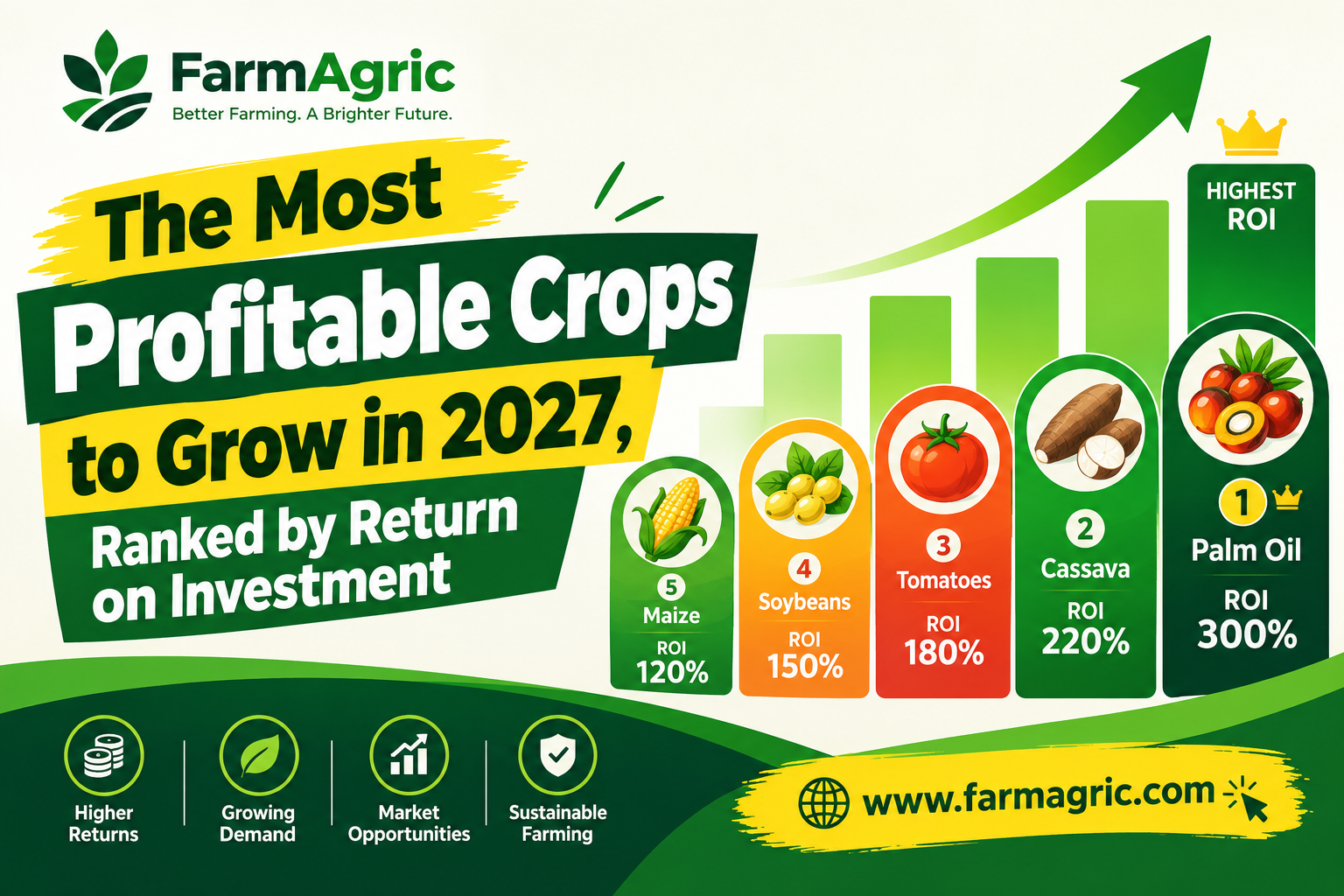
The Most Profitable Crops to Grow in 2027, Ranked by Return on Investment
The Most Profitable Crops to Grow in 2027, Ranked by Return on Investment
Every planting season I hear the same question from new farmers. “Which crop should I put my money into?” And every season I give the same first answer, which usually disappoints people. There is no single crop that is universally the most profitable. Location, market access, and how well you manage the season matter more than the crop itself. But there is a real, honest ranking you can work from, based on how much capital a crop needs versus what it actually returns on one hectare, and that is what I am giving you here.
How I Calculated This Ranking
I am using return on investment, meaning net profit divided by the capital you put in, expressed as a percentage. A crop that costs you ₦100,000 to grow and returns ₦300,000 in profit has a 200 percent ROI. This matters more than raw profit figures, because a crop that returns ₦1,000,000 but costs you ₦800,000 to grow is actually a worse investment than one that returns ₦400,000 on a ₦100,000 cost, even though the naira figure looks smaller.
I have also separated short-cycle crops, the ones that pay you back in three to six months, from long-cycle and perennial crops, which take years to mature but keep paying for decades once established. Ranking them on the same table without that distinction would be misleading, so I have flagged it clearly below.
These figures are based on typical smallholder, one-hectare budgets commonly reported across Nigerian agribusiness sources and academic farm budgeting studies. Your actual numbers will move depending on your state, your soil, your input costs that season, and how well you sell rather than dump your harvest. Treat this as a starting compass, not a guarantee.
Ranked by Return on Investment (Short-Cycle Crops)
1. Cassava, roughly 300 to 500 percent ROI Cassava remains the single best entry point for a farmer with limited capital. A smallholder can establish a hectare for as little as ₦50,000 to ₦100,000, and because cassava tolerates poor soil, erratic rainfall, and low input management better than almost any other staple, a well-managed hectare can return profits up to ₦500,000. The processing side, garri, fufu, starch, adds another layer of income most farmers leave on the table.
2. Melon and Cowpea Intercrop, documented at 127.58 percent ROI This is not a marketing number, it comes from a published farm budgeting study on melon-based cropping systems, and it is one of the most solid, evidence-backed figures in this list. Intercropping melon with cowpea consistently outperformed melon grown alone or paired with groundnut, because the two crops share land and labour costs while each still produces its own harvest. If you have never intercropped before, this combination is a genuinely low-risk place to start.
3. Maize, roughly 100 to 200 percent ROI Maize needs more capital than cassava, typically ₦100,000 to ₦200,000 per hectare for seed, fertiliser, and pest control, but it pays back fast and has the most reliable market of any staple in Nigeria, since it feeds both people and the entire poultry and livestock feed industry. The ROI is solid rather than spectacular, but the speed of the cash cycle and depth of the market make it a safe anchor crop.
4. Watermelon, roughly 100 to 165 percent ROI Watermelon rewards farmers who get their timing right more than almost any other crop on this list. Plant for a gap in the market, not the peak, and your ROI moves toward the higher end. Plant when everyone else does and you will be selling into a flooded market at a fraction of the price, which is the single biggest reason watermelon farmers underperform this number.
5. Vegetables, Tomato and Pepper, strong margins with fast turnover Industry voices consistently point to habanero pepper and tomato as capital-light, quick-turnover crops, especially when grown in the dry season under irrigation when supply from rain-fed farms drops and prices rise. The ROI on paper looks excellent, but this is the crop category most vulnerable to post-harvest loss, since both tomato and pepper spoil within days without proper storage or a fast buyer. Your real return depends less on your farming and more on how quickly you move your harvest.
6. Soybeans, roughly 100 to 200 percent ROI Soybeans sit in a similar capital bracket to maize, around ₦200,000 to ₦400,000 per hectare, with profits typically between ₦400,000 and ₦800,000. Demand from the feed and oil processing industry keeps this crop stable, and soybean’s nitrogen-fixing ability means it also improves your soil for whatever you plant next, which is a return most farmers forget to count.
7. Pineapple, roughly 65 to 150 percent ROI Pineapple needs more upfront capital, typically ₦300,000 to ₦600,000 per hectare, and a longer wait than the crops above it, but export demand and processing opportunities push the ceiling higher for farmers who can access those markets. This is a crop where your ROI is heavily determined by whether you are selling into a local market or an export or processing contract.
Long-Cycle and Perennial Crops (Different Time Horizon, Different Math)
8. Ginger, high value per tonne, high capital and labour intensity Nigerian split ginger has commanded exceptional prices in recent seasons, driven largely by export demand. But ginger is labour-intensive, requires careful post-harvest drying and handling, and your real ROI depends heavily on whether you can reach export-grade buyers rather than local markets. Treat this as a specialist crop to grow into, not a first crop to start with.
9. Plantain, strong absolute profit, slower first-year ROI A well-managed hectare of plantain can return profits of ₦500,000 to ₦1,000,000, but plantain takes longer to establish and fruit than any short-cycle crop on this list, and the upfront cost of suckers, staking, and establishment is higher. Where plantain wins is in years two and three, when the plant keeps producing with far lower fresh input costs, quietly turning into one of the better multi-year ROI performers on any farm.
10. Oil Palm, the slowest start, the longest payoff Oil palm asks for patience most farmers do not have. It typically takes five to seven years before you see meaningful commercial harvest, but the plantation then keeps producing for around twenty-five years. Companies like Presco and Okomu Oil have built entire fortunes on exactly this pattern. If you are farming for your children as much as for this year’s harvest, oil palm belongs on your land. If you need income in the next twelve months, it does not.
What the Ranking Does Not Tell You
A high ROI on paper means nothing if you cannot sell what you grow at a fair price, and this is where most farmers actually lose money, not in the field but at the point of sale. The farmer who grows the “less profitable” crop but has a guaranteed buyer, proper storage, and good timing will consistently out-earn the farmer chasing the highest ROI figure on a list like this one. Use this ranking to decide where to start, not as a promise of what you will personally earn.
Frequently Asked Questions
Should a new farmer start with the highest ROI crop on this list? Not necessarily. Cassava tops the list partly because it is forgiving of mistakes, which makes it a genuinely good first crop. A high-ROI crop that is also high-risk, like ginger or export vegetables, can wipe out a beginner faster than a modest, reliable crop like maize.
Why is cassava ranked above crops that make more money in naira terms? Because ROI measures efficiency, not size. Cassava needs very little capital to start, so even a modest profit represents an enormous return relative to what you put in. A crop like oil palm makes far more money over its lifetime, but not relative to year-one capital.
Do these numbers apply the same way in every state? No. Input costs, soil quality, rainfall pattern, and how close you are to a real market all shift these numbers up or down significantly. Use this list to choose a direction, then run your own numbers for your specific farm using your actual input costs.
Is intercropping really more profitable than growing one crop alone? In the documented melon and cowpea case, yes, clearly. Intercropping generally improves land-use efficiency because you are spreading fixed costs like land preparation and labour across two harvests instead of one, though not every crop pairing works this well together.
If there is one thing thirty years on the land has taught me, it is that the crop you choose matters less than whether you actually finish what you start, protect it properly in the field, and sell it before it spoils in your hands. Pick a crop from this list that fits your capital and your patience, not just the biggest number on the page.