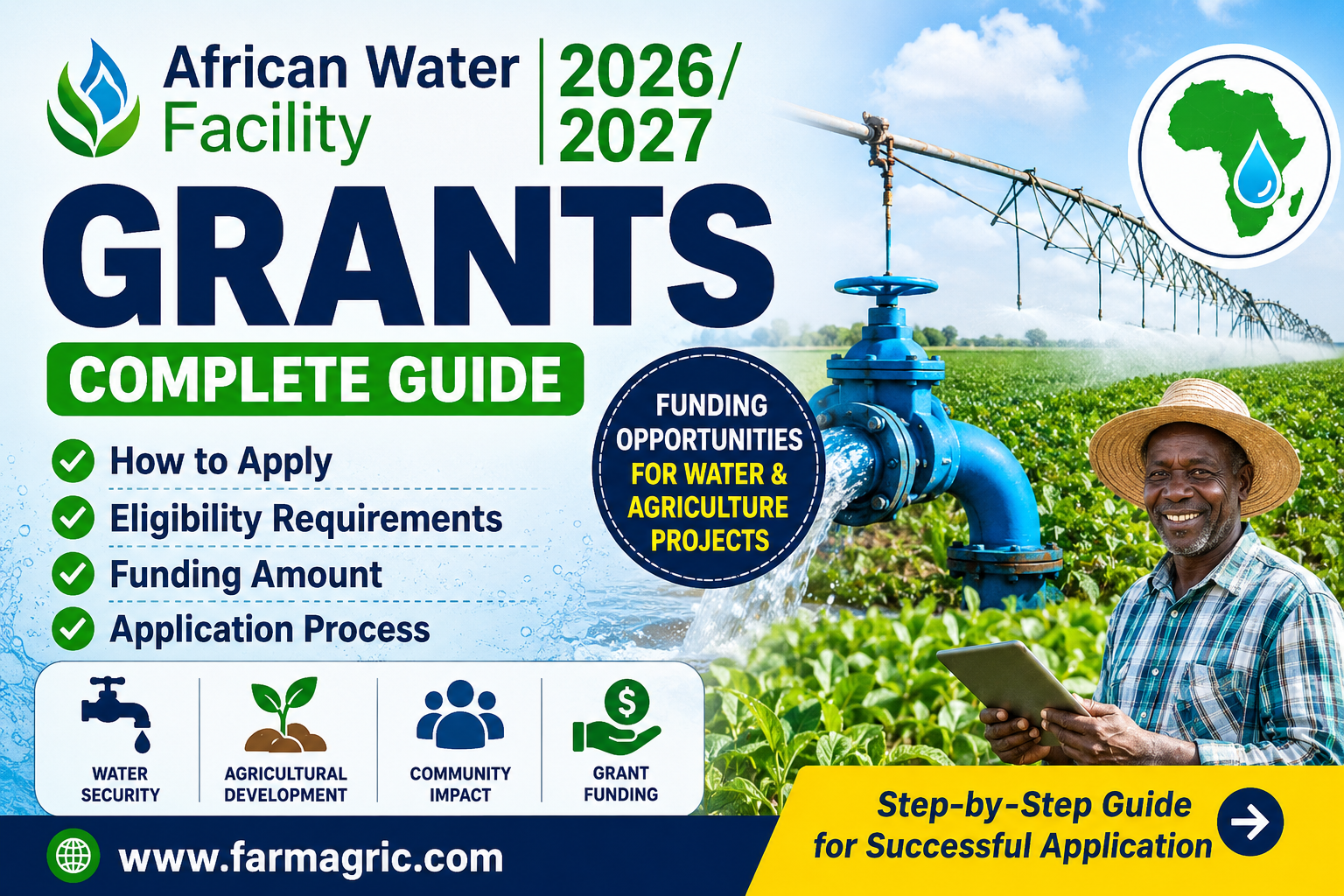
African Water Facility 2026/2027 Grants: How to Apply, Eligibility Requirements, Funding Amount, and Application Process
Applicants whose concept notes are successful may be invited to prepare a more detailed proposal containing technical, financial, environmental, and implementation information.
One of the most common questions people ask is whether individual farmers can apply directly.
In most cases, the African Water Facility provides funding to eligible organizations rather than individuals. The exact eligibility requirements depend on each funding call.
Organizations that may qualify include:
- National governments
- State and local government agencies
- Water ministries
- Water utilities
- River basin organizations
- Public institutions
- Agricultural development agencies
- Public-private partnerships
- Regional organizations
- Research institutions
- Non-governmental organizations (NGOs)
- International organizations working in Africa
Some funding opportunities may also involve partnerships between several organizations to maximize project impact.
If you are a farmer or agribusiness owner, you may still benefit from African Water Facility-funded projects through government programs, agricultural cooperatives, irrigation schemes, or development initiatives supported by eligible institutions.
In the next section of this guide, we will explain how much funding applicants can receive, the eligibility requirements for projects, and how farmers and agribusinesses can benefit from African Water Facility grants.
Before investing time in writing a proposal, verify that your organization qualifies for the current funding opportunity.
Questions to consider include:
- Is your organization legally registered?
- Does your organization operate in an eligible African country?
- Does your project address water security, sanitation, irrigation, or climate resilience?
- Does your organization have the technical capacity to implement the project?
- Can you manage grant funds responsibly?
- Can you provide the reports required during implementation?
Meeting the eligibility requirements is the first step toward a successful application.
Explain the water-related problem your project will address.
Describe:
- The current situation
- The communities affected
- Why the problem requires urgent attention
Use reliable statistics and evidence whenever possible.
Describe the challenge your project will solve.
After the submission deadline, eligible applications move through a detailed evaluation process.
Reviewers typically assess:
- Alignment with the funding priorities
- Technical quality
- Innovation
- Environmental sustainability
- Climate resilience
- Financial feasibility
- Institutional capacity
- Social impact
- Gender and inclusion considerations
- Long-term sustainability
Projects that demonstrate strong planning, measurable impact, and value for money are generally more competitive.
Submitting a well-prepared application is only part of the process. The African Water Facility (AWF) also evaluates whether applicants have the technical, financial, and organizational capacity to successfully implement the proposed project. Preparing the required documents and understanding how applications are reviewed can significantly improve your chances of success.
Many applicants want to know when they can expect feedback after submitting their proposals.
There is no fixed review period because timelines vary depending on:
- The number of applications received
- The complexity of the proposed projects
- The evaluation process for the specific funding round
- Internal review and approval procedures
Large infrastructure or multi-country projects often require more time to assess than smaller technical assistance projects.
Applicants should monitor official communication channels and regularly check the email address provided in their application for updates or requests for additional information.
Once the agreement becomes effective, project implementation begins.
Activities may include:
- Recruiting project staff
- Procuring equipment
- Finalizing implementation schedules
- Engaging local stakeholders
- Conducting baseline assessments
Reviewers want confidence that the project’s benefits will continue after the grant ends.
Explain:
- Who will maintain the infrastructure
- How operating costs will be covered
- Community involvement
- Institutional support
- Long-term financing strategy
Projects with strong sustainability plans are generally viewed more favorably.
Many organizations begin preparing their applications only a few days before the deadline.
This approach increases the likelihood of mistakes, missing documents, weak proposals, and incomplete budgets.
Starting early gives your team enough time to:
- Conduct research
- Consult stakeholders
- Review technical information
- Refine the project design
- Obtain required approvals
- Proofread the application
Well-prepared proposals generally stand out because they are clear, organized, and supported by evidence.
Generally, no. The African Water Facility primarily funds organizations rather than individuals. However, farmers often benefit from projects implemented by governments, cooperatives, NGOs, and other eligible institutions through improved irrigation systems, water supply infrastructure, and climate-resilient agricultural programs.
Funding opportunities are generally intended for eligible African countries. However, eligibility may differ depending on the objectives of a particular funding call. Applicants should carefully review the official guidelines to confirm whether their country and organization qualify.
How can applicants improve their chances of receiving funding?
Applicants can strengthen their proposals by:
- Carefully following the application guidelines
- Clearly defining the project objectives
- Using reliable data and evidence
- Demonstrating measurable community impact
- Preparing a realistic budget
- Building strong implementation partnerships
- Including a sustainability plan
- Submitting a complete and error-free application before the deadline
A well-planned proposal that aligns with the African Water Facility’s priorities is more likely to perform well during evaluation.
Conclusion
The African Water Facility 2026/2027 Grants present an important opportunity for eligible organizations to secure funding for projects that improve water security, sanitation, irrigation, and climate resilience across Africa. Well-designed projects have the potential to transform communities, strengthen agricultural productivity, improve public health, and support sustainable economic development.
Because competition for funding is often high, organizations should begin preparing early. Take time to identify a genuine water-related challenge, gather supporting data, engage experienced partners, develop a realistic budget, and create a project that delivers measurable and lasting impact.
Remember that every funding call may introduce new priorities, eligibility requirements, or application procedures. Before submitting your proposal, carefully review the latest guidance issued by the African Water Facility and ensure that all required documents are complete and submitted before the deadline.
With careful planning, strong technical preparation, and a clear focus on sustainable development, your organization can significantly improve its chances of securing funding and delivering meaningful benefits to the communities it serves.