
How to Increase Rice Yield in a Small Farm
How to Increase Rice Yield in a Small Farm: A Farmer’s Guide to Getting More From Less Land
I farm less than an acre and a half of rice, and for a long time I assumed that small plots simply couldn’t compete with what the bigger operations down the road were pulling in per acre, that scale itself was the limiting factor and there wasn’t much I could do about it. Then a season came where I actually sat down and tracked my yield per acre against a neighbor farming almost six acres, and found my numbers weren’t far behind his at all, sometimes better, once I started managing my small plot with real intention instead of just doing what fit in the time I had available. That comparison changed how I think about small-scale rice farming entirely. Size isn’t the ceiling most people assume it is. Management intensity is, and a small plot, precisely because it’s small, actually lets you manage every square meter more closely than a large field ever allows.
So let me answer you straight, because I know you’re working a small piece of land and wondering whether you’re just naturally capped at a lower yield than the bigger farms around you. You increase rice yield on a small farm by maximizing what you can control most closely at that scale, precise water management, careful transplanting with proper spacing, disciplined nutrient timing, and thorough weed and pest control that a smaller area makes genuinely achievable, rather than trying to copy large-scale practices that don’t translate well to intensive small-plot management. A small farm’s real advantage is attention to detail, and the farmer who treats every square meter of a small plot with the same care a large-scale farmer can only give to the field as a whole will consistently see yields that rival or beat much bigger operations.
Why Small Farms Have a Real Advantage, Not Just a Limitation
Large-scale rice farming almost always involves some degree of compromise for the sake of efficiency across a big area, slightly less precise water depth control, slightly wider tolerance in transplanting spacing, fertilizer applied by broad zones rather than individual plant needs. A small farm doesn’t have to make those same compromises. You can walk every row, check every section of standing water, adjust spacing plant by plant if you genuinely want to, and respond to a developing problem within hours rather than days simply because the whole plot is within easy reach. The yield potential per acre isn’t actually lower on a small farm, in many cases the achievable yield per acre is higher, because the management intensity required to hit that higher number becomes realistic at a scale where one or two people can genuinely stay on top of everything.
What Most Farmers Get Wrong
The first mistake, one I made in my early years, is assuming a small plot doesn’t justify the same level of input and management care as a larger field, treating it almost casually because the total output in absolute terms will never rival a big farm anyway. This thinking caps yield unnecessarily, since per-acre potential has nothing to do with total field size.
The second mistake is transplanting carelessly, without proper spacing discipline, simply because the area feels manageable enough to eyeball. Poor spacing costs yield at any scale, and a small farm that could easily maintain precise spacing throughout often doesn’t bother, treating precision as something only necessary for larger, harder-to-manage areas.
The third mistake is under-investing in soil fertility building on a small plot, since the same field gets used intensively season after season without enough attention to replenishing what’s been removed. Small farms often have less flexibility to rotate or rest land compared to larger operations, which makes fertility management even more critical, not less.
The fourth mistake is neglecting water management precision, assuming that because the area is small, water depth naturally stays more consistent without much active management. In reality, a poorly leveled small plot has the exact same uneven flooding problems as a poorly leveled large field, just at a smaller scale, and those problems still cost real yield.
The fifth mistake is not tracking yield and inputs carefully enough to know what’s actually working. Small farms are perfectly positioned to experiment, trying a slightly different spacing on one section versus another, comparing fertilizer timing between two halves of the same small plot, but few farmers actually do this kind of close comparison, missing an opportunity that their scale makes genuinely practical.
Step-by-Step Plan to Increase Rice Yield on a Small Farm
1. Level your land as precisely as your scale allows. On a small plot, thorough hand leveling or careful use of a simple leveling board is entirely achievable in a way it often isn’t across many acres. Even, consistent field level means even water depth, which underpins almost every other management decision that follows.
2. Use quality seed and proper seedling management. Start with certified or at minimum carefully selected, disease-free seed, and raise seedlings in a well-managed nursery with adequate spacing so transplants go into the main field strong and uniform rather than weak or overcrowded from the nursery stage itself.
3. Transplant at the correct seedling age and with disciplined spacing. Transplant seedlings at around eighteen to twenty-five days old for most varieties, avoiding both overly young, fragile seedlings and overly old, stressed ones. Use a marked rope or spacing frame to maintain consistent spacing, typically around twenty by twenty centimeters for many varieties, adjusted based on your specific variety’s growth habit and your soil fertility.
4. Transplant one to two seedlings per hill rather than clumping several together. Dense clumping at each transplanting point creates the same kind of internal competition that overcrowded direct-seeded rice suffers from, just concentrated at each individual hill rather than spread evenly, and it costs yield in a way that’s easy to avoid with just slightly more careful transplanting.
5. Manage water depth actively through each growth stage rather than passively. Maintain shallow water during early establishment, deeper flooding during active tillering and through the reproductive stage, and a controlled drain-down as the crop approaches maturity. On a small plot, checking and adjusting water levels daily or every other day is realistic in a way it simply isn’t across a large area.
6. Apply fertilizer in properly timed splits, matched closely to growth stage. Basal application at or before transplanting, a first top-dress around active tillering, and a second top-dress around panicle initiation gives the crop nutrients precisely when demand is highest at each stage, something a small plot allows you to time and apply with real precision rather than broad approximation.
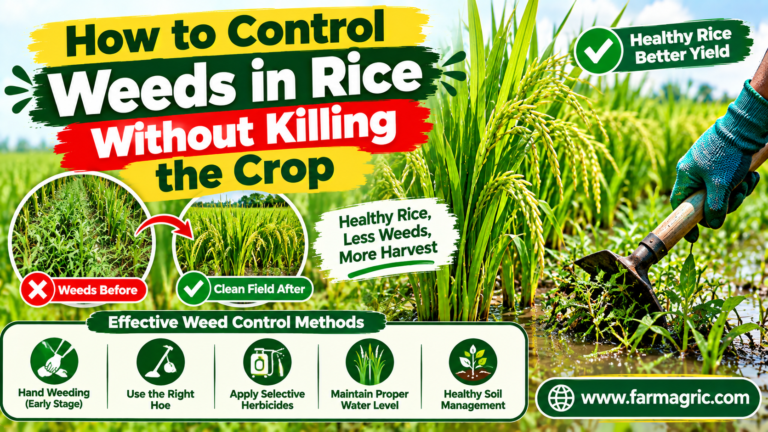
7. Weed thoroughly and promptly during the critical early weeks. With a small area, hand weeding the entire plot within the critical fourteen to twenty-one day window after transplanting is genuinely achievable without needing to rely as heavily on herbicide, and thorough early weeding on a small scale often outperforms partial weeding across a larger area.
8. Scout for pests and disease at least twice a week. A small plot can realistically be walked in full every few days, catching problems like stem borers, leaf folders, or early disease symptoms while intervention is still simple and cheap, rather than discovering significant damage only during a less frequent check.
9. Consider intensive methods suited specifically to small-scale management. Techniques like the System of Rice Intensification, which involves wider spacing, younger single seedlings per hill, and careful water management with alternating wetting and drying, are labor-intensive in a way that suits small, closely managed plots far better than large-scale operations, and can produce meaningfully higher yields per plant when executed with the kind of attention a small farm can provide.
10. Keep detailed records and experiment deliberately. Track what you applied, when, and how each section responded, and don’t hesitate to manage two halves of the same small plot slightly differently as a genuine comparison. This kind of close experimentation is one of the biggest practical advantages small-scale farming has over large-scale operations.
Warning Signs You’re Underusing Your Small Farm’s Potential
Uneven plant height or color across a small plot that could easily be walked and inspected daily suggests management isn’t actually being applied with the precision the scale allows, often meaning water, fertilizer, or spacing decisions are being made too casually for how manageable the area actually is. Visible weed pressure persisting past the critical early weeks on a plot small enough to fully hand weed points to a scheduling or prioritization problem rather than any real difficulty of the task itself. Yield per acre that’s noticeably lower than what larger, well-managed farms in your same area are achieving is a signal that the small farm’s natural management advantage isn’t being used, since scale alone doesn’t explain a yield gap that management intensity should be closing, not widening. And a lack of any real fertilizer or spacing records after several seasons on the same small plot means missed opportunities for exactly the kind of fine-tuned comparison that small-scale farming makes genuinely practical.
What I’d Do Differently If Starting Again Today
If I were starting over on my small plot, I’d stop treating its size as an excuse for looser management and instead lean into the precision advantage from the very first season, since that mindset shift alone probably cost me several seasons of yield I could have had much earlier. I’d adopt disciplined transplanting spacing and seedling age control from day one rather than eyeballing it the way I did for years, assuming a small area didn’t need that level of care. I’d track my inputs and results properly from the start too, since the handful of genuine comparisons I’ve run on split sections of my own plot in recent years have taught me more about what actually works on my specific soil than any general guideline ever did. And I’d have tried intensive methods like closer water management and single-seedling transplanting far earlier, since I now understand how well-suited a small, closely watched plot is to exactly that kind of attention-heavy approach.
Frequently Asked Questions About Increasing Rice Yield on Small Farms
Can a small rice farm really match the yield per acre of a large commercial farm?
Yes, in many cases a small, intensively managed plot can match or exceed the yield per acre of a larger farm, since the close attention to water, spacing, and timing that a small area makes practical often outweighs the efficiency advantages of scale that larger operations rely on.
What is the ideal seedling age for transplanting rice?
Most varieties transplant best at around eighteen to twenty-five days old, since seedlings younger than this can be fragile and slow to establish, while significantly older seedlings often experience more transplant shock and recover more slowly in the main field.
Is the System of Rice Intensification worth trying on a small plot?
Yes, its labor-intensive requirements, including wider spacing, single young seedlings per hill, and careful alternating water management, suit small, closely managed plots particularly well, often producing meaningfully higher yields per plant than conventional dense transplanting methods.
How often should I check water levels on a small rice plot?
Checking daily or at minimum every other day is realistic and worthwhile on a small plot, since active, precise water management through each growth stage, rather than passive flooding, is one of the most effective yield-boosting practices available at small scale.
Does splitting fertilizer application really make a noticeable difference on a small farm?
Yes, timing fertilizer to match the rice plant’s actual nutrient demand at each growth stage, basal at transplanting, top-dress at tillering, and top-dress at panicle initiation, consistently outperforms a single large application, and the precision a small plot allows makes this splitting genuinely easy to execute well.
If there’s one thing I want you to remember from all this, it’s that a small farm isn’t a smaller version of a big farm’s limitations, it’s a different kind of opportunity entirely, one where the close attention you can give every square meter is worth more than the acreage you don’t have, so farm it like it matters, because per acre, it absolutely can outperform land ten times its size.