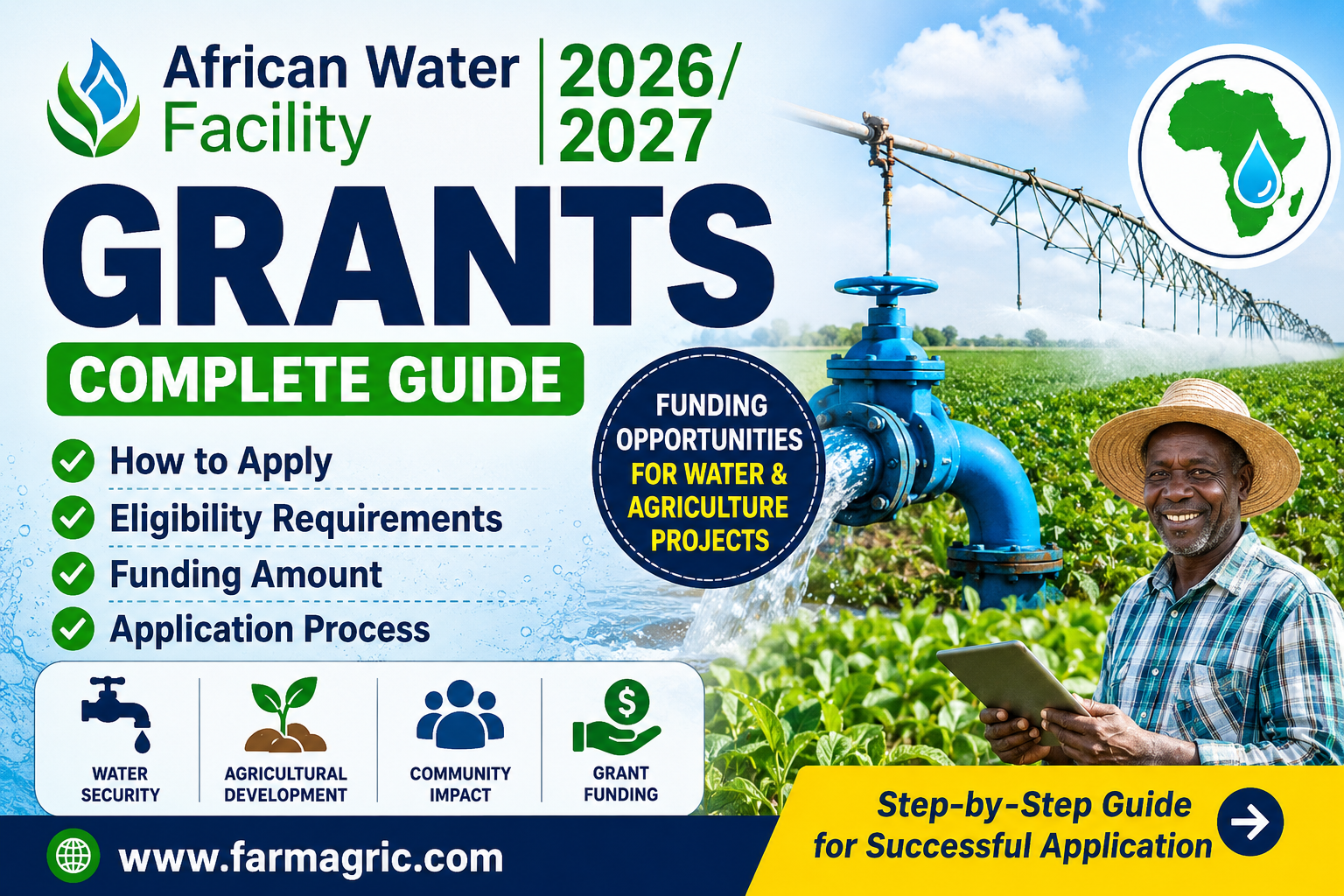
African Water Facility 2026/2027 Grants: How to Apply, Eligibility Requirements, Funding Amount, and Application Process
How to Apply, Eligibility Requirements, Funding Amount, and Application Guide
Access to clean water remains one of the biggest challenges facing agriculture and rural development across Africa. Many farmers struggle with unreliable rainfall, inadequate irrigation systems, poor water storage, and limited funding to develop sustainable water infrastructure. To address these challenges, the African Water Facility (AWF) provides grant funding to support innovative water projects that improve water security, sanitation, climate resilience, and agricultural productivity.
If you are searching for information about the African Water Facility 2026/2027 Grants, this guide explains everything you need to know. You will learn how the grant works, who is eligible to apply, how the application process works, and how agricultural organizations can benefit from this funding opportunity.
Whether you represent a government agency, a water authority, an agricultural cooperative, a non-governmental organization (NGO), or another eligible institution, understanding the African Water Facility’s funding priorities can help you prepare a stronger application.
What Is the African Water Facility, and How Does It Support Water Projects in Africa?
The African Water Facility (AWF) is a specialized fund that supports the development of sustainable water resources and sanitation projects across Africa. It was established to help African countries improve access to clean water, strengthen water security, and prepare high-quality investment projects that attract additional financing.
The Facility is hosted by the African Development Bank (AfDB) and works with governments, public institutions, development partners, and other eligible organizations to address Africa’s growing water challenges.
Instead of financing every type of project, the African Water Facility focuses on projects that create long-term social, environmental, and economic benefits. These projects often include:
- Irrigation infrastructure for agriculture
- Water supply systems for rural and urban communities
- Climate-resilient water management
- Watershed protection
- Flood and drought resilience
- Water storage facilities
- Sanitation improvements
- Capacity building for water institutions
- Project preparation for large-scale water investments
By funding these initiatives, the African Water Facility helps African countries improve food security, increase agricultural productivity, strengthen climate resilience, and support sustainable economic growth.
Why Is the African Water Facility Important for African Agriculture?
Agriculture depends heavily on reliable access to water. Unfortunately, many African farmers still rely entirely on seasonal rainfall, making them vulnerable to droughts, changing weather patterns, and climate change.
The African Water Facility helps address these challenges by supporting projects that improve water availability for farming and rural communities.
Some of the agricultural benefits include:
- Improved irrigation systems
- Better water conservation
- Increased crop yields
- Reduced impact of drought
- Improved livestock water supply
- Climate-smart farming practices
- Stronger food security
- Higher farmer incomes
- Sustainable management of water resources
When communities have reliable water infrastructure, farmers can produce crops throughout the year instead of depending solely on the rainy season.
How Does the African Water Facility Grant Work?
Unlike commercial loans, African Water Facility funding is generally provided as grants for eligible projects that align with the Facility’s priorities.
The funding is designed to help organizations prepare and implement projects that can create lasting improvements in water security and sanitation across Africa.
The grant process generally includes several stages.
Project Identification
Applicants identify a water-related problem that affects communities, agriculture, or the environment.
Preparation of a Concept Note
Eligible organizations prepare a concept note describing:
- The problem being addressed
- Proposed solution
- Expected impact
- Estimated budget
- Implementation strategy
Initial Screening
The African Water Facility reviews submitted concept notes to determine whether they meet its funding priorities and eligibility requirements.
Full Proposal Development
Applicants whose concept notes are successful may be invited to prepare a more detailed proposal containing technical, financial, environmental, and implementation information.
Technical Evaluation
Experts assess the proposal based on factors such as:
- Technical feasibility
- Sustainability
- Climate resilience
- Social impact
- Financial viability
- Environmental considerations
- Potential long-term benefits
Grant Approval
Projects that successfully complete the evaluation process may receive grant funding according to the approved project budget and implementation plan.
Because every funding call may have different priorities, applicants should always review the specific guidelines before submitting an application.
Who Can Apply for the African Water Facility 2026/2027 Grants?
One of the most common questions people ask is whether individual farmers can apply directly.
In most cases, the African Water Facility provides funding to eligible organizations rather than individuals. The exact eligibility requirements depend on each funding call.
Organizations that may qualify include:
- National governments
- State and local government agencies
- Water ministries
- Water utilities
- River basin organizations
- Public institutions
- Agricultural development agencies
- Public-private partnerships
- Regional organizations
- Research institutions
- Non-governmental organizations (NGOs)
- International organizations working in Africa
Some funding opportunities may also involve partnerships between several organizations to maximize project impact.
If you are a farmer or agribusiness owner, you may still benefit from African Water Facility-funded projects through government programs, agricultural cooperatives, irrigation schemes, or development initiatives supported by eligible institutions.
In the next section of this guide, we will explain how much funding applicants can receive, the eligibility requirements for projects, and how farmers and agribusinesses can benefit from African Water Facility grants.
Funding Amount, Eligibility Requirements, and How Farmers Can Benefit
How Much Funding Can Applicants Receive Through the African Water Facility 2026/2027 Grants?
One of the first questions potential applicants ask is how much funding the African Water Facility (AWF) provides.
The amount awarded depends on the nature, size, and objectives of the proposed project. Historically, the African Water Facility has awarded grants ranging from €50,000 to €5,000,000 for eligible projects that align with its strategic priorities.
Funding is intended to support projects that improve water security, sanitation, climate resilience, and sustainable development across Africa. Depending on the funding call, grants may be used for:
- Project preparation and feasibility studies
- Irrigation development
- Water storage infrastructure
- Climate adaptation initiatives
- Rural and urban water supply systems
- Water governance and institutional strengthening
- Pilot projects that demonstrate innovative water solutions
- Technical assistance and capacity building
Applicants should note that the amount awarded is determined after a detailed evaluation of the proposed project, its expected impact, and the available funding under the specific grant call.
How Do You Know If Your Project Is Eligible?
Not every water-related project qualifies for African Water Facility funding. The Facility focuses on projects that contribute to sustainable water management and generate long-term benefits for African communities.
A strong project should demonstrate:
- A clear water-related challenge
- Measurable social and economic impact
- Environmental sustainability
- Climate resilience
- Financial viability
- Strong implementation capacity
- Potential to attract additional investment
- Alignment with national or regional development priorities
Projects that simply request funding without demonstrating long-term sustainability are generally less competitive than those with clear development outcomes.
How Can Farmers and Agribusinesses Benefit from the African Water Facility?
Although individual farmers do not usually receive grants directly from the African Water Facility, they are among the biggest beneficiaries of funded projects.
Many AWF-supported initiatives improve agricultural productivity by increasing access to reliable water.
Farmers may benefit through:
How Irrigation Projects Improve Crop Production
Reliable irrigation enables farmers to cultivate crops during both rainy and dry seasons, reducing dependence on unpredictable rainfall.
Benefits include:
- Higher crop yields
- Multiple harvests each year
- Better crop quality
- Reduced losses during drought
- Increased household income
How Water Storage Projects Help Rural Communities
Water reservoirs, dams, and harvesting systems help communities store water for agricultural use during dry periods.
These projects can support:
- Vegetable farming
- Rice cultivation
- Fruit production
- Livestock watering
- Fish farming
How Climate-Resilient Water Projects Support Agriculture
Climate change has increased the frequency of droughts and floods across many African countries.
The African Water Facility supports projects that help communities:
- Conserve water
- Reduce flood risks
- Improve drought preparedness
- Protect watersheds
- Promote sustainable farming practices
These investments help farmers adapt to changing weather conditions while improving food security.
How Can Agricultural Organizations Increase Their Chances of Receiving Funding?
Organizations planning to apply should develop projects that solve real water challenges rather than simply requesting financial support.
Successful applications often include:
- Clearly defined project objectives
- Reliable data supporting the identified problem
- Evidence of community need
- Realistic implementation timelines
- Qualified technical teams
- Transparent financial planning
- Environmental and social safeguards
- Plans for long-term sustainability after the grant ends
Projects that demonstrate measurable benefits for communities, agriculture, and the environment are generally more competitive during the evaluation process.
Why Are Partnerships Important for African Water Facility Grants?
Many successful AWF-funded projects involve collaboration between multiple organizations.
Partnerships may include:
- Government ministries
- Water authorities
- Agricultural development agencies
- Universities and research institutions
- River basin organizations
- Non-governmental organizations (NGOs)
- Development partners
- Private sector companies
Working together allows applicants to combine technical expertise, financial resources, and implementation capacity, making projects more sustainable and impactful.
In the next phase, we will provide a detailed, step-by-step guide explaining exactly how to apply for the African Water Facility 2026/2027 Grants, including how to prepare a concept note, complete the application, submit supporting documents, and understand the evaluation process.
How to Apply for the African Water Facility 2026/2027 Grants
One of the most important parts of securing funding is understanding the application process. Preparing a strong proposal takes time, careful planning, and a clear understanding of the African Water Facility’s funding priorities.
While each funding call may have specific requirements, the following steps reflect the typical application process used by the African Water Facility.
How Do You Prepare Before Applying for an African Water Facility Grant?
Before completing an application, take time to understand the funding opportunity and confirm that your project aligns with the objectives of the grant.
You should:
- Read the official call for proposals carefully.
- Confirm that your organization is eligible.
- Review the funding priorities for the current call.
- Understand the evaluation criteria.
- Check the submission deadline.
- Identify all required supporting documents.
- Assemble a qualified project team.
Preparing early gives you enough time to gather information, consult stakeholders, and improve the quality of your proposal.
How Do You Check Whether Your Organization Is Eligible?
Before investing time in writing a proposal, verify that your organization qualifies for the current funding opportunity.
Questions to consider include:
- Is your organization legally registered?
- Does your organization operate in an eligible African country?
- Does your project address water security, sanitation, irrigation, or climate resilience?
- Does your organization have the technical capacity to implement the project?
- Can you manage grant funds responsibly?
- Can you provide the reports required during implementation?
Meeting the eligibility requirements is the first step toward a successful application.
How Do You Develop a Strong Project Concept Note?
The concept note is often the first document reviewed during the application process. It provides an overview of your proposed project and helps reviewers decide whether it should proceed to the next stage.
A strong concept note should include:
Project Background
Explain the water-related problem your project will address.
Describe:
- The current situation
- The communities affected
- Why the problem requires urgent attention
Use reliable statistics and evidence whenever possible.
Project Objectives
State what your project aims to achieve.
For example:
- Increase irrigation coverage
- Improve rural water supply
- Strengthen drought resilience
- Improve sanitation services
- Protect water resources
Objectives should be specific, measurable, achievable, relevant, and time-bound.
Proposed Activities
Clearly explain the activities you plan to carry out.
Examples include:
- Constructing irrigation systems
- Building water storage facilities
- Rehabilitating damaged infrastructure
- Training farmers in water conservation
- Installing solar-powered water pumps
- Conducting feasibility studies
Expected Results
Explain the measurable outcomes of the project.
Examples include:
- Number of farmers benefiting
- Additional hectares under irrigation
- Increase in crop production
- Households gaining access to clean water
- Reduction in water losses
- Jobs created during implementation
How Do You Prepare a Competitive Project Budget?
Your budget should clearly explain how grant funds will be used.
Include realistic estimates for:
- Personnel
- Equipment
- Construction
- Professional services
- Training
- Transportation
- Monitoring and evaluation
- Administration
- Contingency costs
Every budget item should directly support the project objectives.
Avoid including unnecessary or unrelated expenses.
How Do You Complete the Full Grant Application?
If your concept note is accepted, you may be invited to submit a detailed project proposal.
This proposal normally includes:
Executive Summary
Provide a concise overview of the project.
Problem Statement
Describe the challenge your project will solve.
Technical Design
Explain how the project will be implemented.
Include:
- Engineering approach
- Technology to be used
- Water management strategy
- Environmental considerations
Implementation Plan
Describe:
- Major activities
- Timeline
- Responsibilities
- Project milestones
Risk Assessment
Identify possible risks, such as:
- Climate events
- Construction delays
- Financial risks
- Community engagement challenges
Explain how each risk will be managed.
Sustainability Plan
Demonstrate how the project will continue delivering benefits after the grant funding ends.
For example:
- Community ownership
- Maintenance plans
- Revenue generation
- Government support
- Local capacity building
Projects with strong sustainability plans are generally more competitive.
How Do You Submit Your African Water Facility Grant Application?
Applications are usually submitted according to the instructions provided in the official funding announcement.
Before submitting, carefully review your application to ensure:
- Every required section has been completed.
- Supporting documents have been attached.
- Budget figures are accurate.
- Contact information is correct.
- All required signatures have been provided.
- The application is submitted before the deadline.
Submitting a complete and accurate application reduces the risk of disqualification due to administrative errors.
How Does the African Water Facility Evaluate Applications?
After the submission deadline, eligible applications move through a detailed evaluation process.
Reviewers typically assess:
- Alignment with the funding priorities
- Technical quality
- Innovation
- Environmental sustainability
- Climate resilience
- Financial feasibility
- Institutional capacity
- Social impact
- Gender and inclusion considerations
- Long-term sustainability
Projects that demonstrate strong planning, measurable impact, and value for money are generally more competitive.
How Can You Avoid Common Mistakes During the Application Process?
Many applications fail because of avoidable errors.
Common mistakes include:
- Ignoring the application guidelines
- Missing submission deadlines
- Providing incomplete information
- Submitting unrealistic budgets
- Using unsupported claims without evidence
- Setting unclear project objectives
- Failing to explain long-term sustainability
- Omitting required supporting documents
- Not proofreading the application before submission
Taking time to review your proposal carefully can significantly improve your chances of success.
In the next phase, we will explain the documents required for the African Water Facility 2026/2027 Grants, how long the review process typically takes, what happens after approval, and practical strategies to strengthen your application and improve your chances of receiving funding.
Required Documents, Application Review Process, and How to Increase Your Chances of Receiving an African Water Facility Grant
Submitting a well-prepared application is only part of the process. The African Water Facility (AWF) also evaluates whether applicants have the technical, financial, and organizational capacity to successfully implement the proposed project. Preparing the required documents and understanding how applications are reviewed can significantly improve your chances of success.
What Documents Are Required for an African Water Facility Grant Application?
The exact documentation depends on the specific funding call. However, applicants are commonly required to provide documents that demonstrate their legal status, technical capability, financial accountability, and project readiness.
Typical supporting documents may include:
- Completed grant application form
- Project concept note or full project proposal
- Detailed project budget
- Implementation work plan
- Project timeline
- Logical framework (Logframe), if required
- Environmental and social impact information, where applicable
- Monitoring and evaluation framework
- Proof of legal registration
- Organizational profile
- Governance structure
- Audited financial statements or other financial records
- Letters of support or partnership agreements, where applicable
- Maps, technical drawings, or feasibility studies for infrastructure projects
Before submitting your application, review the official call for proposals to ensure that all required documents are included.
How Long Does the African Water Facility Review Process Take?
Many applicants want to know when they can expect feedback after submitting their proposals.
There is no fixed review period because timelines vary depending on:
- The number of applications received
- The complexity of the proposed projects
- The evaluation process for the specific funding round
- Internal review and approval procedures
Large infrastructure or multi-country projects often require more time to assess than smaller technical assistance projects.
Applicants should monitor official communication channels and regularly check the email address provided in their application for updates or requests for additional information.
What Happens After Your Project Is Approved?
If your project is selected for funding, the approval process does not end with the announcement.
Successful applicants are typically required to complete several administrative steps before grant funds are released.
These steps may include:
Signing the Grant Agreement
The grant agreement outlines:
- The approved project activities
- Funding amount
- Reporting obligations
- Procurement requirements
- Financial management responsibilities
- Performance indicators
Applicants should carefully review the agreement before signing.
Project Mobilization
Once the agreement becomes effective, project implementation begins.
Activities may include:
- Recruiting project staff
- Procuring equipment
- Finalizing implementation schedules
- Engaging local stakeholders
- Conducting baseline assessments
Financial Reporting
Grant recipients are expected to maintain accurate financial records and use funds only for approved project activities.
Transparent financial management is essential throughout the implementation period.
Progress Reporting
Recipients usually submit periodic reports explaining:
- Activities completed
- Project achievements
- Challenges encountered
- Budget utilization
- Progress toward expected outcomes
These reports help ensure accountability and demonstrate that grant funds are being used effectively.
How Can You Increase Your Chances of Receiving an African Water Facility Grant?
Competition for development grants is often strong. Preparing a high-quality proposal can make a significant difference.
Consider the following strategies.
Use Reliable Data
Support every major claim with credible evidence.
Include:
- Government statistics
- Research findings
- Water resource assessments
- Agricultural production data
- Climate information
Reliable data strengthens your proposal and demonstrates that the project addresses a genuine need.
Focus on Measurable Results
Avoid vague promises.
Instead, explain exactly what your project will achieve.
For example:
- Number of communities served
- Farmers benefiting from irrigation
- Hectares brought under irrigation
- Households gaining access to clean water
- Increase in agricultural productivity
- Reduction in water losses
Clear performance indicators help reviewers understand your project’s potential impact.
Demonstrate Long-Term Sustainability
Reviewers want confidence that the project’s benefits will continue after the grant ends.
Explain:
- Who will maintain the infrastructure
- How operating costs will be covered
- Community involvement
- Institutional support
- Long-term financing strategy
Projects with strong sustainability plans are generally viewed more favorably.
Build Strong Partnerships
Projects involving collaboration between experienced organizations often perform well during evaluation.
Potential partners include:
- Government ministries
- Water authorities
- Universities
- Agricultural research institutes
- Development agencies
- Farmer cooperatives
- Community organizations
- Private sector partners
Strong partnerships demonstrate broader technical expertise and implementation capacity.
Align Your Project With National Development Priorities
Show how your project supports:
- National water policies
- Agricultural development strategies
- Climate adaptation plans
- Sustainable development goals
- Food security initiatives
Projects that complement government priorities are often more attractive to funding organizations.
Prepare a Realistic Budget
An unrealistic budget is one of the most common reasons proposals lose points during evaluation.
Your budget should:
- Match project activities
- Include reasonable cost estimates
- Clearly explain every major expense
- Avoid unnecessary spending
- Demonstrate value for money
Transparency builds confidence among reviewers.
Why Is Early Preparation Important?
Many organizations begin preparing their applications only a few days before the deadline.
This approach increases the likelihood of mistakes, missing documents, weak proposals, and incomplete budgets.
Starting early gives your team enough time to:
- Conduct research
- Consult stakeholders
- Review technical information
- Refine the project design
- Obtain required approvals
- Proofread the application
Well-prepared proposals generally stand out because they are clear, organized, and supported by evidence.
How Can Applicants Stay Updated on Future African Water Facility Funding Opportunities?
Because funding opportunities are announced periodically, organizations should monitor official announcements and subscribe to updates from the African Water Facility and the African Development Bank.
Staying informed allows applicants to begin planning well before a call for proposals opens, giving them more time to prepare a competitive application.
In the final phase of this guide, we will answer the most frequently asked questions about the African Water Facility 2026/2027 Grants, clarify common misconceptions, and provide a strong conclusion with practical next steps for prospective applicants.
Frequently Asked Questions About the African Water Facility 2026/2027 Grants
Frequently Asked Questions (FAQs)
How do I apply for the African Water Facility 2026/2027 Grants?
To apply, you must first confirm that your organization is eligible under the current funding call. Next, carefully read the application guidelines, prepare a strong concept note or project proposal, gather all required supporting documents, and submit your application before the deadline using the method specified in the official call for proposals.
Who is eligible to apply for the African Water Facility Grants?
Eligibility varies depending on the funding opportunity. In most cases, eligible applicants include:
- National and local government agencies
- Water utilities and water authorities
- River basin organizations
- Public institutions
- Agricultural development agencies
- Research institutions
- Non-governmental organizations (NGOs)
- Regional organizations
- Public-private partnerships
Always review the eligibility requirements for the specific grant call before applying.
Can individual farmers apply directly?
Generally, no. The African Water Facility primarily funds organizations rather than individuals. However, farmers often benefit from projects implemented by governments, cooperatives, NGOs, and other eligible institutions through improved irrigation systems, water supply infrastructure, and climate-resilient agricultural programs.
Can agricultural cooperatives apply?
Some agricultural cooperatives may qualify if they meet the eligibility criteria outlined in a specific funding call or apply in partnership with eligible public institutions or development organizations.
Is there an application fee?
The African Water Facility does not normally charge an application fee. If you encounter anyone requesting payment in exchange for guaranteed funding or faster approval, exercise caution and verify the information through official African Water Facility communication channels.
What types of projects receive funding?
Projects that commonly receive consideration include:
- Irrigation development
- Rural and urban water supply
- Water storage systems
- Climate resilience initiatives
- Flood and drought management
- Sanitation improvements
- Watershed protection
- Water governance reforms
- Project preparation studies
- Capacity-building initiatives
Projects should demonstrate long-term social, environmental, and economic benefits.
How much funding is available?
Grant amounts vary depending on the funding call and the scope of the project. Historically, the African Water Facility has supported projects ranging from €50,000 to €5,000,000, although applicants should always refer to the latest official funding announcement for the applicable funding limits.
How long does the evaluation process take?
There is no standard timeline. The review period depends on several factors, including the number of applications received, the complexity of the proposed projects, and the internal evaluation process. Applicants should monitor official communications for updates after submitting their proposals.
Can organizations from any African country apply?
Funding opportunities are generally intended for eligible African countries. However, eligibility may differ depending on the objectives of a particular funding call. Applicants should carefully review the official guidelines to confirm whether their country and organization qualify.
How can applicants improve their chances of receiving funding?
Applicants can strengthen their proposals by:
- Carefully following the application guidelines
- Clearly defining the project objectives
- Using reliable data and evidence
- Demonstrating measurable community impact
- Preparing a realistic budget
- Building strong implementation partnerships
- Including a sustainability plan
- Submitting a complete and error-free application before the deadline
A well-planned proposal that aligns with the African Water Facility’s priorities is more likely to perform well during evaluation.
Conclusion
The African Water Facility 2026/2027 Grants present an important opportunity for eligible organizations to secure funding for projects that improve water security, sanitation, irrigation, and climate resilience across Africa. Well-designed projects have the potential to transform communities, strengthen agricultural productivity, improve public health, and support sustainable economic development.
Because competition for funding is often high, organizations should begin preparing early. Take time to identify a genuine water-related challenge, gather supporting data, engage experienced partners, develop a realistic budget, and create a project that delivers measurable and lasting impact.
Remember that every funding call may introduce new priorities, eligibility requirements, or application procedures. Before submitting your proposal, carefully review the latest guidance issued by the African Water Facility and ensure that all required documents are complete and submitted before the deadline.
With careful planning, strong technical preparation, and a clear focus on sustainable development, your organization can significantly improve its chances of securing funding and delivering meaningful benefits to the communities it serves.