How to Know When Plantain Is Ready for Harvest
How to Know When Plantain Is Ready for Harvest: What 30 Years of Cutting Too Early and Too Late Taught Me
I cut my first full bunch of plantain far too early, and I did it proudly. The fingers were green, plump to my eye, and the bunch looked heavy on the stalk. I carried it to the market feeling like a man who had finally made it. The buyer pressed a finger into one, shook his head, and told me it would never ripen properly. He was right. Within a week, half of that bunch had shrivelled into dry, tasteless fingers that turned yellow without ever getting sweet. A few years later I made the opposite mistake and left a bunch on the plant a week too long during a hot spell. The fingers split, the skins turned yellow on the stalk, and the buyer paid me half price.
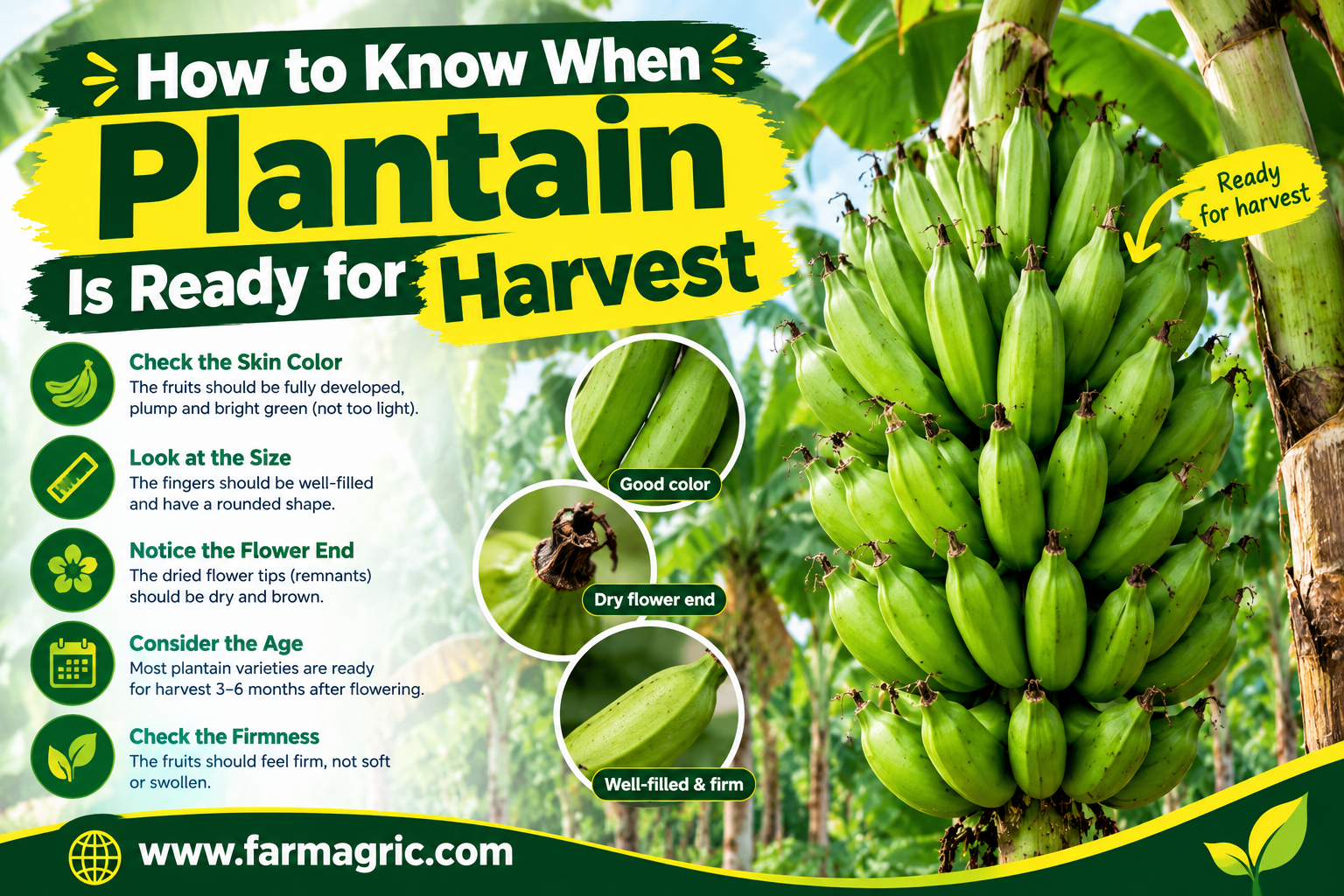
Here is the direct answer. A plantain is ready to harvest when the fingers have filled out and rounded, the sharp angles along the sides have smoothed off, the dried flower remnants at the tip of each finger break off easily, and the bunch has reached the age typical for your variety, usually somewhere around three to four months after the bunch first emerged. For fruit going to a market that is some distance away, cut at the full but still firm green stage. For fruit you plan to sell or eat soon, you can let it fill a little further. No single sign is enough, so you read them together.
If you learn to read these signs, you will stop losing money to bunches that are too thin to ripen well or too ripe to travel.
What Is Happening Inside the Fruit
After the bunch emerges, the fingers do not just grow bigger, they fill with starch. At first they are thin, angular, and hard. Over the weeks they fatten, the ridges soften, and the flesh builds up starch. When the fruit is ripe for eating, that starch turns to sugar. If you cut before the starch has built up properly, there is not enough in the finger to turn into good flavour or texture, and it ripens poorly. If you cut too late, the ripening process may already have started on the plant, and the fruit will not last.
This is why timing matters so much. You are not harvesting a finished product. You are choosing a moment in a process.
What Most Farmers Get Wrong
The first mistake is relying on only one sign, such as size. Fingers can look big and still be immature, particularly on plants that were well watered late in the cycle. Size alone has fooled me more than once.
The second mistake is counting days from the wrong starting point. Many farmers count from planting. Count from the day the bunch emerged instead, because planting to flowering can vary by months depending on the season and how well the plant was looked after. I keep a note of the date each bunch shows.
The third mistake is harvesting everything at the same time because it is convenient. Bunches on the same farm do not all fill at the same pace. A shaded plant, a crowded plant, or a weak plant will lag behind. Cutting a whole block on one day means some bunches are too young.
The fourth mistake is waiting for yellow. Once yellow shows on the fingers while still on the plant, you are late for anything but immediate sale. Yellow is the signal of ripening, not the signal of readiness for cutting.
The fifth mistake is ignoring the buyer. Local buyers who will eat the fruit within days want a fuller bunch. Traders sending fruit on a long journey want it cut earlier so it arrives green and firm. Harvest for the customer, not for your own calendar.
The sixth mistake is rough handling at cutting. A perfectly timed bunch that falls to the ground and bruises ripens unevenly and sells poorly.
How to Read the Signs, Step by Step
Step one: record the date the bunch emerges. Tie a coloured strip of cloth or write on the pseudostem with a marker. Different colours for different weeks make it easy to see at a glance which bunches are due. This is the most reliable habit I have ever built, and it costs nothing.
Step two: start checking at about the usual time for your variety. Plantain generally needs roughly three to four months from bunch emergence to harvest, but that depends on temperature, altitude, variety, and plant health. Cooler weather slows it down, and warm weather speeds it up. Ask older growers around you what is normal for your variety and area, and use that as a starting window, not a rule.
Step three: look at the shape of the fingers. Young fingers have sharp, pronounced angles, almost like a square or triangle in cross section. As the fruit fills, the angles round off until the finger looks full and rounded. When the ridges have mostly smoothed, you are getting close. Slightly angular fingers mean you can wait a bit longer if the fruit is for a nearby market.
Step four: check the dried flower remnants. At the tip of each finger is a small dried bit left from the flower. When the fruit is mature, this usually snaps off easily with a light flick. If it is still stuck fast, the fruit is probably not ready.
Step five: check the colour. The fingers should be a solid, deep green, losing the bright, shiny, fresh-leaf green of young fruit and taking on a slightly duller, more even tone. A hint of lighter green or a slight yellowish tinge starting at the bottom is the warning that ripening is close. For distant markets, cut before that tinge. For local sale, you can allow a very slight change.
Step six: check the bunch’s behaviour on the plant. Fruit that is full tends to hang heavy and the hands sit tightly against each other. On some plants, one or two fingers in the top hand may start to turn yellow. If you see that, cut the bunch right away, because the rest will follow within a day or two.
Step seven: sample one finger if you are unsure. Cut a single finger from the second or third hand, snap it, and look at the cut surface. The flesh should be firm, pale, and full, not watery or stringy. Do not sample every bunch, but do it for the first one in a block, and you will get a feel for the whole stand.
Step eight: cut cleanly and carefully. Harvest in the cool of the morning if you can. Cut the pseudostem partway so the bunch lowers gently, and have someone ready to catch it on their shoulder or on a padded surface. Then cut the stalk, leaving a short piece attached to the bunch. Never let the bunch drop to the ground. Place bunches in the shade immediately, never in direct sun, and move them quickly to where they will be sold or stored.
Warning Signs That You Are Cutting at the Wrong Time
Cutting too early shows up as fingers that stay thin and angular after cutting, skin that wrinkles or shrivels in a few days, flesh that is pale and tasteless when cooked, and fruit that turns yellow but stays hard and dry in the middle.
Cutting too late shows up as split skins, yellow fingers while still on the plant, soft spots, fruit that falls off the hand when you handle it, and bunches that ripen unevenly in transit. Birds and bats going for your bunches is also a hint that the fruit is already too ripe.
If you see either pattern in your sales, adjust your timing by a few days next time and keep notes.
What I Would Do Differently If I Were Starting Today
I would mark every bunch with its emergence date from the very first season. I would learn the standard time for each variety I grow by tracking real bunches rather than guessing. I would harvest bunch by bunch, not block by block. I would talk to buyers about what stage they want, because a trader who wants green fruit for a long journey needs a different bunch from a roadside seller. And I would train my workers to handle bunches like eggs, because the best timing in the world is wasted if the fruit is bruised on the way down.
Frequently Asked Questions
How many months after planting is plantain ready to harvest?
There is no single figure, since it depends on variety, climate, and care. Plantain often flowers several months after planting, and the bunch then needs roughly three to four months more before cutting. Well-managed plants usually come in sooner than stressed ones.
Can I harvest plantain while it is still green?
Yes, and that is normal. Most plantain is harvested green, at the mature but unripe stage, and ripens afterwards. The key is that it is mature green, with rounded fingers, not young green with sharp angles.
What happens if plantain is harvested too early?
The fruit is thin, may shrivel, and tends to ripen poorly with little flavour and a dry texture. It also gives you less weight to sell.
How can I tell if the bunch is too old?
Yellowing fingers on the plant, splitting skins, soft spots, and fingers that detach easily are the signs. Cut it immediately and sell it quickly.
Does the weather change when I should harvest?
Yes. In hot weather fruit fills and ripens faster, so check more often. In cool or rainy spells the same bunch may take noticeably longer, so do not rush to cut by the calendar alone.
One Thing to Remember
Plantain tells you when it is ready, but only if you are watching the date, the shape, and the tip together. Cut by the signs, sell by the buyer, and never harvest by the calendar alone.