How to Write a Farm Grant Proposal That Gets Funded: Step-by-Step Guide for African Farmers
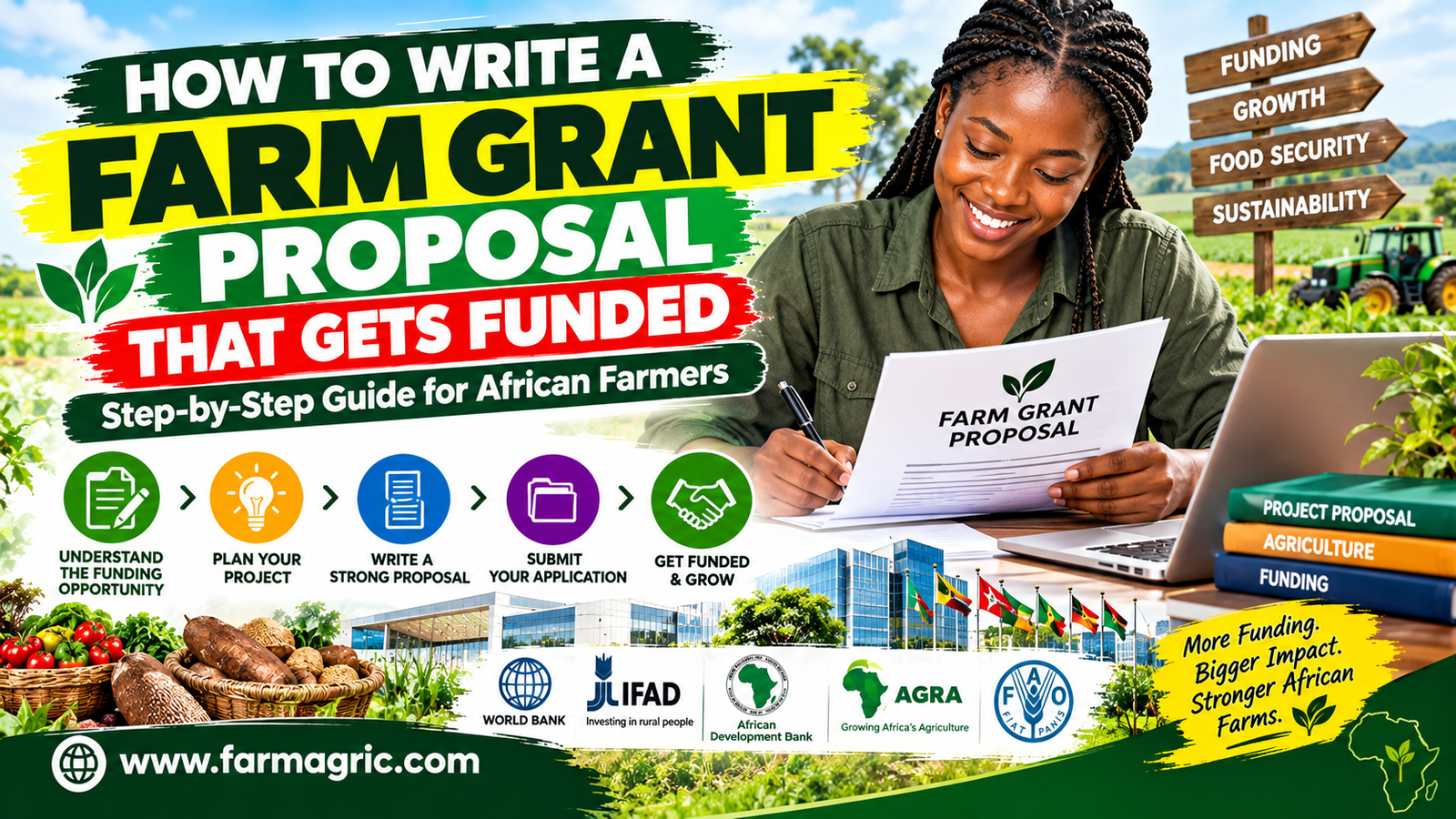
How to Write a Farm Grant Proposal That Gets Funded
Getting an agricultural grant can make the difference between a farm that remains small and one that expands into a profitable, sustainable business. Yet many farmers across Africa struggle to secure grant funding even when they have good farming ideas. The problem is often not the quality of the farm itself. It is the way the funding proposal is written.
A farmer may have an excellent idea for expanding a maize farm, starting a poultry project, installing irrigation, processing cassava, establishing a greenhouse, developing an agroforestry business or creating a cooperative, but a grant organization cannot fund an idea it does not understand. The proposal has to explain the problem, the solution, the amount of money required, how the money will be used and what measurable results the project will produce.
A strong farm grant proposal therefore does much more than ask for money. It shows the funder why the project matters, why the applicant is capable of implementing it and why the investment can create meaningful agricultural, economic, social or environmental results.
This guide explains how farmers, cooperatives, agribusinesses and agricultural entrepreneurs across Africa can write a stronger farm grant proposal and avoid the mistakes that cause applications to be rejected.
What Is a Farm Grant Proposal?
A farm grant proposal is a formal document submitted to a government agency, development organization, foundation, NGO, agricultural programme, financial institution or other funder requesting financial support for a specific agricultural project.
The proposal explains what the applicant wants to accomplish and how grant funding will be used to accomplish it.
Depending on the programme, the proposal may cover crop production, livestock, poultry, fisheries, irrigation, agricultural processing, mechanization, agroforestry, climate-smart agriculture, agricultural technology, food security, youth employment, women’s farming enterprises or rural development.
Some funding programmes support individual farmers, while others are designed specifically for farmer cooperatives, producer organizations, community groups, SMEs or established agribusinesses.
This distinction is important because a farmer should never write the same proposal for every grant opportunity. The proposal must respond directly to the objectives and eligibility requirements of the particular funder.
For example, a climate-resilience grant may be interested in drought-resistant production, water conservation and soil management, while an agribusiness grant may focus more heavily on revenue, market demand, employment and business growth.
Start With the Grant Guidelines Before Writing Anything
One of the biggest mistakes applicants make is writing a complete proposal before carefully reading the grant guidelines.
Every funder has different requirements. Some may ask for a short concept note. Others may require a detailed business plan, budget, logical framework, financial statements, registration documents, environmental information or evidence of matching funds.
Before writing, read the application guidelines carefully and identify five things: who can apply, what activities are eligible, how much funding is available, what documents are required and when the application closes.
You should also identify the exact problem the funder is trying to solve.
If the funder is supporting climate-smart agriculture, do not submit a proposal that focuses only on increasing the number of chickens you own. Explain how the poultry project addresses the funder’s objectives, such as climate resilience, efficient feed use, employment or improved food security.
A grant proposal is much stronger when the applicant demonstrates that they understand what the funding programme is trying to achieve.
FAO guidance on agricultural and rural investment planning emphasizes the importance of developing the project with the community and clearly defining the investment before preparing the proposal.
Choose a Real Agricultural Problem to Solve
Funders are not simply looking for people who want money. They are looking for projects that address identifiable problems.
Your proposal should therefore begin with a clear agricultural problem.
For example, instead of writing:
“I need funding to expand my tomato farm.”
You could explain that farmers in the target community lose a significant proportion of tomato production because of inadequate irrigation, post-harvest losses, poor storage and limited access to markets.
The difference is important.
The first statement describes what you want.
The second explains why the project is necessary.
A strong problem statement should answer questions such as:
- What problem are farmers experiencing?
- Who is affected?
- Where does the problem occur?
- What is causing the problem?
- What happens if the problem is not addressed?
- What evidence demonstrates that the problem exists?
Your problem should be specific enough that the funder can understand exactly what the proposed project is designed to change.
Explain Who Will Benefit From the Project
Grant funders want to know who will benefit from their investment.
If you are applying as an individual farmer, explain how the project will affect your farm, household, workers, customers and potentially the wider agricultural community.
If you are applying as a cooperative, provide the number of members and explain how they will benefit.
For example, instead of saying:
“The project will help farmers.”
Write:
“The project will support 120 smallholder vegetable farmers organized through three producer groups by improving access to drip irrigation, certified seed, extension training and structured markets.”
Specific numbers make the proposal easier to understand and evaluate.
If women and young people are expected to benefit, explain their participation clearly. Do not simply add the words “women and youth” because they sound attractive to funders.
Explain how many women and young people will participate, what roles they will perform and what economic benefit they are expected to receive.
Write a Clear Project Goal
Your project goal should describe the larger change you want the grant to contribute to.
For example:
Goal: Improve the productivity, profitability and climate resilience of smallholder vegetable farmers in the target community.
The goal should not be a shopping list.
Avoid writing:
“The goal is to buy tractors, fertilizer, seeds, irrigation equipment and build a warehouse.”
Those are activities or purchases, not the actual goal.
The goal explains what will improve because of the project.
The equipment, inputs and infrastructure are simply the tools you will use to achieve that improvement.
Turn Your Goal Into Measurable Objectives
After defining the overall goal, create specific objectives.
A good objective should be measurable.
For example:
Objective 1: Increase average vegetable production among 120 participating farmers within 12 months.
Objective 2: Establish 20 hectares of efficient irrigation-supported production.
Objective 3: Reduce post-harvest losses through improved handling, storage and market coordination.
Objective 4: Increase the participation of women and young farmers in the agricultural value chain.
These objectives give the funder something concrete to evaluate.
Grant-development guidance commonly treats objectives, activities, indicators, monitoring and evaluation as connected parts of a proposal rather than separate pieces.
Explain Exactly What You Will Do
Once the objectives are clear, explain the activities required to achieve them.
This is where you tell the funder how the project will actually operate.
For an irrigation project, activities could include site assessment, irrigation design, equipment procurement, installation, farmer training, water management and production monitoring.
For a poultry project, activities could include housing preparation, purchase of chicks, feed procurement, vaccination, farm management training, record keeping and market development.
For an agricultural processing project, activities could include equipment procurement, installation, operator training, quality control, packaging and market development.
Each activity should connect directly to one of your objectives.
If you cannot explain why an expense or activity is necessary, it probably does not belong in the proposal.
Build a Realistic Farm Grant Budget
The budget is one of the most important parts of a grant proposal.
A funder needs to understand exactly how much money you are requesting and how it will be spent.
A simple agricultural project budget could include:
| Budget Item | Quantity | Estimated Cost |
|---|---|---|
| Improved seed | 100 bags | $X |
| Fertilizer | 200 bags | $X |
| Irrigation equipment | 1 system | $X |
| Farmer training | 4 sessions | $X |
| Farm tools | 50 sets | $X |
| Storage improvements | 1 facility | $X |
| Transportation | Project period | $X |
| Monitoring and reporting | Project period | $X |
The actual figures should come from realistic quotations or current market prices in the project location.
Do not simply choose a round number because it sounds attractive.
If your project requires $48,700, request $48,700 with a proper explanation rather than changing the figure to $50,000 simply because the funder advertises grants of up to $50,000.
A budget should also correspond to the activities in the proposal.
If the proposal says you will train 100 farmers but the budget contains training materials for only 20 people, the inconsistency may weaken the application.
USAID grant-development guidance identifies the budget narrative and justification as major components of a proposal and emphasizes explaining the costs associated with the proposed activities.
Explain Why Every Major Expense Is Necessary
Do not simply provide a list of expenses.
Explain the reason behind important costs.
For example:
“The requested irrigation equipment will support dry-season vegetable production across 10 hectares and reduce dependence on unpredictable rainfall.”
That is stronger than:
“Irrigation equipment: $12,000.”
The funder needs to see the connection between the expenditure and the expected result.
This is particularly important for expensive items such as tractors, irrigation systems, processing machinery, vehicles, storage facilities, greenhouses and livestock housing.
Show What You Are Contributing
If you are contributing land, labour, existing equipment, buildings, money or other resources, explain it.
For example:
“The applicant will provide 15 hectares of land, existing farm buildings and two permanent farm workers as an in-kind contribution to the project.”
A contribution demonstrates commitment and can show that the grant will build on an existing agricultural operation rather than create a project from nothing.
Some grant programmes specifically require applicants to provide matching contributions. For example, the FAO Forest and Farm Facility’s direct beneficiary grant model requires eligible applicants to contribute at least 10 percent in cash toward qualifying investments.
However, never claim that you can provide matching funds if you cannot actually provide them.
Demonstrate That There Is a Market
A farmer can produce an excellent crop and still lose money if there is no reliable market.
Grant funders therefore want to know what will happen to the products after production.
Explain:
- Who will buy the products?
- Where will they be sold?
- What prices are expected?
- Are there existing buyers?
- Are there contracts or letters of intent?
- How will the products reach the market?
- What happens when production increases?
For example, a cassava-processing proposal becomes more convincing when the applicant can explain that processed cassava products will be sold to identified wholesalers, processors or institutional buyers.
A poultry project becomes stronger when the applicant can identify local markets, restaurants, retailers, processors or distributors.
If you already have customers, provide evidence where the application allows it.
Include Evidence Instead of Making Big Claims
One of the strongest ways to improve a grant proposal is to replace unsupported statements with evidence.
Instead of:
“There is huge demand for our product.”
Explain:
“The business currently sells approximately 800 bags of maize annually to three identified buyers and has received additional purchase requests that exceed current production capacity.”
Evidence can include sales records, farm records, photographs, customer letters, contracts, market surveys, production records, cooperative records or other documentation.
The more credible evidence you provide, the easier it becomes for a reviewer to understand the opportunity.
Explain Why You Are Capable of Implementing the Project
A funder needs confidence that the project can actually be delivered.
This does not mean that you need to be a large commercial farmer.
You need to demonstrate relevant experience and access to the skills required.
Explain:
- How long you have been farming.
- What crops or livestock you produce.
- The size of your current operation.
- Your production experience.
- Your management team.
- Technical support available to you.
- Existing farm infrastructure.
- Previous agricultural projects.
- Existing market relationships.
If you are a young farmer without extensive experience, explain the training, mentors, agricultural officers, consultants or technical partners who will support the project.
Build a Strong Implementation Timeline
A grant proposal should show what will happen and when.
A simple timeline might look like this:
| Period | Main Activity |
|---|---|
| Months 1 to 2 | Procurement and preparation |
| Months 2 to 3 | Installation and training |
| Months 3 to 6 | Production |
| Months 6 to 8 | Monitoring and market development |
| Months 9 to 10 | Harvesting and processing |
| Months 11 to 12 | Sales, evaluation and reporting |
The timeline should be realistic.
Do not promise to construct infrastructure, train hundreds of farmers, plant hundreds of hectares and reach a national market within two months if the activities realistically require a year.
Include Monitoring and Evaluation
Monitoring and evaluation, often called M&E, explains how you will determine whether the project is succeeding.
This is one area where many small farm proposals are weak.
Do not simply say:
“We will monitor the project.”
Explain what you will measure.
For example:
| Indicator | Target |
|---|---|
| Farmers trained | 120 |
| Hectares under improved production | 20 |
| Women participants | 60 |
| Youth participants | 30 |
| Production increase | 30% |
| Post-harvest losses | Reduced by 20% |
| New market buyers | 5 |
These indicators allow the funder to see whether the project achieved its objectives.
Grant-management guidance emphasizes implementation schedules, benchmarks, indicators, deliverables and monitoring and evaluation plans.
Address Climate and Environmental Risks
Agricultural projects are increasingly exposed to drought, floods, soil degradation, pests, disease, extreme temperatures and unpredictable rainfall.
A strong farm proposal should identify the risks affecting the project and explain how they will be managed.
For example, a crop project could include drought-tolerant varieties, irrigation, mulching, water harvesting, soil improvement and integrated pest management.
A livestock project could address heat stress, disease prevention, water availability, feed shortages and biosecurity.
A proposal does not need to pretend that there are no risks.
In fact, acknowledging realistic risks and showing how you will manage them can make the project more credible.
Explain How the Project Will Continue After the Grant
One of the questions funders often want answered is:
What happens when the grant ends?
Do not make the project completely dependent on another grant.
Explain how the farm will generate revenue and maintain the investment.
For example, if a grant pays for irrigation equipment, explain how crop revenue will cover maintenance and future operating costs.
If the grant supports processing equipment, explain how processing revenue will finance repairs, electricity, labour and replacement parts.
If the project trains farmers, explain how farmer groups, extension services or local organizations will continue supporting participants.
A sustainability plan is a standard component of strong grant proposals.
Make the Proposal About Results, Not Just Equipment
This is one of the most important lessons for farmers.
A weak proposal says:
“We need a tractor.”
A stronger proposal says:
“The project will establish a mechanization service that will provide affordable land preparation and planting services to 300 smallholder farmers, reducing delays caused by manual labour and improving access to timely farm operations.”
The tractor is not the result.
The agricultural improvement created by the tractor is the result.
This principle applies to every major purchase.
Do not focus only on what you want to buy.
Explain what the investment will accomplish.
Use Simple Language
You do not need complicated English to write a strong agricultural grant proposal.
A funder should understand your project after reading it once.
Use short paragraphs, clear headings and specific numbers.
Avoid unnecessary technical language unless the application specifically requires it.
Instead of:
“The project seeks to operationalize an integrated climate-resilient agricultural production architecture leveraging multisectoral stakeholder engagement.”
Write:
“The project will help smallholder farmers increase production while reducing the effects of drought and unpredictable rainfall.”
Simple writing is often more persuasive because the reviewer can quickly understand the project.
Avoid Copying a Grant Proposal From the Internet
Farmers sometimes search for a sample farm grant proposal, download one and change the name and location.
This is risky.
A copied proposal may describe the wrong country, crop, market, costs or agricultural problem.
More importantly, it may not answer the specific questions asked by your funder.
Use sample proposals only to understand structure.
Your actual proposal should be based on your own farm, your own market, your own numbers and the specific funding programme.
FAO’s RuralInvest approach similarly emphasizes developing agricultural investment proposals around the actual project and its financial and economic feasibility rather than relying on generic applications.
Common Reasons Farm Grant Proposals Are Rejected
Many applications fail for avoidable reasons.
One common problem is applying for a grant that the applicant does not qualify for. Always check eligibility before spending time writing the proposal.
Another problem is an unrealistic budget. Inflated prices, unexplained expenses and arithmetic errors can reduce confidence in the application.
Weak proposals also often contain vague objectives. Saying “increase agricultural production” is not enough. Explain how much production you expect to increase, for whom and within what period.
Another major problem is failing to demonstrate market demand.
A funder may ask:
If we give you this money and your production doubles, who will buy the additional output?
If you cannot answer that question, your proposal needs more work.
Other common weaknesses include missing documents, poor financial records, unrealistic timelines, unsupported claims, copying another proposal and submitting after the deadline.
A Simple Farm Grant Proposal Structure
If you are writing your first proposal, use this structure:
1. Project Title
Make it specific and easy to understand.
2. Executive Summary
Briefly explain the problem, solution, beneficiaries, requested funding and expected results.
3. Background
Explain the agricultural situation and why the project is needed.
4. Problem Statement
Clearly describe the specific problem the project will address.
5. Project Goal
Describe the overall change you want to achieve.
6. Specific Objectives
List measurable objectives.
7. Project Activities
Explain exactly what you will do.
8. Target Beneficiaries
Identify who will benefit and how many people are involved.
9. Market Analysis
Explain who will buy the products and how they will reach the market.
10. Implementation Plan
Show what will happen and when.
11. Budget
List the costs and explain the major expenses.
12. Monitoring and Evaluation
Explain what you will measure.
13. Risk Management
Identify agricultural, financial, environmental and operational risks.
14. Sustainability
Explain how the project will continue after grant funding ends.
15. Organizational Capacity
Explain why you or your organization can successfully implement the project.
16. Conclusion
Summarize why the proposed investment matters and what the funding will accomplish.
17. Supporting Documents
Attach only the documents requested or permitted by the funder.
Farm Grant Proposal Example
Imagine a cooperative of 100 smallholder farmers wants funding to establish an irrigation-supported vegetable production project.
A weak proposal might say:
“Our cooperative needs $30,000 to buy irrigation equipment and fertilizer so that farmers can increase vegetable production.”
A stronger proposal could explain:
“The Green Valley Farmers Cooperative represents 100 smallholder vegetable farmers producing tomatoes, onions and peppers. Production is currently limited by unreliable rainfall, resulting in seasonal shortages and reduced household income. The cooperative is requesting $30,000 to install irrigation infrastructure covering 15 hectares, purchase improved seed and provide production and water-management training. The project is expected to increase the area under year-round production, reduce dependence on rainfall and improve market supply for identified buyers in the surrounding districts.”
The second version gives the funder a clearer picture of the problem, the beneficiaries, the investment and the expected results.
How to Make Your Farm Grant Proposal More Competitive
Before submitting, read your proposal as if you were the person deciding whether to give you the money.
Ask yourself:
Is the problem clear?
Are the beneficiaries clearly identified?
Does the project match the grant’s objectives?
Are the objectives measurable?
Does every major expense have a reason?
Is the budget realistic?
Is there evidence of market demand?
Can the applicant actually implement the project?
Are the risks addressed?
Can the project continue after the grant ends?
Are all required documents included?
Was the proposal submitted before the deadline?
If the answer to these questions is yes, your proposal is likely to be much clearer and easier for a reviewer to assess.
Use an Agricultural Investment Tool If You Need Help
Farmers who find proposal writing difficult do not necessarily have to start from a blank page.
FAO’s RuralInvest is a free multilingual methodology and toolkit designed to help rural communities and agricultural stakeholders prepare sustainable investment proposals and business plans. FAO reports that the approach has been used to develop hundreds of project proposals and train farmer groups in multiple countries.
This can be particularly useful for farmer cooperatives and rural organizations that need help turning a farming idea into a structured investment proposal.
Final Checklist Before You Submit Your Farm Grant Application
Before clicking the submit button, check the following:
Eligibility: You meet every requirement.
Deadline: You are submitting before the closing date and time.
Project: Your proposed activity is eligible.
Problem: The agricultural problem is clearly explained.
Objectives: Your objectives are measurable.
Activities: Every activity contributes to an objective.
Budget: The numbers are realistic and correctly calculated.
Market: You have explained who will buy the products.
Beneficiaries: You have identified who will benefit.
Impact: You have explained what will change.
Risks: Major agricultural and operational risks are addressed.
Sustainability: You have explained what happens after the grant ends.
Documents: All required attachments are included.
Proofreading: Names, numbers, dates and financial figures have been checked.
Final Thoughts
A successful farm grant proposal is not simply a document asking someone to give you money.
It is a business and development case showing why an agricultural investment is necessary, how the money will be used and what measurable results the funder can expect.
For African farmers, this means moving beyond statements such as “I need funding to expand my farm.” Explain the agricultural problem, identify the people who will benefit, provide realistic numbers, demonstrate market demand and show how the investment will continue generating value after the grant period.
Whether you are applying for a crop-production grant in Ghana, an irrigation programme in Kenya, a climate-resilience opportunity in Tanzania, a farmer-support programme in South Africa, an agribusiness grant in Rwanda or another agricultural funding opportunity anywhere in Africa, the same principle applies: make the proposal specific to the funder’s objectives, support your claims with evidence and show exactly what the investment will accomplish.
Most importantly, do not wait until a grant opens before preparing your basic farm records. Keep production records, sales records, photographs, financial information, registration documents, market contacts and project information ready. When a suitable funding opportunity appears, you will be able to adapt your existing information to the application instead of starting from zero.