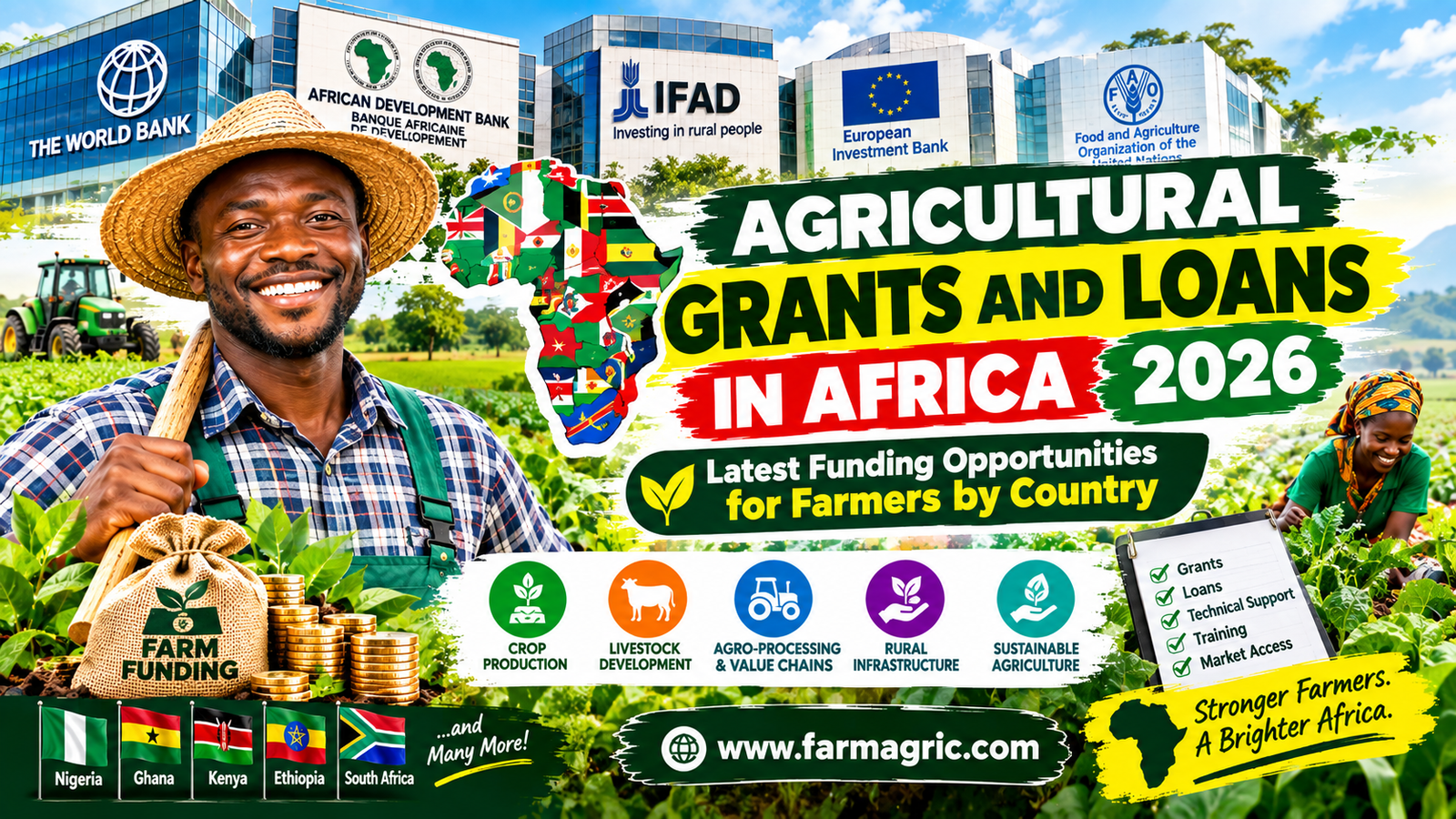
Agricultural Grants and Loans in Africa 2026: Latest Funding Opportunities for Farmers by Country
Agricultural Grants and Loans in Africa 2026: Latest Funding Opportunities for Farmers by Country
Farmers, agribusiness owners, cooperatives and agricultural entrepreneurs across Africa are actively searching for grants, farm loans and other sources of agricultural financing in 2026. The challenge is that funding opportunities are often scattered across government ministries, development banks, international organizations, commercial banks, agricultural investment funds and private-sector programmes.
This guide brings together some of the most important agricultural funding opportunities and financing programmes relevant to African farmers and agribusinesses in 2026. The opportunities are organized by country and region so that farmers can quickly identify programmes that may apply to them.
It is important to understand that an agricultural grant is not the same as an agricultural loan. A grant generally does not have to be repaid when the recipient follows the programme conditions, while a loan must be repaid according to agreed terms. Some programmes use blended finance, matching grants, guarantees or investment rather than giving farmers unrestricted cash.
Because agricultural funding programmes can open and close quickly, farmers should always confirm the latest application status with the official organization before submitting documents or paying anyone to apply on their behalf.
Latest Agricultural Funding Opportunities in Africa in 2026
There are several significant agricultural finance initiatives currently relevant to African farmers and agricultural businesses.
One of the most important new developments is the US$200 million Africa Rural Climate Adaptation Finance Mechanism, known as ARCAFIM. The mechanism was launched by the International Fund for Agricultural Development and Equity Group in September 2026 and is designed to expand climate-adaptation finance for smallholder producers and rural enterprises in Kenya, Uganda, Tanzania and Rwanda. It aims to reach approximately 260,000 smallholder producers and 500 rural MSMEs.
Another important source of financing is the Africa Agriculture and Trade Investment Fund, or AATIF. AATIF provides financing to agricultural businesses, intermediaries and financial institutions operating in African agriculture. Its application system allows eligible agricultural companies and projects to submit investment opportunities for review.
African agribusinesses can also look at AgDevCo Ventures, which provides investment financing to qualifying early-stage agribusinesses in East Africa. Its current focus includes Ethiopia, Kenya, Rwanda, Tanzania and Uganda, with financing generally aimed at businesses with an established operating history rather than individuals starting a farm from scratch.
Kenya: Agricultural Grants and Loans for Farmers in 2026
Kenyan farmers have access to a combination of agricultural credit, climate finance, agribusiness investment and grant programmes.
One current regional financing opportunity relevant to Kenya is ARCAFIM. The programme is designed to channel climate-adaptation finance toward smallholder farmers and rural businesses. Kenya is one of four initial countries covered by the mechanism, alongside Uganda, Tanzania and Rwanda. The initiative is expected to provide financing to farmers and rural enterprises investing in activities that improve resilience to climate change.
Kenyan agricultural SMEs can also watch for opportunities under the PLACE Programme, implemented by FAO with European Union support. Its SME Grant Facility was designed to support enterprises working in climate-resilient livestock and pastoral value chains in counties including Mandera, Narok, Kajiado, Turkana and West Pokot. The programme offered matching grants of US$5,000 to US$15,000, although the 2026 application deadline was August 7, 2026. Farmers and agribusinesses should therefore watch for subsequent rounds rather than treating this particular call as still open.
Kenya is also among the East African countries targeted by AgDevCo Ventures. Qualifying agricultural businesses can seek mezzanine financing between US$1 million and US$3 million, provided they meet the investment requirements, including an established operating history and a scalable business model.
For an individual smallholder farmer, the practical route may therefore be through a cooperative, agribusiness, financial institution or value-chain programme rather than applying directly for a multimillion-dollar investment facility.
Tanzania: Agricultural Grants, Farm Loans and Climate Finance
Tanzania is one of the countries attracting significant agricultural financing in 2026.
The country is included in the new ARCAFIM US$200 million climate-adaptation finance mechanism. The initiative is intended to make financing more accessible to smallholder producers and rural enterprises and to encourage investment in activities that make agricultural businesses more resilient to climate risks.
Tanzania is also included in AgDevCo Ventures’ East African investment focus. The fund provides mezzanine financing for qualifying agribusinesses operating across the agricultural value chain, including primary production, processing and input supply. Businesses generally need at least three years of operating history and a proven revenue model to qualify.
Another important programme to know about is the AFR100 Support Programme, implemented by FAO and partners. In 2026, direct beneficiary grant calls were opened in Tanzania, Kenya, Togo and the Democratic Republic of Congo. The grants supported locally led forest and landscape restoration, including soil and water conservation, nurseries, restoration-compatible livelihoods, biodiversity conservation and related infrastructure. The 2026 application deadline was June 19, so farmers should monitor FAO and AFR100 for future calls.
This is particularly relevant to farmers involved in agroforestry, beekeeping, soil restoration, water conservation and other agricultural activities connected to landscape restoration.
Uganda: Agricultural Loans and Climate-Resilience Financing
Uganda is another major beneficiary of new East African agricultural financing.
ARCAFIM includes Uganda among its four target countries and is designed to expand climate-adaptation finance for smallholder producers and rural businesses. The initiative is expected to reach approximately 260,000 smallholder producers across the four participating countries.
Ugandan agribusinesses can also monitor AgDevCo Ventures because Uganda is within the fund’s current East African investment geography. Its financing focuses on established agricultural businesses capable of scaling and generating positive impacts for smallholder farmers and rural communities.
Farmers should understand that these facilities are not necessarily applications for free cash. They may operate through banks, agribusinesses, investment partners or other financial intermediaries. A farmer may therefore benefit indirectly through a financed aggregator, cooperative, processor or agricultural service provider.
Rwanda: New US$21 Million Financing for Farmers’ Organizations
Rwanda has received a significant new agricultural financing commitment in September 2026.
The International Fund for Agricultural Development, Bank of Kigali and Aceli Africa announced a financing initiative expected to mobilize US$21 million for Rwanda’s farmers’ organizations. This includes US$12 million in IFAD financing and US$9 million in co-financing from Bank of Kigali.
The Farmers’ Organizations Financing Programme for Rwanda is expected to strengthen approximately 215 farmers’ organizations and provide financing to around 172 of them. More than 35,000 smallholder farmers are expected to benefit, particularly women and young farmers. The programme covers important value chains including maize, rice, cassava, dairy and horticulture.
For farmers in Rwanda, this is particularly important because the financing is structured around farmers’ organizations rather than simply giving unrestricted cash to individual farmers. Farmers who belong to cooperatives or organized producer groups should therefore watch for information from participating organizations and financial institutions.
Rwanda is also part of ARCAFIM, giving the country’s agricultural sector access to another major climate-finance mechanism alongside the farmers’ organization financing programme.
Ghana: Agricultural Grants and Rice Farming Funding
Ghana remains one of West Africa’s important agricultural funding markets.
In August 2026, the African Development Bank approved an US$18.8 million grant to the Government of Ghana for the Regional West Africa Resilient Rice Value Chains project, known as REWARD. The project aims to increase rice productivity, improve access to agricultural inputs and mechanization, strengthen irrigation and land development, improve processing and expand market connections.
Farmers should note that this is a government-level development grant rather than a situation where individual farmers can simply apply to the African Development Bank for an $18.8 million payment. The funding is being used to implement a project that supports Ghana’s rice value chain.
Ghana also has the Ghana Agriculture Sector Investment Programme, or GASIP. The programme has been designed around agricultural value chains and includes support for smallholder farmers, rural financial services, agribusiness linkages and climate resilience. Ghana’s Ministry of Food and Agriculture states that GASIP has provided matching-grant support to beneficiaries through value-chain development structures.
Farmers searching for Ghana agricultural grants should therefore monitor the Ministry of Food and Agriculture and relevant value-chain programmes instead of relying on unofficial “government grant registration” websites.
Zimbabwe: Agricultural Grants and Climate-Resilience Funding
Zimbabwe has one of the more significant agricultural climate-resilience projects announced in 2026.
The African Development Bank approved a US$25 million grant for Zimbabwe’s Agricultural Climate Resilient and Vulnerability Reduction Project. The project is expected to directly benefit approximately 92,500 vulnerable smallholder farmers in Masvingo and Matabeleland South.
The project will focus on climate-exposed communities and is intended to strengthen smallholder agriculture, develop grazing areas and water resources and support food security and rural livelihoods. At least 50 percent of the direct beneficiaries are expected to be women and 20 percent youth.
Zimbabwean agricultural businesses can also look at AATIF-backed financing. In January 2026, AATIF announced a US$15 million investment in NMB Bank Zimbabwe’s Agrobill, a financing instrument intended to expand lending to sustainable, export-oriented agricultural businesses and support primary production, agribusiness and value addition.
This means Zimbabwe farmers may find opportunities through agricultural banks and financial institutions supported by larger development-finance facilities rather than through direct applications to international development banks.
South Africa: Agricultural Grants and Farmer Support Programmes
South Africa has several agricultural support mechanisms that target smallholder, subsistence and commercial producers.
A current 2026 opportunity is the Integrated Land Reform and Rural Development Support Programme, which opened applications on September 3, 2026 and is scheduled to close on September 30, 2026. Eligible categories include rural households, subsistence farmers, communal producers, land reform beneficiaries, smallholder farmers, cooperatives, agri-SMMEs and other qualifying agricultural projects.
This makes the programme particularly relevant to South African farmers who are actively looking for government agricultural support before the end-of-September deadline.
South Africa’s national agricultural budget also includes substantial funding for farmer support. The government has stated that the Comprehensive Agricultural Support Programme, or CASP, was merged with the Ilima/Letsema Projects Grant for the 2026/27 financial year. The grant framework continues to support commercial, smallholder and subsistence farming, including production, infrastructure, irrigation, mechanization and market-related activities.
Smallholder producers can also investigate MAFISA, the Micro Agricultural Financial Institutions of South Africa scheme. The Department of Agriculture states that MAFISA provides financial services to smallholder producers in agriculture, forestry and fisheries, including production loans for inputs such as fertilizer, seed and pesticides.
Zambia: Agricultural Loans for Smallholder Farmers
Zambia has a specific agricultural financing facility that is important for farmers searching for farm loans.
The Sustainable Agriculture Financing Facility, or SAFF, provides low-interest agricultural loans to qualifying farmers and agricultural businesses. The Ministry of Agriculture describes the facility as a non-collateral financing mechanism for farmers adopting sustainable agricultural practices. Participating banks include ABSA, Atlas Mara, NATSAVE, Indo Zambia and Zanaco.
SAFF can support crop production and other agricultural activities, and previous implementation has included financing for aquaculture, irrigation, mechanization, livestock and crops. The programme has provided loans through banks and agro-dealers rather than treating the financing as a grant.
Zambia is also working to expand climate-resilient agricultural finance. The country’s Ministry of Agriculture has reported efforts to mobilize additional investment and develop a Rural and Agriculture Finance Strategy covering 2025 to 2030.
Farmers should therefore monitor SAFF and other agricultural-finance initiatives through the Ministry of Agriculture and participating financial institutions.
Malawi: Agricultural Investment and Finance Opportunities
Malawi’s agricultural funding landscape includes financing, investment, blended finance and agricultural insurance.
The country’s National Agrifood Systems Investment Platform identifies agricultural lending, investment funds, blended finance, leasing, insurance and guarantee mechanisms as opportunities for strengthening agricultural finance.
Malawi’s Mega Farm Legacy Investment Programme is also structured around major agricultural investment across priority value chains. The programme identifies maize, rice, soybean, groundnuts, beef and dairy, fish and aquaculture, and honey and apiculture as priority areas. It also emphasizes connecting commercial investment with smallholder farmers, processing, aggregation and markets.
Individual farmers should note that much of this platform is investment-oriented rather than a simple cash-grant programme. Farmers may benefit through commercial partnerships, anchor firms, outgrower arrangements, cooperatives and value-chain financing.
Tanzania, Kenya, Uganda and Rwanda: A Major East African Climate-Finance Opportunity
Farmers in East Africa should pay particular attention to ARCAFIM.
The Africa Rural Climate Adaptation Finance Mechanism was launched in September 2026 with a total financing ambition of US$200 million. It is designed to reach approximately 260,000 smallholder producers and 500 rural enterprises across Kenya, Uganda, Tanzania and Rwanda. At least 50 percent of the intended beneficiaries are women and 30 percent are youth.
The purpose is to finance investments that help farmers and rural businesses withstand climate-related challenges. The mechanism is designed to work through financial institutions and agricultural value chains, meaning that farmers may access financing through participating lenders or organizations rather than submitting a generic application directly to IFAD.
For farmers searching Google for “agricultural loans in East Africa 2026,” “climate finance for farmers in Kenya,” “Tanzania agricultural loans,” or “Uganda farmer funding,” this is one of the major regional programmes worth following.
Africa-Wide Agricultural Financing Through AATIF
The Africa Agriculture and Trade Investment Fund, or AATIF, is particularly relevant to agricultural companies that need investment rather than small personal farm loans.
AATIF’s official funding application allows agricultural companies operating in one or more African countries to submit investment opportunities for review. Eligible profiles include direct agricultural businesses, large agribusinesses that work with smallholders and financial institutions that finance agriculture. Applicants are asked to provide information such as a business plan and financial statements.
This makes AATIF more appropriate for established agribusinesses, agricultural intermediaries and financial institutions than for a farmer simply looking for money to buy fertilizer for one season.
African farmers can nevertheless benefit indirectly when AATIF financing strengthens the ability of banks, processors, aggregators and agricultural companies to finance smallholder producers.
Africa-Wide Agribusiness Loans Through AgDevCo
AgDevCo is another important financing organization for African agriculture.
Its AgDevCo Ventures vehicle currently focuses on East Africa, including Ethiopia, Kenya, Rwanda, Tanzania and Uganda. It provides mezzanine loans of approximately US$1 million to US$3 million to qualifying early-stage agribusinesses. Businesses generally need at least three years of operating history, a proven revenue model and the potential to scale profitably.
This is not a smallholder farmer grant. It is better suited to agricultural companies that are already operating and need significant capital to expand production, processing, input supply or other parts of the agricultural value chain.
However, such financing can ultimately benefit thousands of farmers when an agricultural company uses the investment to establish outgrower programmes, increase purchasing from farmers, expand processing or develop agricultural supply chains.
Grants for African Farmers Through Restoration and Climate Programmes
Farmers involved in environmental restoration should pay attention to specialized agricultural and climate grants.
The AFR100 Support Programme has opened direct beneficiary grant opportunities in several African countries, including Tanzania, Kenya, Togo and the Democratic Republic of Congo. The programme supports local communities, smallholder forest and farm producer organizations and local enterprises involved in restoration and livelihood activities.
Eligible activities have included soil and water conservation, community nurseries, beekeeping, fodder production, biodiversity conservation, water management and production of organic inputs.
The 2026 call for those four countries closed in June, so farmers should not pay anyone claiming to offer the same application today. Instead, the opportunity should be monitored for subsequent funding rounds.
Agricultural Funding for African Youth and Agribusiness Startups
Young Africans interested in agriculture should look beyond traditional farm grants.
Many agricultural funding programmes increasingly support agritech, agricultural processing, mechanization, digital agriculture, climate-smart farming, logistics and market access rather than only primary crop production.
The East African Community Youth Agribusiness Portal, for example, currently lists funding opportunities covering grants, loans, investments, competitions, blended finance and other forms of agricultural business support. Its listings include opportunities across Kenya, Uganda, Tanzania and other African markets.
This is particularly useful for young people who may not own a large farm but operate an agricultural technology company, input business, processing company, livestock enterprise, logistics service or agricultural marketplace.
What African Farmers Should Prepare Before Applying for Funding
The first mistake many farmers make is searching only for the phrase “free agricultural grant.” Funding organizations usually want to know what the farmer or agricultural business will do with the money and what measurable result the investment will produce.
A farmer should therefore prepare a simple farm business plan. It should explain the type of farming activity, location, farm size, production cycle, target market, expected costs, expected income and the amount of funding required.
Farmers should also keep records of production and sales. Even basic records showing the amount produced, prices received, customers served and expenses incurred can help demonstrate that the farm is an operating business rather than only an idea.
For cooperatives, additional information may include the number of members, crops produced, existing buyers, storage capacity, financial records and previous projects.
For agribusinesses seeking large investment, lenders and investors may require formal financial statements, registration documents, business plans, environmental information and evidence of revenue.
Grants, Loans and Investment Are Not the Same Thing
Farmers should understand the difference before applying.
A grant is generally funding that does not have to be repaid if the recipient follows the programme’s rules.
A loan must be repaid, usually with interest or other financing costs.
A matching grant requires the beneficiary to contribute part of the project cost.
A guarantee helps reduce the risk to a lender but does not mean the farmer has received free money.
Blended finance combines different forms of capital, such as concessional funding, commercial loans, guarantees or private investment.
An equity investment means an investor provides capital in exchange for an ownership interest or another agreed financial return.
Knowing the difference can prevent farmers from applying for a programme that is completely unsuitable for their needs.
Beware of Fake African Farmer Grants
The increasing demand for agricultural grants has also created opportunities for fraud.
Farmers should be careful with websites and social media accounts claiming that the African Union, African Development Bank, United Nations, World Bank or another international organization is giving every farmer a guaranteed cash grant.
A legitimate funding programme should identify the organization behind it, explain who is eligible, state the application requirements and provide an official application channel.
Farmers should also be suspicious when someone demands money simply to “activate” a government grant. An application fee is not proof that an opportunity is fraudulent, but farmers should verify any payment request through the official programme before paying.
Ghana’s Ministry of Food and Agriculture, for example, currently carries a warning concerning a fraudulent agricultural SME grant initiative, demonstrating why farmers should verify funding announcements through official government channels.
How to Find New Agricultural Grants in Africa
Because agricultural grants change frequently, farmers should not rely on one old list published months or years ago.
A better strategy is to monitor the agriculture ministry in the farmer’s country, development banks, FAO, IFAD, agricultural investment funds, farmer organizations and reputable agricultural opportunity platforms.
The East African Community Youth Agribusiness Portal currently provides a searchable database of grants, loans, investments, competitions and other funding opportunities for agribusinesses in East Africa.
There are also Africa-wide agricultural opportunity platforms that aggregate funding, investment, trade and other agricultural opportunities across multiple countries. One current platform reports live opportunities across dozens of African countries and multiple agricultural value chains.
Farmers should still verify an opportunity against the original funder’s website before applying.
Frequently Asked Questions About Agricultural Grants and Loans in Africa
Which African countries have agricultural grants in 2026?
Agricultural grants and other forms of agricultural funding are available across multiple African countries, but eligibility differs by programme. Current and recently announced initiatives include opportunities and financing mechanisms in Kenya, Tanzania, Uganda, Rwanda, Ghana, Zimbabwe, South Africa, Zambia, Malawi, Togo and the Democratic Republic of Congo, among others.
Is there a free government grant for every farmer in Africa?
No. There is no single grant that automatically gives every African farmer free money. Agricultural funding is usually targeted according to country, commodity, age, gender, business type, climate programme, location or value chain.
Which African countries are included in ARCAFIM?
The initial ARCAFIM mechanism covers Kenya, Uganda, Tanzania and Rwanda. It is designed to expand climate-adaptation finance for smallholder farmers and rural enterprises.
Can farmers in Africa apply directly for AATIF funding?
AATIF’s application system is primarily designed for agricultural companies, agribusiness intermediaries and financial institutions. A direct agricultural company operating in an African country can submit an investment opportunity for review, but this is not the same as a smallholder farmer applying for a personal farm loan.
Are there agricultural loans for smallholder farmers?
Yes. Several countries have smallholder agricultural-finance programmes. Examples include Zambia’s Sustainable Agriculture Financing Facility and South Africa’s MAFISA scheme, while regional initiatives such as ARCAFIM are intended to increase access to climate-adaptation finance for smallholder producers.
What should farmers do if a grant has already closed?
Do not pay anyone claiming they can reopen a closed application. Instead, save the official programme information, monitor the funder’s website and look for the next application round or another programme with similar eligibility.
Final Takeaway for African Farmers
Agricultural financing in Africa in 2026 is broader than traditional government farm grants. Farmers and agricultural businesses can find opportunities through grants, agricultural loans, climate finance, matching grants, guarantees, blended finance and private investment.
For Kenya, Uganda, Tanzania and Rwanda, the new ARCAFIM mechanism is an important regional development because it is specifically designed to expand climate-adaptation finance to smallholder producers and rural businesses.
For Rwanda, the new Farmers’ Organizations Financing Programme is expected to mobilize US$21 million and support thousands of smallholder farmers through organized farmer groups.
For Ghana, the US$18.8 million REWARD grant is supporting resilient rice production and agricultural value chains.
For Zimbabwe, a US$25 million African Development Bank grant is supporting climate-resilient agriculture and rural communities, with 92,500 vulnerable smallholder farmers expected to benefit.
For South Africa, the Integrated Land Reform and Rural Development Support Programme is currently accepting applications through September 30, 2026, while CASP and MAFISA provide additional mechanisms for farmer support and agricultural finance.
For Zambia, the Sustainable Agriculture Financing Facility provides agricultural loans through participating financial institutions and supports farmers across several agricultural activities.
The most important lesson for farmers is to look for the funding programme that matches their country, farming activity and business stage. A farmer looking for fertilizer money should not apply for a multimillion-dollar agribusiness investment fund, while an established agricultural company should not limit its search to small individual farmer grants.
APPLY NOW: AATIF: Agricultural Funding Application
Most importantly, verify every funding opportunity through the official organization before submitting personal documents or sending money to an agent. Agricultural funding opportunities change throughout the year, so this page should be updated whenever new application windows open or existing programmes close.