Agricultural Loans for Farmers in Nigeria 2026: Current Farm Financing Options and How to Apply
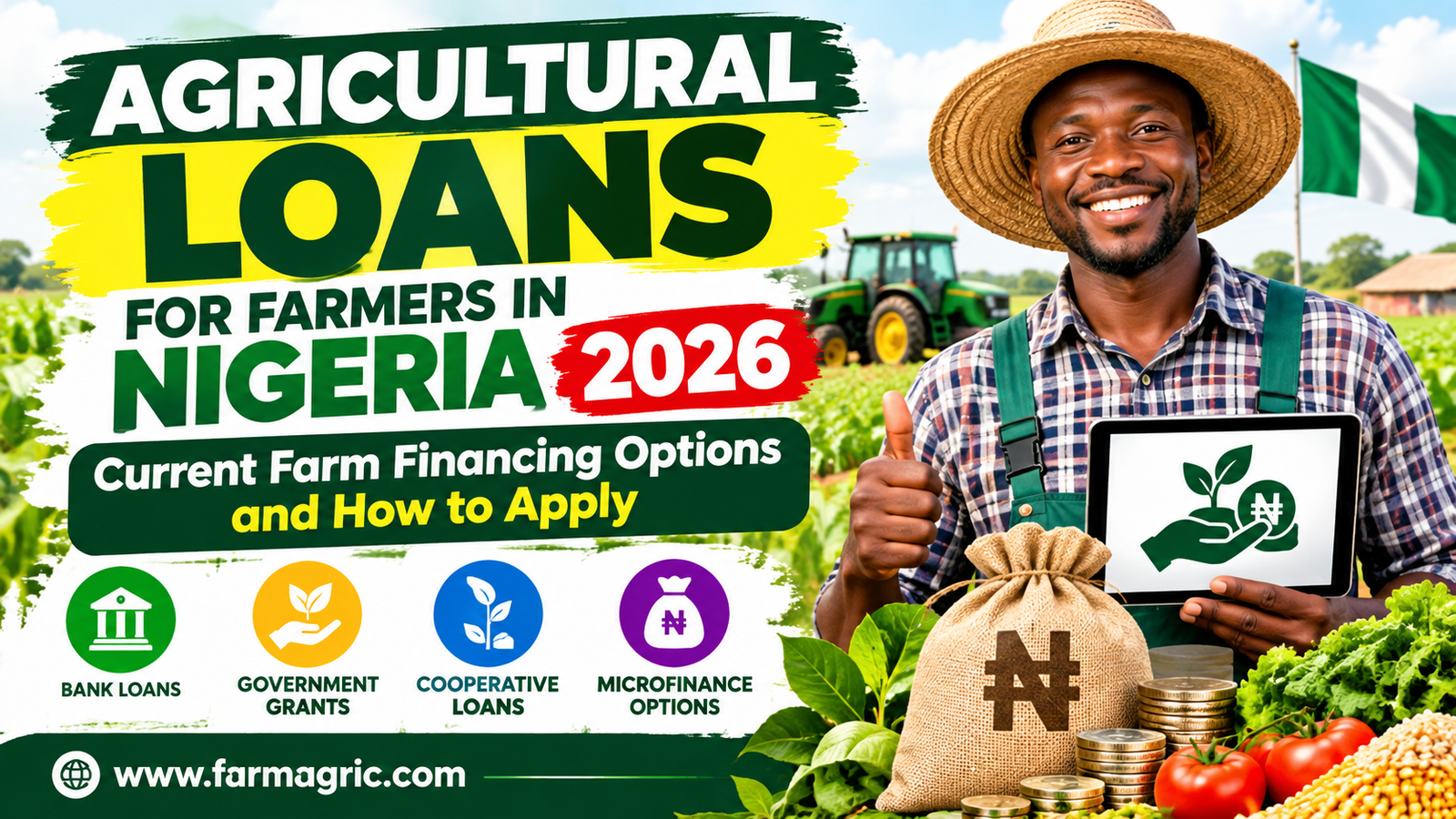
Agricultural Loans for Farmers in Nigeria 2026: Current Farm Financing Options and How to Apply
Farmers looking for agricultural loans in Nigeria in 2026 have several financing routes to consider, including Bank of Agriculture credit, smallholder financing programmes, microcredit and government-backed agricultural credit guarantees. The biggest challenge for many farmers is not knowing where legitimate farm loans are available or whether a programme is actually a loan, a grant, a subsidy or simply a government announcement. With input prices, labour costs, land preparation expenses and transportation costs continuing to put pressure on farm businesses, access to reliable agricultural finance has become one of the most important issues for farmers preparing for the next production cycle.
Agricultural Loans for Farmers in Nigeria Are Becoming More Structured
Nigeria’s agricultural financing system is increasingly moving toward structured lending that connects farmers with inputs, extension services, aggregation companies, markets and financial institutions. The Federal Ministry of Agriculture and Food Security has said it is working with the Agricultural Credit Guarantee Scheme Fund to expand farmers’ access to agricultural credit. Under the Agricultural Credit Guarantee Scheme, participating lending institutions can receive guarantees on agricultural loans, which is intended to make it easier for farmers and agribusinesses to obtain credit.
For farmers, this distinction is important because the Agricultural Credit Guarantee Scheme is not simply a programme where government hands cash directly to every applicant. It works through lending institutions that provide agricultural credit. This means a farmer should still expect eligibility checks, documentation and repayment obligations. Farmers searching online for “free agricultural loans” should therefore be careful with websites that describe every government-backed loan as free money.
Bank of Agriculture Loans for Smallholder Farmers
The Bank of Agriculture, commonly known as BOA, remains one of the major institutions focused specifically on agricultural and rural finance in Nigeria. The bank says its mandate covers agricultural credit facilities across the agricultural value chain, including support for smallholder farmers, agribusinesses and rural entrepreneurs.
One financing option currently listed by BOA is its Micro Credit facility. The facility is designed for individuals, groups and micro-enterprises involved in income-generating activities, including agriculture. BOA specifically identifies smallholder farmers and processors, cooperatives and self-help groups among potential users. The bank says the facility can support working capital, seasonal farm inputs, tools, equipment and business expansion, with repayment arrangements that can be daily, weekly or monthly depending on the facility.
This type of financing can be relevant to farmers who do not need a very large commercial agricultural loan but need money to solve an immediate production problem. A poultry farmer may need funds to purchase feed, a vegetable farmer may need irrigation equipment, while a crop farmer may need working capital for land preparation, seed, fertilizer or labour. The amount a farmer can access depends on the lender’s assessment, repayment capacity and the requirements of the particular facility.
Renewed Hope Smallholder Support and Value Chain Programme
Another important agricultural financing development in 2026 is the Federal Government’s Renewed Hope Smallholder Support and Value Chain Programme. The programme is being implemented with the Bank of Agriculture and private-sector partners and is designed to connect smallholder farmers with financing, farm inputs, extension support and structured markets.
In July 2026, the Federal Ministry of Agriculture and Food Security announced the distribution of more than 10 million bags of fertilizer under the programme and said the initiative was designed to reach about two million smallholder farmers. The programme also includes a Guaranteed Price Model intended to reduce some of the market risk farmers face after harvest.
The Bank of Agriculture has also reported partnerships under the programme involving single-digit agricultural loans. In one August 2026 implementation in Jigawa State, BOA said participating farmers were receiving financing at a 9 percent interest rate, with a nine-month repayment period designed around the farming and harvest cycle. The financing was channelled through accredited Farmer Aggregation Companies.
Farmers should understand that this is not the same thing as a free grant. Where financing is provided as a loan, the money has to be repaid according to the agreed terms. Farmers who are interested should therefore confirm whether their commodity, location, cooperative or farmer aggregation organisation is participating before assuming that they can apply individually.
Agricultural Credit Guarantee Scheme Fund
Farmers who have difficulty obtaining loans because of collateral requirements should also investigate the Agricultural Credit Guarantee Scheme Fund. The scheme was established to encourage lending to agriculture by providing guarantees for qualifying agricultural loans issued by lending institutions. The Federal Ministry of Agriculture said in July 2026 that the government was strengthening collaboration with ACGSF to improve farmers’ access to credit.
The practical benefit for a farmer is that a credit guarantee can reduce some of the risk faced by the lending institution. However, a guarantee does not automatically mean that every farmer qualifies for a loan. The farmer still has to meet the requirements of the participating financial institution and demonstrate that the proposed agricultural activity can support repayment.
National Agricultural Development Fund and Agricultural Finance
Farmers should also pay attention to the National Agricultural Development Fund, or NADF, as Nigeria develops new financing mechanisms for agriculture. NADF states that its purpose includes helping bridge the financing gap in the agricultural sector through different funding sources, tailored financial products and loan guarantee programmes. It also supports research, capacity building and agricultural development initiatives.
The Federal Ministry of Agriculture and Food Security has described the operationalization of NADF as part of a broader shift toward financing agricultural research, technology development, enterprise creation and value-chain modernization.
For farmers and agribusiness owners, this means that agricultural finance is increasingly being designed around the entire value chain rather than simply providing cash for planting. Farmers should therefore watch official NADF announcements for new financing windows, guarantee programmes and sector-specific interventions.
What Farmers Need Before Applying for an Agricultural Loan
Before applying for any farm loan, a farmer should prepare basic information about the farm business. This normally includes the type of farming activity, farm size, location, production cycle, expected costs, expected revenue and the purpose of the loan. A lender needs to understand how the money will be used and how repayment will be made.
Farmers should also keep records of previous production and sales where available. Bank statements, cooperative records, invoices, receipts, evidence of land access, farm registration information and details of existing buyers can make it easier to demonstrate that the farming operation is genuine and commercially viable.
One of the biggest mistakes farmers make is borrowing without calculating the complete cost of production. A farmer should calculate seed, fertilizer, chemicals, labour, transportation, irrigation, feed, veterinary expenses, land preparation, harvesting and marketing costs before deciding how much to borrow. Borrowing too little can leave a farm unfinished, while borrowing too much can create unnecessary repayment pressure.
Beware of Fake Agricultural Loan Websites
Farmers searching for “agricultural loan application 2026” should be extremely careful about fake websites and social media pages requesting registration fees, processing fees or payments before releasing a supposed government loan. The Bank of Agriculture has specifically warned Nigerians about false claims concerning agricultural loans, grants and the Renewed Hope National Agricultural Mechanization Programme. BOA stated that applicants should rely on information published through its official channels.
A legitimate opportunity should clearly identify the organization providing the funding, the eligibility requirements, the application process and whether the money is a grant or a loan. Farmers should never assume that a WhatsApp message, Facebook post or unofficial website is genuine simply because it uses the name of a government agency or bank.
Where Farmers Can Check for Legitimate Agricultural Finance
Farmers can start with the official Bank of Agriculture website for information about its current credit products and application channels. They can also monitor the Federal Ministry of Agriculture and Food Security for announcements concerning national agricultural financing programmes and the Agricultural Credit Guarantee Scheme.
The most important question to ask before applying is not simply “How much money can I get?” Farmers should ask, “What type of financing is this, who qualifies, what will I repay, when does repayment begin, and who is the official organization handling my application?” These questions can prevent farmers from falling into expensive or fraudulent financing arrangements.
Final Advice for Farmers Seeking Loans in 2026
There are genuine agricultural financing opportunities in Nigeria, but farmers should not treat every funding announcement as a cash grant. Current financing initiatives include BOA credit products, smallholder value-chain financing, government-backed agricultural credit guarantees and emerging NADF financing mechanisms.
Farmers who prepare their farm records, calculate their production costs, understand repayment terms and apply through official channels will be in a much stronger position than farmers who simply search for the largest advertised loan amount. Agricultural finance can help a farm expand, but the right loan is one that matches the farm’s production cycle and realistic ability to repay.