How to Know the Right Feed Quantity for Layers
How to Know the Right Feed Quantity for Layers
For my first two years with layers, I fed by feel. I scooped feed until the birds stopped crowding the trough, and I called that “enough.” Some weeks the hens were laying well. Other weeks the egg trays looked thin, and I could not tell why. Then I started weighing what went into the feeders and what came out of them, and what I found was embarrassing. On some days I was wasting nearly a tenth of the feed on the floor and with the rats. On others I was shorting the hens in the hot afternoons, when appetite drops and the birds need the most help. The money I lost to guessing was bigger than the money I spent on any equipment.
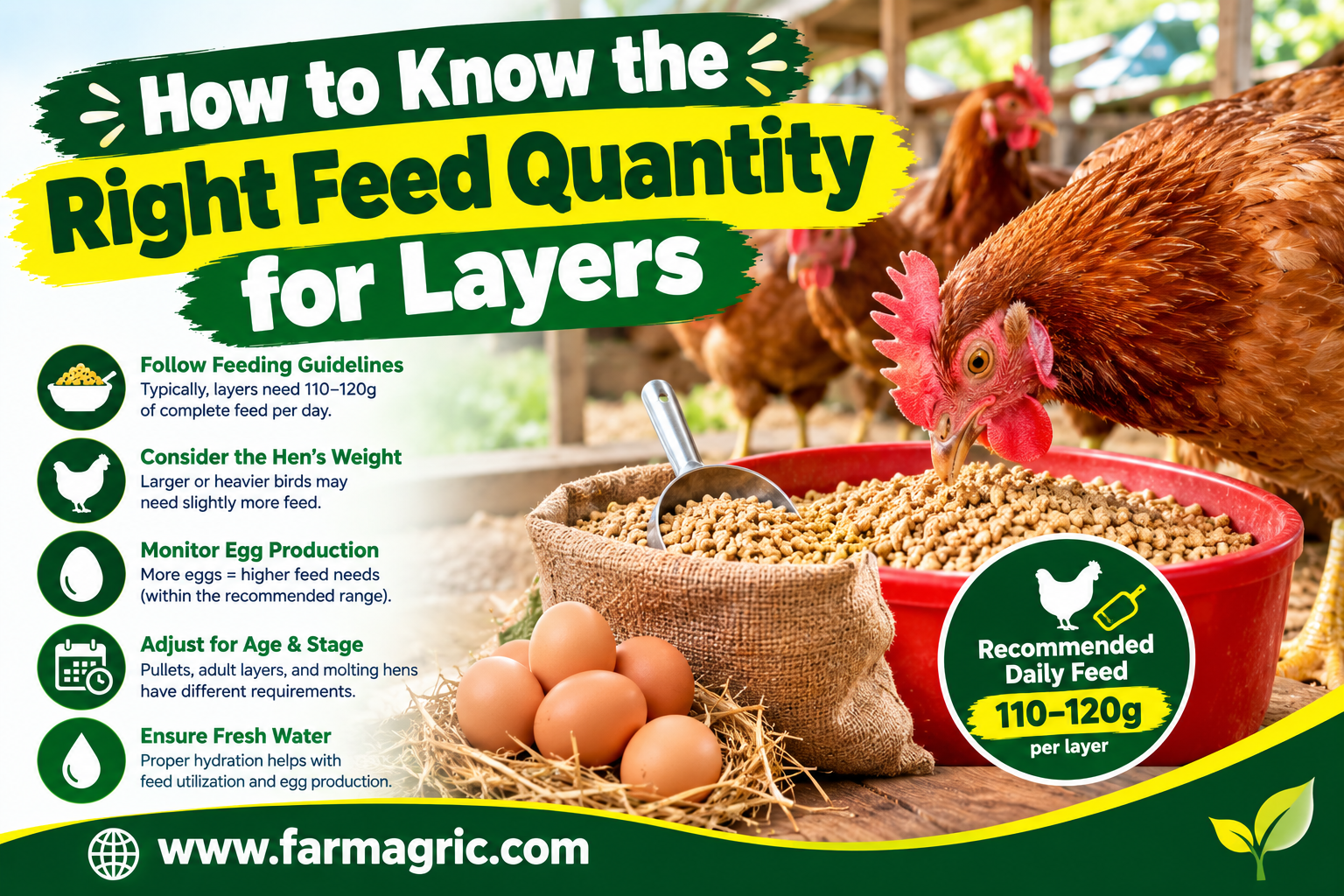
Here is the direct answer. A typical adult commercial laying hen eats roughly 100 to 125 grams of complete layer feed per day, with lighter breeds and hot climates toward the lower end and heavier breeds, cool weather and peak production toward the higher end. For a flock of 100 hens, that works out to about 10 to 12.5 kilograms per day. But that number is a starting point, not a rule. The right quantity for your flock depends on the breed, the age, the stage of production, the temperature, the feed quality and how the birds are housed. To find your own number, feed a good complete layer ration, measure what you give and what is left, and then adjust by watching egg production, egg size, body condition and the weather.
The rest of this article shows you exactly how to work that out, and how to avoid the mistakes that drain farmers’ profits.
Why getting the quantity right matters
Feed is usually the largest cost in egg production, often well over half of the total. Overfeeding wastes money and can make hens too fat, which lowers egg production and raises the risk of problems like fatty liver and prolapse. Underfeeding is just as costly. A hen that does not get enough nutrients cannot make eggs at full speed. Production drops, eggs get smaller, shells weaken, hens lose weight and become more prone to feather pecking and disease. The goal is to give each hen enough to meet her needs for maintenance, egg production and temperature, and no more.
What most farmers get wrong
They feed by eye instead of by weight. Judging by how empty the trough looks is unreliable, because it depends on how fast the birds eat, how much spills and how many times you refill. Measuring in kilograms or a standard scoop takes minutes and reveals the truth.
They use one number for every flock. A figure copied from a neighbor or a book may not fit your breed, your climate or your production stage. Pullets, peak layers and old hens all eat differently.
They forget that heat changes appetite. When it gets hot, hens eat less. If the feed they eat is not nutritionally dense enough, they end up short on protein, minerals and energy even though they are eating normally for the weather, and egg production and shell quality fall.
They feed the wrong kind of feed. Chick and grower feeds are lower in calcium than layer feed, and layer feed is too rich in calcium for young birds, which can harm their kidneys. Feeding grain or kitchen scraps in large amounts dilutes the balanced ration, so hens fill up on low-protein, low-calcium food and lay poorly.
They ignore feeder space and spillage. Too little feeder space means timid birds do not get enough, and uneven flocks result. Poor feeder design and overfilling cause large spillage and waste, and rodents and wild birds take a share too.
They let the feed spoil. Wet, moldy or stale feed lowers intake and can poison birds with mycotoxins. Feed that sits in heat and damp loses nutrients and invites pests.
They forget water. Hens drink roughly twice as much water as the weight of feed they eat. If water is short, feed intake drops, and so does egg production.
How much do layers actually eat?
Think about a hen’s life in stages, because her appetite and needs change.
Chicks and growers eat much less, but their intake rises steadily as they grow. Most commercial layer breeds follow a starter, grower and pre-layer or developer feeding program, with each feed matched to the age of the birds. In the first weeks, chicks eat only a few tens of grams per day, rising to roughly 60 to 90 grams per day by the time they approach point of lay, depending on the strain. The breeder’s management guide for your strain gives the target feed intake and body weight at each week of age, and it is worth getting a copy from your supplier or hatchery.
Once hens begin laying and reach peak production, they usually eat around 100 to 125 grams a day of a complete layer ration, depending on the strain and conditions. Brown egg layers and heavier birds generally eat a bit more than light white egg layers. Local or dual-purpose breeds, which lay fewer eggs, often eat somewhat less per bird, though they too need a balanced ration to perform.
Intake changes with temperature. Birds eat less in hot weather and more in cool weather. As a rough guide, intake tends to fall as temperatures rise above the comfortable range of about 20 to 25 degrees Celsius, and rise when it gets colder. The exact figures vary with the strain and conditions, so watch your own flock.
Step-by-step: how to work out the right feed quantity for your layers
Step 1: Start with a recommended feed intake for your strain and age. Get the management guide for your breed from your hatchery, feed supplier or extension service. Note the target body weight, the expected feed intake per bird per day, and the production curve for each week. This is your baseline.
Step 2: Choose the right type of feed for the stage. Use a starter feed for chicks, a grower feed for the growing period, and a layer feed when the pullets approach and begin laying, usually around 16 to 18 weeks, or as the strain guide advises. A complete layer feed typically has around 16 to 18 percent crude protein and about 3.5 to 4.5 percent calcium, along with the right vitamins and minerals, though your supplier’s formulation and the strain guide are what matter. Check the label or ask your supplier for the nutrient analysis, and make sure the feed is fresh and from a trustworthy source. If you mix your own feed, have the formula designed by a qualified nutritionist.
Step 3: Work out your daily total. Multiply the number of birds by the grams per bird per day. For example, 500 hens at 115 grams each is 57.5 kilograms per day. Add a small allowance for spillage, then use this as your starting daily amount. Doing this sum helps you plan purchases too, since you will know how many bags you will go through each week.
Step 4: Weigh what you feed, and weigh what is left. For a week, measure the feed you put in the feeders each day, and measure what is left over the next morning. The difference is what the flock actually ate. Divide by the number of birds to get the real intake per bird. Compare it to your target. If birds finish everything quickly and look hungry, you may be underfeeding. If feed is left over and going stale, you may be overfeeding or the feed is not palatable.
Step 5: Decide whether to feed free choice or in measured amounts. Commercial layers are usually fed ad libitum, meaning they have access to feed whenever they want, which lets them eat to their needs, while the farmer manages quality and feeder design. In small flocks, many farmers give measured daily amounts split into two or three feedings. If you feed in measured amounts, spread the feed across the day, and give a larger share in the cooler part of the day, particularly the afternoon, since the hen builds the eggshell overnight and benefits from calcium intake in the late afternoon.
Step 6: Make sure there is enough feeder space. Provide enough feeder space so that all birds can eat at the same time, without bullying. A common guide is about 10 to 15 centimeters of trough space per bird for layers, or one hanging feeder per 25 to 30 birds, but follow the recommendation for your feeder type. Position feeders at back height so birds do not scratch feed out, and avoid overfilling, which causes waste.
Step 7: Provide calcium and grit if needed. Layers need a lot of calcium to make strong shells. A complete layer feed supplies much of it, but some farmers also offer oyster shell or limestone free choice in a separate container, so each hen can take what she needs. Young birds should not get high-calcium feed before they begin to lay. If birds eat a lot of grain or scraps, they may need grit to help grind food in the gizzard.
Step 8: Make sure the water is plentiful and clean. Provide fresh, clean, cool water at all times, in enough drinkers for the flock. Hens drink around twice as much water as feed by weight, and more in hot weather. Clean the drinkers often, and check that the supply does not run out. Less water means less feed intake and fewer eggs.
Step 9: Adjust for the weather. In hot weather, birds eat less, so make sure the feed is nutritionally dense, so each mouthful gives enough protein, minerals and energy. Feed in the cooler hours early in the morning and in the evening, keep the house well ventilated and shaded, and provide cool water. In cold weather, birds eat more to keep warm, so expect a higher feed use per bird. Talk to your feed supplier or nutritionist about adjusting the ration for your season.
Step 10: Watch the production and the birds, not just the feed. The best test of whether you are feeding the right amount is how the flock performs. Track daily egg numbers, egg size, shell quality, body condition and feather cover. Weigh a sample of birds every few weeks and compare to the strain’s target weight. Feel the keel bone and breast. Hens that are very thin or very fat are not getting the right amount. Eggs that are small, shells that are thin, and production that is falling short of the expected curve all deserve a closer look at feed quality and quantity.
Step 11: Reduce waste. Store feed in a cool, dry, rodent-proof place. Use it up in a few weeks, and avoid keeping old feed. Fill feeders only partly, fix broken or leaking feeders, and clean up spills. Keep wild birds and rodents out. Even a few percent savings on feed adds up over a year.
Step 12: Keep records and refine. Write down the daily feed given, the egg count, the number of birds, the weather and any changes in feed or health. Calculate your feed per dozen eggs or per kilogram of eggs. A well-managed commercial layer flock often uses roughly 2 to 2.3 kilograms of feed for each kilogram of eggs produced, although the figure depends on the strain and conditions. Comparing your numbers with this range tells you whether you are efficient or leaking money.
Warning signs your feed quantity is off
If hens are underfed, you may see weight loss, a sharp keel bone, a drop in egg production, smaller eggs, thin or cracked shells, more feather pecking, hens crowding the feeders aggressively, and an uneven flock. If they are overfed, you may see fat birds, heavy abdomens, lower egg production, more prolapse, lots of leftover feed, and rising feed bills without more eggs. A sudden drop in feed intake can signal heat stress, disease, spoiled feed or a water problem, so investigate quickly. A sudden rise in intake with no weight gain may mean cold, parasites or heavy spillage.
What I would do differently if I were starting again today
I would get the strain guide on day one and set up a simple daily record before the chicks arrived. I would measure feed in kilograms, not by feel, and I would calculate the daily total every week as the flock grew. I would invest in good feeders, drinkers and rodent-proof storage, because they pay for themselves in saved feed. I would pay attention to the weather and adjust the feeding times and feed density in the hot months. And I would trust the hens’ performance over my own assumptions, checking egg numbers and body condition every week before changing anything.
The right feed quantity is not a magic number. It is the amount that keeps your hens at the right weight, laying at the right rate, at the lowest waste.
FAQ
How much feed does a laying hen eat per day?
A typical adult commercial layer eats around 100 to 125 grams of complete layer feed per day, depending on breed, age, production stage and temperature. Hot weather and lighter breeds usually mean less, cool weather and heavier breeds mean more.
How much feed do 100 layers need per day?
At about 110 to 120 grams per bird, 100 hens need roughly 11 to 12 kilograms a day, plus a small allowance for spillage. Check your actual intake by weighing feed given and feed left over.
Should I feed layers once or twice a day?
Birds on free-choice feeders eat throughout the day. If you feed in measured amounts, splitting the feed into two or three portions is better than one, and giving a good share in the late afternoon helps supply calcium for eggshell formation overnight.
Can I feed layers kitchen scraps and grain?
In small amounts, yes, but too much dilutes the balanced layer ration and lowers protein and calcium intake, which can reduce egg production and shell quality. Keep treats to a small share of the total diet.
Why are my hens eating less in hot weather?
Heat reduces appetite, since digestion produces heat. Make sure the feed is nutrient dense, provide coo l water and shade, ventilate well, and feed during the cooler parts of the day.
Bookmark this
Do not feed your hens by habit or by eye, feed them by weight and by results, and let the egg tray tell you whether you got it right.