Agricultural Loans in Nigeria: Where Farmers Can Get Funding and How to Apply
Agricultural Loans in Nigeria: Where to Borrow, What You Need and What to Check First
A Nigerian farmer who wants a loan usually faces the same confusion: dozens of websites promise “government farm loans” with different amounts, rates and application links, and most do not say who actually lends the money. This guide separates the real routes from the noise, so you know which institutions lend to farmers, what the main federal scheme does, and what to prepare before you walk into a bank.
One reason the search is hard is that farming is under-served by lenders. According to the CBN governor, agriculture accounts for more than a fifth of Nigeria’s GDP and employs nearly two thirds of the workforce, yet it receives less than five per cent of total bank lending. Knowing where the money really sits gives you an edge.
The Main Places Nigerian Farmers Borrow From
| Source | Who it suits | What to know |
|---|---|---|
| Bank of Agriculture (BOA) | Smallholders, cooperatives, agro-processors | Government-owned development bank focused on agriculture |
| Commercial banks (with ACGSF cover) | Farmers with a bankable plan and some security | The CBN guarantee reduces the bank’s risk, not yours |
| Microfinance banks | Small farmers needing modest amounts | Smaller loans, shorter terms, often closer to rural areas |
| Cooperatives and farmer groups | Members who borrow together | Group guarantees can replace some collateral |
| Value chain buyers and input suppliers | Farmers with a contract buyer | Credit often comes as inputs, repaid at harvest |
A loan is money you must repay, usually with interest. A grant is not repaid. A guarantee is a promise to a bank that part of a defaulted loan will be covered. These are different things, and many misleading ads blur them together.
The Bank of Agriculture (BOA)
BOA is the federal government’s agricultural development bank, and it is the first place most smallholders should ask. Its managing director has said the bank offers farmers loans at single-digit interest rates, and that it is rolling out support in phases, starting with 500,000 beneficiaries who have already received agricultural inputs, within a target of about two million farmers.
There is also a larger federal push. The Minister of Agriculture and Food Security announced that the federal government approved a N250 billion facility for BOA to give smallholder farmers credit at a single-digit interest rate. The stated purposes include inputs, mechanisation and market linkages. Treat the headline figure as a funding pool for the bank, not a sum any one farmer can claim. Amounts, rates and timelines for individual borrowers are set by BOA at application.
Older product pages for BOA list specific loan products with their own caps and rates. Because those figures have changed over the years, do not rely on any rate you read on a third-party blog. Ask your nearest BOA branch for the current product list, the annual rate and the total repayment.
The CBN Agricultural Credit Guarantee Scheme Fund (ACGSF)
The ACGSF is the scheme most often described wrongly online, so it is worth understanding properly. It does not hand money to farmers. It provides a guarantee on loans granted by lending banks for agricultural purposes, with the aim of raising bank credit to the sector. The fund has existed since 1977, and under the amended 2019 Act its share capital was expanded from N3 billion to N50 billion.
Key facts from the CBN’s own page:
- The fund covers 75% of the loan amount in default, net of any security realized.
- The maximum for a non-collateralized loan is ₦100,000, and for a collateralized loan it is ₦50 million.
- Eligible lenders include banks and microfinance banks under the CBN’s regulatory and supervisory role.
- Eligible activities span the whole agricultural value chain.
Two practical points follow. First, you apply through a participating bank, and the bank decides whether to lend. Second, the guarantee protects the bank. If you default, the lending bank is expected to keep pursuing recovery as if no guarantee existed, so you still owe the money.
Commercial and Microfinance Banks
Commercial banks lend to farmers who can show a working business and, for larger amounts, acceptable security. Microfinance banks are often easier to reach for smaller sums. In both cases, ask the loan officer directly whether the facility is covered by the ACGSF. If it is, your bank may be more willing to lend, especially where you lack full collateral.
Lenders differ widely on rates, so compare at least two offers. Ask for the annual interest rate, any management or insurance fees, the repayment schedule, and the total you will pay back.
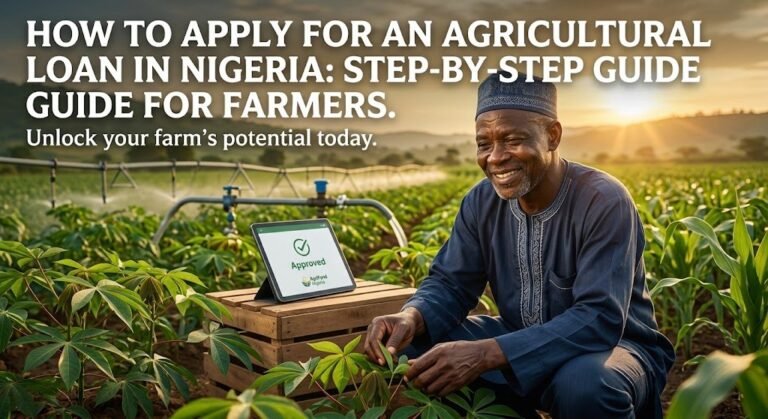
How to Apply for an Agricultural Loan in Nigeria
- Decide the exact use. Seeds and fertiliser, a poultry house, a tractor and a processing machine are different loans with different terms.
- Write a simple farm plan. Include land size, crop or livestock, expected costs, expected income, harvest dates and where you will sell.
- Pick your lender. Start with BOA, then banks and microfinance banks near you.
- Gather documents (see below).
- Submit the application in person or through the lender’s official channel, and keep copies of everything.
- Confirm the terms in writing before signing: rate, fees, grace period, repayment dates and what happens on late payment.
Documents Lenders Commonly Ask For
Requirements differ, so confirm with your lender. These are typical:
- Valid identification and your National Identification Number
- Bank Verification Number (BVN) and a bank account
- Passport photographs
- Proof of your farm: land papers, lease, or a letter from the community head or local authority
- A farm business plan or cash-flow estimate
- Bank statements, where you have an account history
- Evidence of cooperative or group membership, if borrowing through a group
- Guarantor details, where collateral is not required
Repayment: Match the Loan to the Farm Calendar
Crops and livestock earn money at set times, not monthly. A maize loan with monthly repayments starting before harvest can sink a good farm. Ask for a grace period that reflects your crop cycle. Short-cycle activities such as vegetables or poultry can handle shorter terms, while tree crops and fish ponds need longer ones. Farm insurance also helps protect a loan from flood, drought or disease, and the Minister reported that the Nigerian Agricultural Insurance Corporation has supported 199,275 farmers with N700 billion in risk cover over two years.
Before You Apply
- Never pay a “processing fee” to an agent or a social media page that promises a guaranteed government loan. Genuine lenders do not sell access.
- Use official channels only: the BOA branch or website, the CBN website for ACGSF information, or a licensed bank or microfinance bank you can visit.
- Confirm the scheme is active. Some federal programmes are announced, paused or restructured. The CBN governor has said the bank is keeping its position against intervention financing while it reshapes agricultural lending through the guarantee route, so old “CBN farm loan” posts may describe schemes that no longer lend directly.
- Check the lender is licensed before sharing documents or your BVN.
- Ask for the total cost of the loan, not just the headline interest rate.
Common Mistakes to Avoid
- Borrowing more than the farm can repay at harvest prices
- Applying with no written plan or records
- Believing that a guarantee means you do not have to repay
- Signing before understanding the penalties for late payment
- Using loan money for unrelated expenses
- Trusting blog figures over what the lender confirms to you
Where to Find Official Information
Go to the Bank of Agriculture’s branches and website, the Central Bank of Nigeria‘s agriculture pages for ACGSF details, the Federal Ministry of Agriculture and Food Security, and your state ministry of agriculture. Information on this page reflects public reports available as of October 2026, so confirm current terms with the lender before you commit.