How to Export Agricultural Products From Nigeria: A Step-by-Step Guide
Exporting agricultural products from Nigeria is more than finding a buyer overseas and moving farm produce to a seaport or airport. A successful export transaction requires the right product, a reliable supply chain, proper quality control, accurate documentation, suitable packaging, a clear contract, competitive pricing and compliance with Nigerian and destination-country requirements.
The Nigerian Export Promotion Council’s current export guide breaks the export process into nine broad areas: export readiness, e-registration, market understanding, export planning, documentation and procedures, logistics and freight, export pricing, export finance, and legal issues.
For agricultural businesses, there are additional considerations because farm products can be perishable, seasonal, quality-sensitive and subject to sanitary or phytosanitary controls.
This guide explains how to move from having an agricultural product in Nigeria to preparing a legitimate export transaction and delivering it to an international buyer.
What agricultural products can be exported from Nigeria?
Nigeria has a wide range of agricultural commodities and processed agricultural products that can be sold internationally.
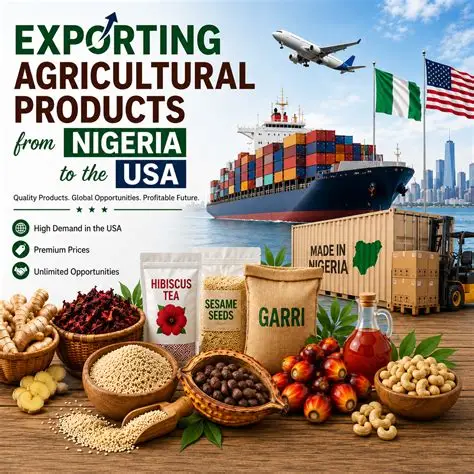
Depending on market requirements, examples include:
- Cocoa beans and cocoa products
- Cashew nuts
- Sesame seeds
- Ginger
- Hibiscus
- Shea products
- Soybeans and soybean products
- Dried beans
- Spices
- Garlic and other selected crops
- Agricultural oils
- Processed food and agricultural ingredients
- Other products that meet Nigerian and destination-market requirements
However, a product being produced in large quantities in Nigeria does not automatically make it suitable for export.
Before buying or producing for export, the exporter needs to establish whether the product is legally exportable, whether there is a viable destination market, what quality specification buyers require, and whether the exporter can supply the required quantity consistently.
NEPC advises prospective exporters to understand their target market before entering an export transaction.
Step 1: Choose the agricultural product you want to export
Start with the product, not the foreign buyer.
Identify the agricultural commodity you can source consistently and then investigate its export potential.
For example, a trader may have access to large quantities of sesame in northern Nigeria, while another business may have established relationships with cocoa farmers or cashew aggregators.
The important question is not simply:
“Which Nigerian farm product sells for a high price abroad?”
A better question is:
“Which product can I source consistently at the required quality, prepare correctly, and deliver to a buyer at a commercially viable total cost?”
Consider the following before committing money:
Availability: Can you obtain enough of the product throughout the intended export period?
Quality: Can the product consistently meet the buyer’s specification?
Seasonality: When is the commodity harvested, and how does that affect supply?
Storage: Can you preserve the product without deterioration?
Processing: Does it require cleaning, drying, grading, sorting, milling, extraction or other processing?
Market: Are there genuine buyers in your target destination?
Regulation: Are there restrictions, certificates or special requirements for the commodity?
Logistics: Can the product reach the buyer without excessive damage, spoilage or additional costs?
This initial assessment prevents one of the most common mistakes made by new exporters: buying agricultural produce first and searching for a buyer afterward.
Step 2: Check whether the product is allowed for export
Not every product should be treated as automatically exportable.
Before entering into a transaction, check Nigerian export rules and the requirements of the destination country.
NEPC advises exporters to understand the legal instruments regulating non-oil exports in Nigeria as well as the requirements of the importing country.
Product-specific requirements can also differ.
For example, agricultural commodities may require phytosanitary documentation, while processed foods may have additional health or regulatory requirements.
NEPC identifies the Nigerian Agricultural Quarantine Service as the authority associated with phytosanitary certificates for agricultural commodities. It also identifies NAFDAC health certificates for relevant processed and semi-processed food items.
Do not assume that one certificate covers every agricultural product.
The exact requirements depend on what you are exporting, how it is processed, and where it is going.
Step 3: Register as an exporter with NEPC
For formal exports from Nigeria, you need to register with the Nigerian Export Promotion Council and obtain an Exporter’s Certificate.
NEPC currently states that registration is completed through its e-registration platform.
The documents required depend on the type of business.
For a limited liability company, NEPC lists documents including the Certificate of Incorporation, Memorandum and Articles of Association, the relevant CAC particulars of directors or status report, and a board resolution for NEPC registration. Cooperative societies have different documentation requirements.
NEPC currently lists a new exporter certificate registration fee of ₦13,500, excluding applicable payment charges. The certificate is valid initially for two years and is subsequently renewable annually.
The council also states that certificates are issued within one working day after payment confirmation, although delays can occur where payment is not confirmed or documentation is incomplete.
For a new exporter, this should be one of the first administrative steps rather than something postponed until a shipment is ready.
Step 4: Research the international market
After establishing your export status, identify the market where your product has a realistic opportunity.
Do not select a country simply because you have heard that people there buy Nigerian agricultural products.
Research:
- Existing demand
- Product specifications
- Import requirements
- Applicable duties and taxes
- Packaging rules
- Food safety requirements
- Phytosanitary requirements
- Labelling requirements
- Accepted quality grades
- Currency and payment considerations
- Shipping routes
- Typical buyer quantities
- Competition from other exporting countries
NEPC specifically identifies understanding the market as one of the core stages of preparing for export.
The market research should be product-specific.
The requirements for exporting raw sesame seeds are not necessarily the same as those for processed sesame products. Likewise, exporting cocoa beans is different from exporting cocoa butter or finished chocolate products.
Step 5: Find and verify an international buyer
Finding a buyer is one of the most important stages of agricultural exporting.
Potential buyers may include:
- Importers
- Commodity traders
- Food manufacturers
- Agricultural processors
- Distributors
- Wholesale businesses
- Ingredient companies
- Retail suppliers
A buyer should not be considered genuine simply because the person has an attractive website, business email address or foreign telephone number.
Verify the company before sending goods or making substantial commitments.
Look for:
- Registered business information
- Physical business address
- Company website and business identity
- Trade references where appropriate
- Previous transaction history
- Clear product specifications
- Proper purchase documentation
- Agreed payment terms
- A verifiable company representative
NEPC advises exporters to pay attention to the terms of international export contracts and recommends obtaining professional advice where appropriate.
Be especially careful when a supposed buyer asks you to pay unusual “registration,” “release,” “customs,” or “clearance” charges before a legitimate commercial transaction has been established.
Step 6: Agree on the product specification
Once you have a potential buyer, establish exactly what the buyer wants.
Do not settle for an instruction such as:
“Send me 20 tonnes of Nigerian sesame.”
The contract or purchase specification should establish relevant details such as:
- Product name
- Grade
- Quantity
- Moisture specification
- Purity
- Foreign matter limits
- Size or physical characteristics
- Packaging
- Labelling
- Inspection requirements
- Delivery location
- Delivery period
- Payment terms
- Applicable Incoterm
- Required certificates
The precise specification will depend on the agricultural product.
For some commodities, moisture is critical. For others, colour, size, cleanliness, oil content, microbial quality or processing method may be more important.
The exporter should understand the specification before purchasing the commodity.
Step 7: Source and aggregate the agricultural product
Once the buyer’s requirements are clear, source the commodity.
This is where agricultural experience becomes particularly important.
Do not assume that produce collected from several farms will automatically have uniform quality.
Build a sourcing system.
For example, a sesame exporter may work with farmers and aggregators across several production areas. The exporter needs a method for checking the quality of incoming lots before they are combined.
A cocoa exporter may need records showing where cocoa originated, particularly where the destination market has strict traceability requirements.
A cashew exporter needs to pay attention to moisture, storage conditions and physical quality during aggregation.
The larger the shipment, the more important quality control becomes.
Step 8: Clean, grade, process and prepare the product
Agricultural products normally need preparation before export.
Depending on the commodity, this can include:
- Cleaning
- Sorting
- Grading
- Drying
- De-stoning
- Removal of foreign materials
- Pest control
- Processing
- Moisture testing
- Quality inspection
- Packaging
- Labelling
The purpose is not to make the product look good only for shipment.
The product needs to arrive at the buyer’s destination within the agreed specification.
Poor post-harvest handling can turn a commercially attractive commodity into a rejected shipment.
This is particularly important for products such as cocoa, sesame, ginger, cashew and other agricultural commodities where contamination, moisture or improper storage can affect quality.
Step 9: Obtain the required quality and agricultural certificates
Agricultural exports can require certificates from relevant Nigerian authorities.
NEPC identifies phytosanitary certificates for agricultural commodities as a relevant quality assurance document issued by the Nigerian Agricultural Quarantine Service. For applicable processed and semi-processed food products, NEPC identifies health certificates issued by NAFDAC.
Other agricultural products may have different requirements.
Therefore, identify the exact certificate requirements for your product and destination before preparing the shipment.
This is important because certificates should not be treated as an afterthought.
A buyer may have made the purchase based on a particular quality specification, while the importing country may have its own regulatory requirements.
Step 10: Prepare your export documents
Documentation is one of the areas where inexperienced exporters can encounter serious problems.
NEPC identifies export documentation as a formal requirement and lists documents covering exporter registration, export contracts, quality assurance, commercial transactions, financial transactions and movement of goods.
Depending on the transaction, relevant documents can include:
Exporter Certificate: Evidence of registration with NEPC.
Export contract: The agreement between the exporter and buyer.
Proforma invoice: An offer showing the product, quantity, price and relevant transaction terms.
Commercial invoice: The final commercial document showing the value of the exported goods.
Packing list: Details of packaging units and quantities.
NXP form: The Nigeria Export Proceeds form used in the export transaction.
Phytosanitary certificate: Relevant to agricultural commodities where required.
Clean Certificate of Inspection: A document associated with pre-shipment inspection.
Certificate of Origin: Evidence of the origin of the goods where required.
Bill of Lading: Used for sea transportation.
Air Waybill: Used for air freight.
Road transport documentation: Used where the export is transported by road.
The exact document set varies by commodity, destination, transaction and transport method. NEPC’s current documentation guidance should be checked before each export transaction.
Step 11: Understand the NXP and financial requirements
Agricultural exports involve financial documentation as well as physical movement of goods.
NEPC identifies the Nigeria Export Proceeds form as part of the formal export process and notes that it is issued through a commercial bank.
The exporter should therefore involve the bank early enough to understand the financial documentation required for the transaction.
Also establish:
- Who pays the freight
- Who pays insurance where applicable
- When the buyer will pay
- What currency will be used
- Whether payment is made before shipment, against documents or under another agreed arrangement
- How bank charges are handled
- How export proceeds will be received
Never agree to payment terms simply because the buyer proposes them.
The payment structure should be understood by both parties before the shipment leaves Nigeria.
Step 12: Calculate the real export price
One of the easiest ways to lose money in agricultural export is to calculate the price using only the farm-gate cost.
Your export costing may need to include:
Cost of agricultural produce
Plus:
Aggregation and handling
Plus:
Processing and cleaning
Plus:
Packaging
Plus:
Quality testing and certification
Plus:
Inland transportation
Plus:
Warehousing
Plus:
Inspection and documentation
Plus:
Port or terminal charges
Plus:
Freight
Plus:
Insurance where applicable
Plus:
Bank and transaction charges
Plus:
Other export-related costs
This gives you a much more realistic picture of the cost of getting the commodity to the buyer.
NEPC specifically identifies export pricing as a separate stage of the export process and advises exporters to consider sourcing and costing when establishing export prices.
Do not quote an international buyer based only on what you paid the farmer.
Step 13: Choose the appropriate logistics and freight method
The transportation method depends heavily on the product.
Bulk, non-perishable commodities may commonly move by sea.
Smaller, urgent or highly perishable products may require air freight depending on the economics and buyer requirements.
The exporter should establish:
- Pickup location
- Warehouse location
- Port or airport
- Transport provider
- Freight forwarder
- Container requirements
- Packaging requirements
- Expected transit period
- Insurance arrangements
- Delivery terms
NEPC identifies logistics and freight as one of the nine stages of export preparation.
The cheapest transport option is not automatically the most appropriate.
A cheaper route that causes excessive delays or product deterioration can become more expensive overall.
Step 14: Inspect the shipment before dispatch
Before the agricultural product leaves your facility, carry out a final quality and documentation check.
Confirm:
- Product quantity
- Product quality
- Packaging condition
- Labelling
- Moisture where applicable
- Contamination controls
- Certificate availability
- Invoice accuracy
- Packing list accuracy
- Buyer specifications
- Shipping details
- Container condition where applicable
This is the point where mistakes are still relatively easy to correct.
Once the goods are loaded and the shipment is in transit, correcting an incorrect quantity, damaged packaging or missing document can become much more difficult and expensive.
Step 15: Complete the export and shipment process
With the product prepared and documentation in place, the shipment can proceed through the relevant export and logistics processes.
The exact procedure depends on the commodity and transportation method.
Your freight forwarder, customs representative and other relevant service providers should understand the shipment requirements.
Maintain copies of the complete transaction file.
That should include the contract, invoices, certificates, inspection documents, shipping documents, payment records and correspondence relevant to the transaction.
Good record keeping becomes particularly important if there is a dispute with the buyer or if documentation needs to be reviewed later.
Step 16: Track the shipment and confirm delivery
Exporting does not end when the container leaves Nigeria.
Track the shipment and maintain communication with the buyer.
Confirm:
- Shipment departure
- Transit status
- Arrival
- Customs clearance status where relevant
- Delivery
- Quantity received
- Product condition
- Buyer acceptance
- Payment status
If the buyer reports a quality or quantity problem, review the agreed contract, inspection records, photographs, shipping documents and other evidence before deciding how the matter should be handled.
NEPC notes that exporters may encounter commercial disputes with overseas buyers and recommends obtaining appropriate legal advice before and after transactions.
Step 17: Build a repeatable export supply chain
A single successful shipment is not the same as having a successful agricultural export business.
The real objective is to create a system that can repeatedly deliver:
- Consistent quality
- Reliable quantity
- Accurate documentation
- Predictable delivery
- Competitive pricing
- Clear communication
- Proper payment collection
This requires relationships with farmers, cooperatives, aggregators, processors, quality inspectors, logistics companies, banks, freight forwarders and international buyers.
For farmers and farmer organizations, consistent supply is especially important.
An international buyer may be interested in Nigerian cocoa or sesame, but the commercial relationship becomes much stronger when the exporter can demonstrate that the required quantity can be supplied repeatedly.
Agricultural export documents at a glance
| Document or requirement | Main purpose |
|---|---|
| NEPC Exporter’s Certificate | Registers the business as an exporter |
| Export contract | Defines the buyer and seller’s obligations |
| Proforma invoice | Sets out the proposed transaction |
| Commercial invoice | Records the commercial value of the shipment |
| Packing list | Shows packaging and quantity details |
| NXP form | Records the export proceeds transaction |
| Phytosanitary certificate | Supports plant and agricultural commodity health requirements where applicable |
| Health certificate | Relevant to applicable processed or semi-processed food products |
| Clean Certificate of Inspection | Supports inspection requirements for applicable exports |
| Certificate of Origin | Establishes the origin of goods where required |
| Bill of Lading | Shipping document for sea freight |
| Air Waybill | Shipping document for air freight |
| Road transport document | Shipping documentation for road transportation |
NEPC’s current export documentation guidance confirms that the required documents vary across stages of the export process and according to the product and transaction.
Common mistakes new agricultural exporters make
Buying produce before finding a buyer
This can leave an exporter holding a commodity without a confirmed market or agreed specification.
Focusing only on the farm-gate price
The international selling price must cover the complete cost of getting the product to the buyer.
Ignoring quality specifications
A buyer may reject or discount a shipment that does not meet the agreed specification.
Mixing different quality grades
Combining different grades without proper controls can make it difficult to maintain a consistent export specification.
Waiting until shipment time to prepare documents
Missing or incorrect documentation can delay the transaction.
Using unverified buyers
A professional-looking buyer is not automatically a legitimate buyer.
Ignoring destination-country requirements
Meeting Nigerian requirements does not necessarily mean the product automatically satisfies the importing country’s rules.
Underestimating logistics costs
Transportation, handling, packaging, storage and freight can materially affect the economics of an agricultural export.
Failing to keep records
Exporters should retain transaction and shipment records so that they can investigate disputes and demonstrate what was agreed and delivered.
How much money do you need to start agricultural exporting?
There is no single amount that applies to every agricultural export business.
The capital requirement depends on the commodity, shipment size, processing requirements, sourcing model, destination and transport method.
A merchant exporting a small quantity of a high-value processed product may have a very different capital requirement from a business purchasing and shipping a full container of a bulk commodity.
Your starting calculation should therefore be based on a specific transaction rather than a general claim about how much an agricultural export business costs.
Build the budget around the actual product, quantity, buyer, destination and logistics route.
NEPC also notes that export finance requirements depend largely on the product and export destination.
How to find export opportunities for Nigerian farm products
Start with products you can source reliably.
Then investigate destinations where buyers require that product.
Useful sources of market information can include export promotion agencies, trade events, industry associations, international trade databases, commodity organizations and direct buyer research.
NEPC states that it provides market information for selected Nigerian export products and offers trade linkage services to exporters.
You can also study existing Nigerian export activity to understand which commodities already have established international markets.
However, established export activity should be treated as evidence of market participation, not as a guarantee that a new exporter will make money.
A simple checklist before your first agricultural export
Before committing to your first shipment, make sure you can answer “yes” to these questions:
Have I selected a product I can source consistently?
Have I confirmed that the product is permitted for export?
Have I registered with NEPC?
Have I identified and researched my target market?
Have I verified the buyer?
Have we agreed on the product specification?
Have we agreed on quantity, price and payment terms?
Have I calculated the complete export cost?
Have I obtained the required product-specific certificates?
Is the product properly cleaned, graded, packaged and labelled?
Are the required export documents complete?
Have I arranged appropriate transportation and freight?
Have I inspected the shipment before dispatch?
Do I have a complete record of the transaction?
If several answers are “no,” the shipment needs more preparation before the goods are committed to export.
The most important principle for new Nigerian exporters
Agricultural exporting is a supply-chain business.
Having access to cocoa, cashew, sesame, ginger, shea or another Nigerian agricultural commodity is only the starting point.
The exporter must connect production to international demand through quality control, traceability where applicable, documentation, finance, logistics and reliable commercial relationships.
NEPC’s current export framework reflects this by treating export readiness, registration, market research, planning, documentation, logistics, pricing, finance and legal compliance as connected stages rather than isolated tasks.
For a first-time exporter, the safest approach is to start with one clearly defined product, one carefully researched market and one properly documented transaction.
Once that process works, it can be improved and repeated.
Frequently Asked Questions
How can I export agricultural products from Nigeria?
Start by selecting an exportable agricultural product, researching the destination market, registering with NEPC, identifying a legitimate buyer, agreeing on product specifications and commercial terms, preparing the required quality certificates and export documents, arranging logistics, and completing the shipment process.
Do I need an NEPC Exporter’s Certificate?
Yes. NEPC currently states that businesses exporting from Nigeria are required to register with the Council and obtain an Exporter’s Certificate through its e-registration platform.
What documents are needed to export agricultural products from Nigeria?
The exact documents depend on the product and transaction. NEPC identifies the Exporter’s Certificate, export contract, commercial documents, financial documentation, applicable quality assurance certificates and goods movement documents among the requirements for formal exports.
Do agricultural products need a phytosanitary certificate?
Agricultural commodities may require a phytosanitary certificate. NEPC identifies this certificate as a relevant quality assurance document for agricultural commodities and identifies the Nigerian Agricultural Quarantine Service as the issuing authority. Requirements should be confirmed for the specific product and destination.
How do I find international buyers for Nigerian farm products?
Research the target market, identify legitimate importers and processors, attend relevant trade events, use recognized trade-linkage channels and conduct proper buyer verification before entering into a transaction. NEPC provides market information and trade linkage services as part of its exporter support services.
How should I calculate the price of an agricultural export?
Start with the cost of sourcing the agricultural product and add processing, cleaning, packaging, quality testing, transportation, storage, documentation, inspection, freight, insurance where applicable, banking charges and other transaction costs. The final price should be based on the actual economics of the particular shipment.
Can a farmer export directly without using an exporter?
A farmer can participate in agricultural exports, but formal export procedures and registration requirements still apply to the exporting business. NEPC requires exporters from Nigeria to register and obtain an Exporter’s Certificate.
What is the biggest mistake a new agricultural exporter should avoid?
One of the most damaging mistakes is committing money to large quantities of produce before confirming the buyer, product specification, destination requirements, total export cost and documentation. The export transaction should be planned before the commodity is purchased for shipment.